Fundulus parvipinnis
California killifish
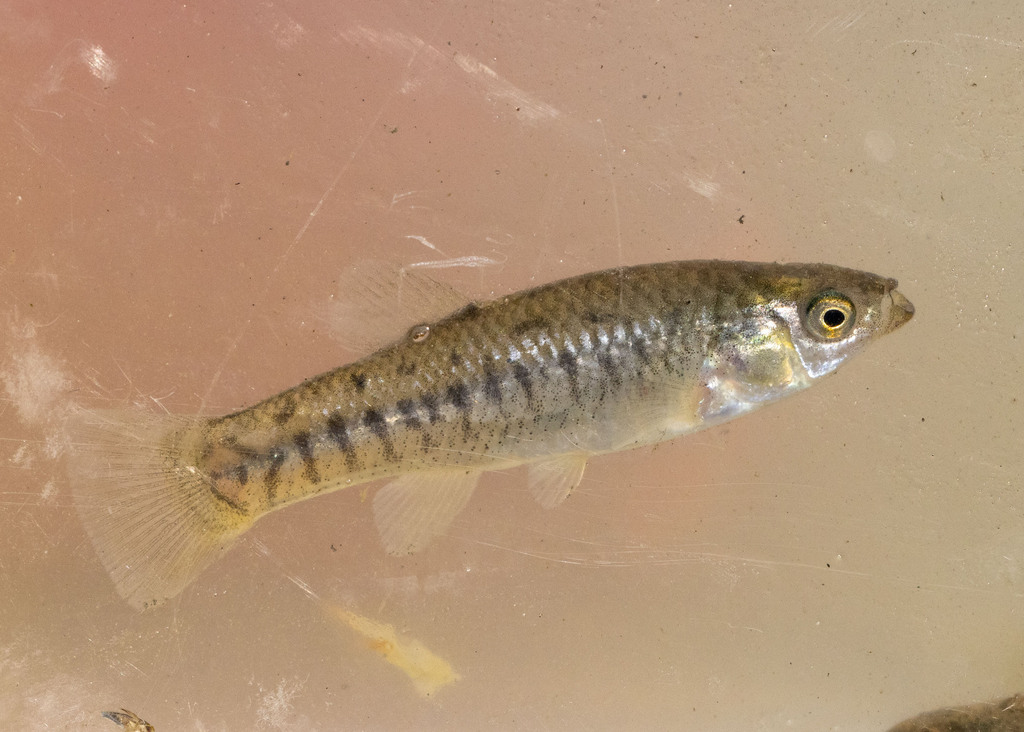
(c) Zack Abbey, some rights reserved (CC BY) · licence
Family: Fundulidae · Class: Actinopterygii · Order: Cyprinodontiformes
Fundulus parvipinnis (California killifish) is a California animal in the Fundulidae family.
The California killifish is a small, robust freshwater and brackish water fish native to coastal California and Baja California, Mexico. Adults typically measure 25 to 50 mm (1.0 to 2.0 inches) in total length, with females generally larger than males. The body is deep and laterally compressed with a relatively large head and upturned mouth adapted for surface feeding. Males display more vibrant coloration during breeding season, with olive-green to brown dorsal surfaces and lighter ventral areas marked by distinct dark vertical bars along the sides. Females are generally more subdued in coloration with less pronounced barring. Historically, California killifish ranged from Morro Bay in San Luis Obispo County south to Baja California Sur, Mexico. The species currently inhabits coastal waters, lagoons, and estuaries from central California to Mexico, with documented populations in Los Angeles, Orange, Riverside, San Bernardino, Santa Barbara, and Ventura counties. Northern populations have experienced range contractions, with extirpations reported from several historical locations in the Santa Barbara and Ventura County areas. California killifish occupy shallow, vegetated areas of coastal lagoons, salt marshes, estuaries, and tidal pools. The species demonstrates broad salinity tolerance, surviving in waters ranging from fresh to hypersaline conditions exceeding 70 parts per thousand. They typically inhabit areas with muddy or sandy substrates and abundant aquatic vegetation, preferring water depths less than one meter. Temperature tolerance ranges from 5 to 35 degrees Celsius (41 to 95 degrees Fahrenheit). This species exhibits opportunistic feeding behavior, consuming small invertebrates, algae, detritus, and occasionally small fish. California killifish are primarily surface feeders, using their upturned mouths to capture prey and organic matter from the water surface and vegetation. Reproduction occurs from March through September, with peak spawning activity during warmer months. Females deposit adhesive eggs individually or in small clusters on aquatic vegetation or substrate. A single female may produce 50 to 200 eggs per spawning event, with multiple spawning cycles throughout the breeding season. Eggs typically hatch within 10 to 14 days, depending on water temperature. California killifish are not federally or state listed but face ongoing conservation challenges. Primary threats include habitat loss from coastal development, water diversions, pollution, and invasification by non-native species such as mosquitofish. Urban runoff containing pesticides, heavy metals, and other contaminants degrades water quality in many occupied habitats. Climate change poses additional risks through sea level rise, altered precipitation patterns, and increased frequency of extreme weather events. Several coastal lagoon restoration projects have incorporated California killifish habitat enhancement, including vegetation restoration and invasive species control. The species serves as an important indicator of coastal wetland ecosystem health and provides ecological services through mosquito control in brackish water environments.
Classification
Class: Actinopterygii · Order: Cyprinodontiformes · Family: Fundulidae
Frequently asked questions
How is Fundulus parvipinnis classified?
Fundulus parvipinnis belongs to class Actinopterygii, order Cyprinodontiformes, family Fundulidae.
What family does Fundulus parvipinnis belong to?
Fundulus parvipinnis is in the Fundulidae family.
What is Fundulus parvipinnis?
The California killifish is a small, robust freshwater and brackish water fish native to coastal California and Baja California, Mexico.
Is Fundulus parvipinnis found in California?
Yes. Fundulus parvipinnis is recorded in California in The California Species Project's catalogue.
Related species
Other California species in the same genus, family, or bioregion.
Data from The California Species Project — 14,000+ California species with verified data from CNPS, CDFW, USFWS, and more.