Furcula nivea
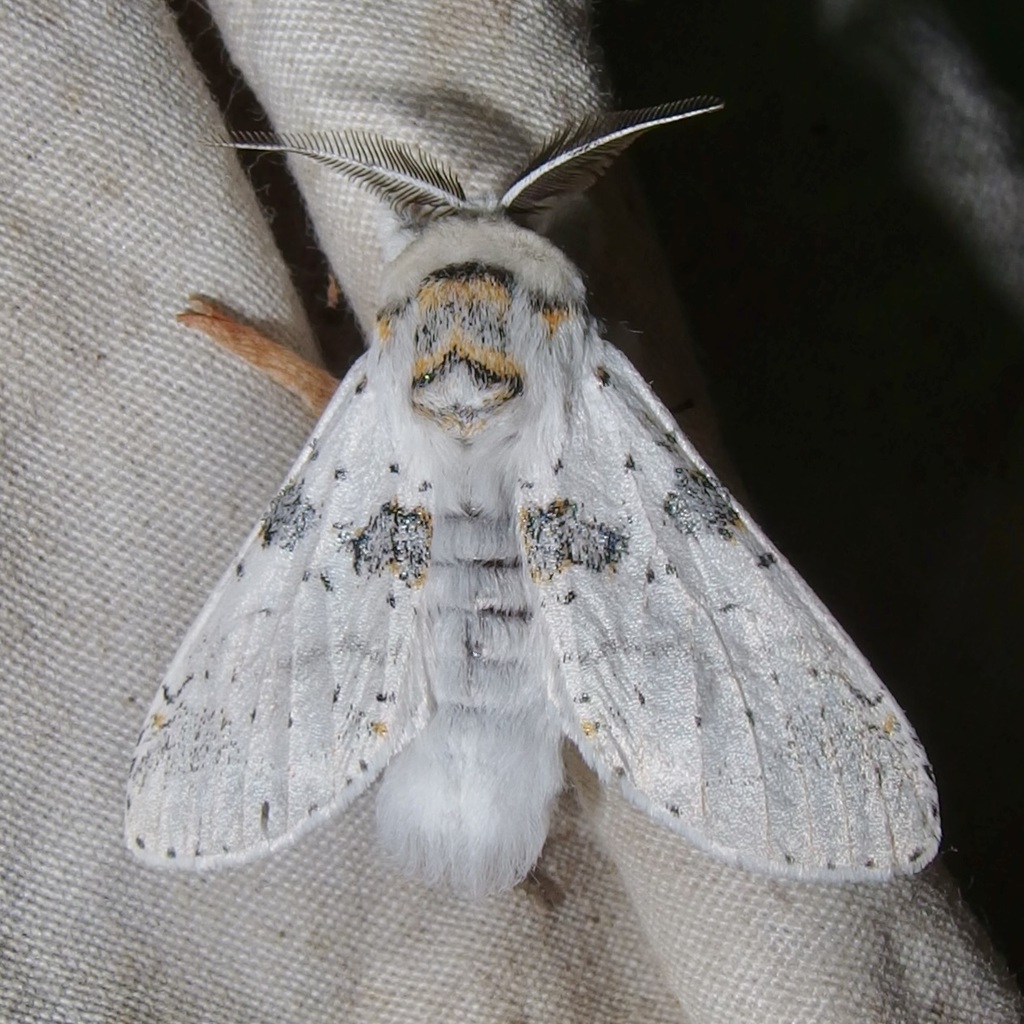
(c) Sue Carnahan, some rights reserved (CC BY) · licence
Family: Notodontidae · Class: Insecta · Order: Lepidoptera
Furcula nivea is a California animal in the Notodontidae family.
Furcula nivea, commonly known as the White Furcula or White Prominent, is a medium-sized moth in the family Notodontidae. Adults have a wingspan of approximately 25-35 mm (1.0-1.4 inches). The forewings are predominantly white to cream-colored with subtle gray markings and thin black lines that create distinctive patterns across the wing surface. The hindwings are typically paler, appearing nearly translucent white. The thorax and abdomen are covered in white to pale gray scales, giving the moth its characteristic pale appearance that distinguishes it from other Furcula species. Furcula nivea has a transcontinental distribution across North America, ranging from southern Canada through much of the northern and western United States. In California, the species occurs primarily in mountainous regions and higher elevation areas, though specific county-level distribution records within the state are limited in available databases. The species extends eastward across the Rocky Mountains and northern Great Plains to the Great Lakes region and northeastern states. This moth inhabits deciduous and mixed forests, particularly areas dominated by poplar, aspen, and willow species (Populus and Salix). Adults are typically found at elevations ranging from 1,000 to 2,500 meters (3,300 to 8,200 feet) in California's mountain ranges. The species shows a preference for riparian corridors and forest edges where host plants are abundant. Larvae develop on various Populus species, including quaking aspen (Populus tremuloides) and black cottonwood (Populus trichocarpa). Furcula nivea exhibits a univoltine life cycle in most of its range, with adults emerging from late spring through mid-summer, typically from May to August depending on elevation and local climate conditions. Females deposit eggs singly or in small clusters on the undersides of host plant leaves. Larvae are distinctive caterpillars that feed on poplar and willow foliage, developing through five instars before pupating in soil or leaf litter. The species overwinters as pupae. Adults are nocturnal and are attracted to artificial lights, making them occasionally observed at porch lights and moth traps in appropriate habitat. The conservation status of Furcula nivea appears stable across most of its range, with no current federal or state listing status. However, like many forest-dependent moths, the species may face localized pressures from habitat fragmentation, forest management practices, and climate change effects on montane ecosystems. The moth's dependence on specific host plants in riparian and forest habitats makes it potentially vulnerable to changes in water availability and forest composition. Population trends are not well-documented, as comprehensive surveys of Notodontidae moths are infrequent. The species benefits from forest conservation efforts and maintenance of diverse riparian plant communities that support its host plants.
Classification
Class: Insecta · Order: Lepidoptera · Family: Notodontidae
Frequently asked questions
How is Furcula nivea classified?
Furcula nivea belongs to class Insecta, order Lepidoptera, family Notodontidae.
What family does Furcula nivea belong to?
Furcula nivea is in the Notodontidae family.
What is Furcula nivea?
Furcula nivea, commonly known as the White Furcula or White Prominent, is a medium-sized moth in the family Notodontidae.
Is Furcula nivea found in California?
Yes. Furcula nivea is recorded in California in The California Species Project's catalogue.
Related species
Other California species in the same genus, family, or bioregion.
Data from The California Species Project — 14,000+ California species with verified data from CNPS, CDFW, USFWS, and more.