Gallinula galeata
Common Gallinule
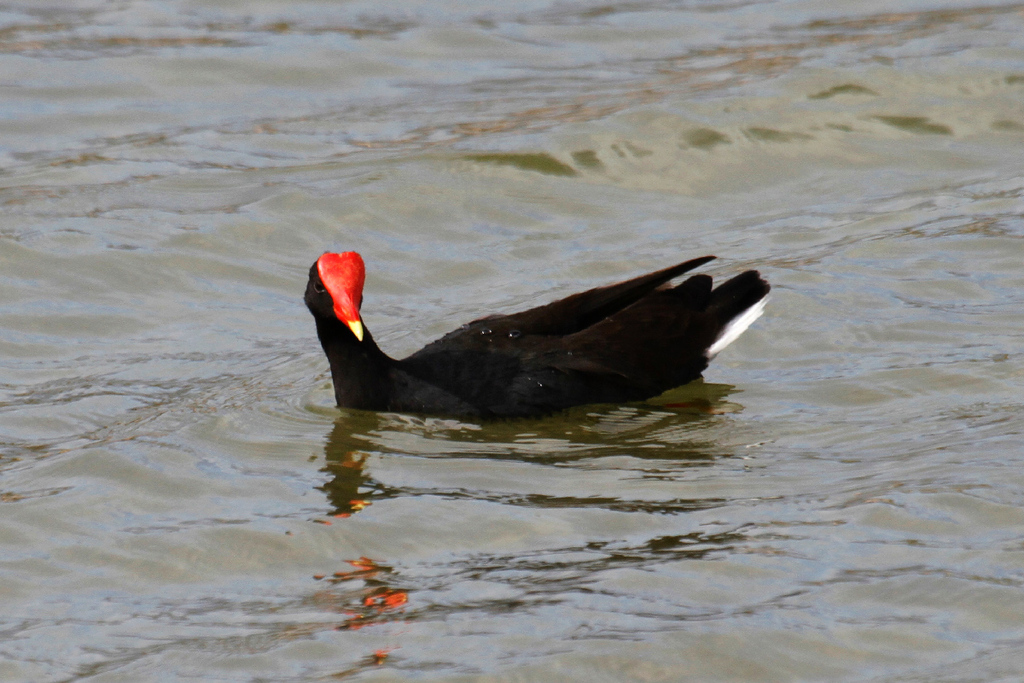
no rights reserved · CC0
Family: Rallidae · Class: Aves · Order: Gruiformes
Gallinula galeata (Common Gallinule) is a California animal in the Rallidae family.
The Common Gallinule is a medium-sized waterbird measuring 32 to 35 centimeters (12.6 to 13.8 inches) in length with a wingspan of 50 to 55 centimeters (19.7 to 21.7 inches). Adults weigh between 200 to 340 grams (7.1 to 12.0 ounces). The species displays distinctive plumage with dark slate-gray to blackish upperparts and head, contrasting with brownish underparts. A prominent bright red bill with a yellow tip distinguishes adults, along with a red frontal shield extending from the bill to the forehead. The legs and feet are bright yellow-green with elongated toes adapted for walking on floating vegetation. White undertail coverts are conspicuous during flight and when the tail is raised. Juveniles lack the bright coloration, showing brownish plumage with a duller bill. The Common Gallinule occurs throughout much of California, with populations distributed across the Central Valley, coastal regions, and scattered locations in the desert southwest. The species inhabits freshwater marshes, ponds, lakes, and slow-moving waterways from sea level to approximately 1,200 meters (3,937 feet) elevation. According to eBird data, the species is most commonly observed in the Sacramento Valley, San Francisco Bay Area, and Imperial Valley regions. Common Gallinules require habitats with emergent vegetation such as cattails, tules, and sedges, combined with open water areas. They favor shallow wetlands with water depths of 0.3 to 1.0 meter (1 to 3 feet) and dense stands of aquatic vegetation providing nesting cover and foraging opportunities. The species also utilizes constructed wetlands, irrigation canals, and urban park ponds when suitable vegetation is present. This species exhibits secretive behavior, often remaining hidden within dense marsh vegetation. Common Gallinules are omnivorous, consuming aquatic plants, seeds, small fish, frogs, snails, insects, and occasionally bird eggs. They forage by picking food from the water surface, probing in mud, and gleaning from vegetation. The breeding season extends from March through August in California. Pairs construct floating nests of dead vegetation anchored to emergent plants. Females lay 6 to 12 buff-colored eggs with dark spots, which are incubated for 19 to 22 days. Both parents care for the semi-precocial young, which can swim and dive shortly after hatching but remain dependent on parents for approximately 50 days. The Common Gallinule is not federally or state listed in California and maintains stable populations across much of its range as of December 2025. However, the species faces habitat loss through wetland drainage, urban development, and agricultural conversion. Water diversions and drought conditions can reduce suitable breeding habitat. Climate change may alter precipitation patterns affecting wetland availability. Conservation efforts focus on wetland preservation and restoration through programs such as the North American Waterfowl Management Plan and California's Central Valley Joint Venture, which benefit this species along with other waterbirds.
Classification
Class: Aves · Order: Gruiformes · Family: Rallidae
Frequently asked questions
How is Gallinula galeata classified?
Gallinula galeata belongs to class Aves, order Gruiformes, family Rallidae.
What family does Gallinula galeata belong to?
Gallinula galeata is in the Rallidae family.
What is Gallinula galeata?
The Common Gallinule is a medium-sized waterbird measuring 32 to 35 centimeters (12.6 to 13.8 inches) in length with a wingspan of 50 to 55 centimeters (19.7 to 21.7 inches).
Is Gallinula galeata found in California?
Yes. Gallinula galeata is recorded in California in The California Species Project's catalogue.
Related species
Other California species in the same genus, family, or bioregion.
Data from The California Species Project — 14,000+ California species with verified data from CNPS, CDFW, USFWS, and more.