Gambelia copeii
Cope's Leopard Lizard
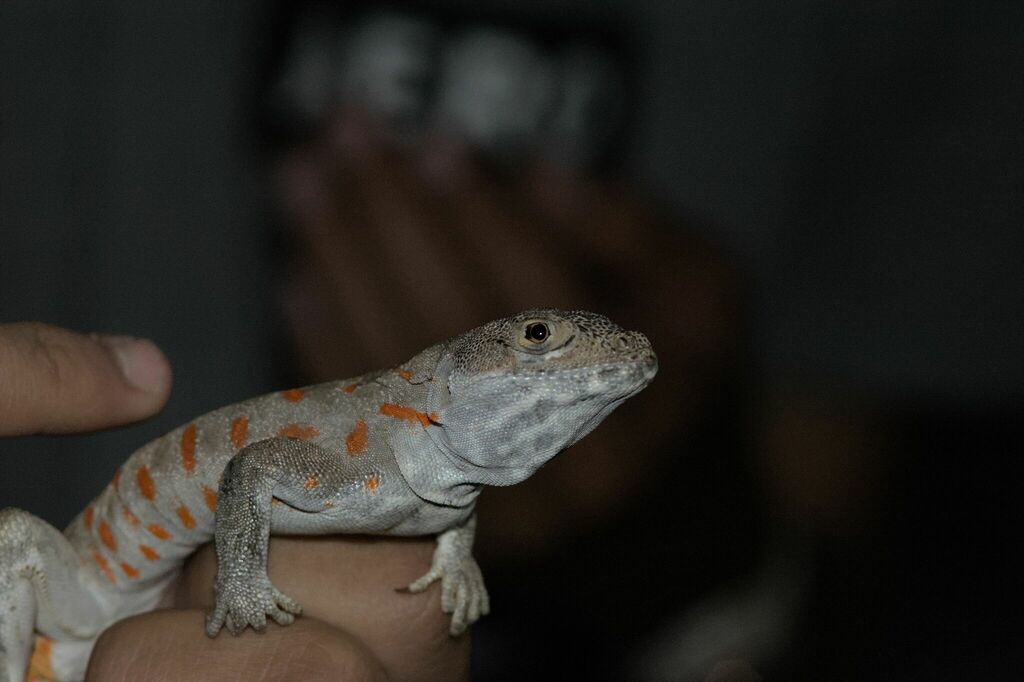
(c) Diego Maldonado de la Torre, some rights reserved (CC BY) · licence
Family: Crotaphytidae · Class: Reptilia · Order: Squamata
Conservation status: G5 S1S2
Gambelia copeii (Cope's Leopard Lizard) is a California animal in the Crotaphytidae family.
Cope's leopard lizard is a large, robust lizard reaching 120 to 155 mm (4.7 to 6.1 inches) in snout-to-vent length, with total length including tail reaching up to 356 mm (14 inches). The species displays distinct sexual dimorphism and seasonal color variation. Adults have a gray to brownish base coloration with dark crossbars and scattered white or pale spots across the body and limbs. During breeding season, gravid females develop bright orange to red coloration on the sides and ventral surfaces. Males typically retain the gray-brown pattern year-round but may show subtle color intensification during breeding periods. The head is proportionally large with a distinct neck constriction, and the tail exhibits alternating dark and light bands. Cope's leopard lizard is endemic to the southwestern United States and northwestern Mexico. In California, the species occurs in the southeastern desert regions, primarily in Imperial, Riverside, and San Bernardino counties. The range extends into the Sonoran Desert of Arizona and continues south into Baja California and Sonora, Mexico. California populations represent the northwestern limit of the species' distribution and are geographically isolated from core populations. The species inhabits arid desert flats, bajadas, and gentle slopes with sparse vegetation, typically below 610 meters (2,000 feet) elevation. Preferred habitat consists of open areas with scattered shrubs including creosote bush (Larrea tridentata), desert broom, and various cacti. Substrate preferences include sandy or gravelly soils with minimal rock cover. The lizards utilize small mammal burrows, particularly those of kangaroo rats, for shelter and thermoregulation. They also excavate their own burrows or seek refuge under desert shrubs and debris. Cope's leopard lizard is primarily insectivorous but exhibits opportunistic carnivory, consuming beetles, grasshoppers, moths, spiders, and occasionally smaller lizards and nestling rodents. The species is diurnal and most active during morning and late afternoon hours, avoiding midday heat through behavioral thermoregulation. Breeding occurs from April through June, with females laying 2 to 6 eggs in underground nests. Eggs incubate for approximately 75 to 85 days, with hatchlings emerging from late summer through early fall. Adults are territorial during breeding season, with males establishing and defending territories through aggressive displays and combat. Cope's leopard lizard has a global rank of G5 (secure) but California populations are ranked S1S2 (critically imperiled to imperiled). The species is not federally or state listed but faces significant threats in California from habitat loss due to urban development, agriculture, and renewable energy projects. Off-road vehicle use degrades habitat quality and creates barriers to movement. Climate change may alter precipitation patterns and vegetation communities essential for prey availability. The species' limited California range and small population size make it vulnerable to local extirpations from discrete habitat patches.
Classification
Class: Reptilia · Order: Squamata · Family: Crotaphytidae
Conservation status
G5 S1S2
Frequently asked questions
How is Gambelia copeii classified?
Gambelia copeii belongs to class Reptilia, order Squamata, family Crotaphytidae.
What family does Gambelia copeii belong to?
Gambelia copeii is in the Crotaphytidae family.
Is Gambelia copeii protected or of conservation concern?
Gambelia copeii carries the following status: G5 S1S2.
What is Gambelia copeii?
Cope's leopard lizard is a large, robust lizard reaching 120 to 155 mm (4.7 to 6.1 inches) in snout-to-vent length, with total length including tail reaching up to 356 mm (14 inches).
Is Gambelia copeii found in California?
Yes. Gambelia copeii is recorded in California in The California Species Project's catalogue.
Related species
Other California species in the same genus, family, or bioregion.
Data from The California Species Project — 14,000+ California species with verified data from CNPS, CDFW, USFWS, and more.