Gambelia silus
Blunt-nosed leopard lizard
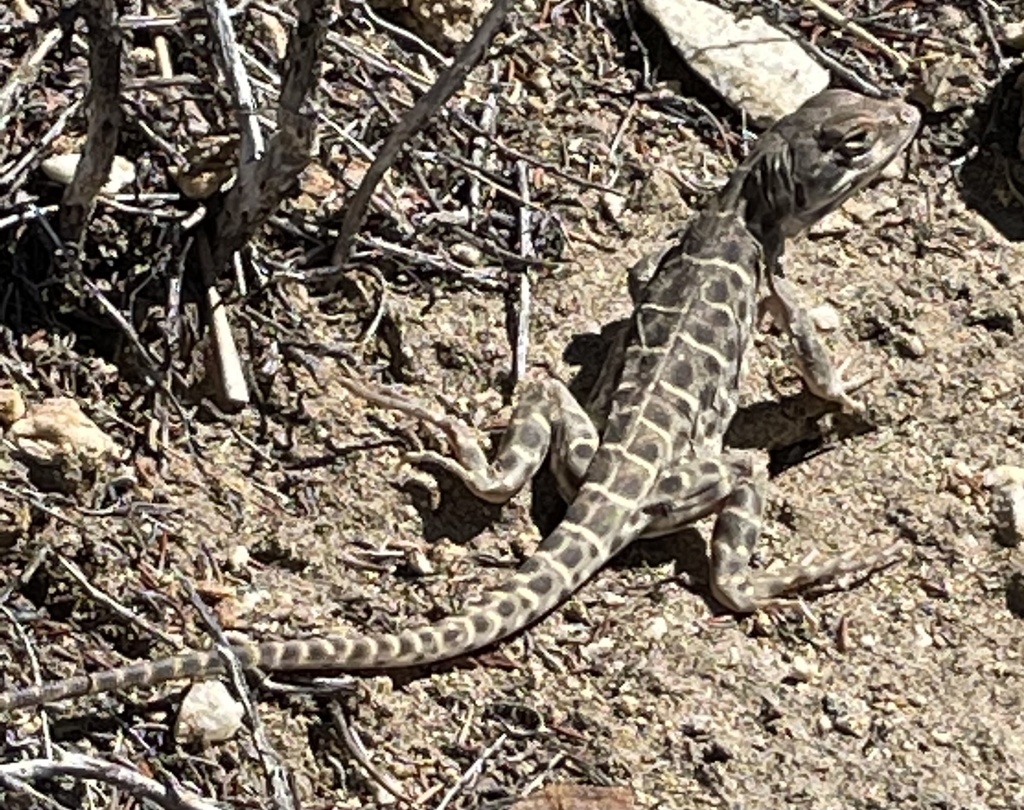
no rights reserved · CC0
Family: Crotaphytidae · Class: Reptilia · Order: Squamata
Conservation status: Endangered
Gambelia silus (Blunt-nosed leopard lizard) is a California animal in the Crotaphytidae family.
The blunt-nosed leopard lizard is a large, terrestrial lizard endemic to California's Central Valley. Adults reach 3.4 to 4.9 inches (8.6 to 12.4 cm) in snout-to-vent length, with males slightly larger than females. The species is characterized by its short, blunt snout, long regenerative tail, and powerful hind limbs that enable bipedal locomotion at high speeds. The body displays cream and tan stripes that provide effective camouflage against the arid landscape. Adults can reach nearly 8 inches (20.3 cm) in total length, not including the long, whip-like tail (USFWS 2023). Historically, the blunt-nosed leopard lizard ranged throughout much of the San Joaquin Valley and adjacent foothills, from Stanislaus County in the north to the Tehachapi Mountains in the south, including the Carrizo Plain and Cuyama Valley. Widespread agricultural development has reduced its habitat to approximately 15 percent of its historic range. Current distribution is highly fragmented, extending from Merced County in the north to Santa Barbara and Ventura counties in the south, with populations scattered across undeveloped parcels of land (USFWS 2023). The species inhabits arid, open areas characterized by patchy or sparse vegetation dominated by low, drought-tolerant shrubs. Blunt-nosed leopard lizards occur in grassland and desert scrub communities below 2,600 feet (800 meters) in elevation. The lizards prefer areas with less-dense vegetation where they can easily detect predators and forage effectively. Suitable habitat requires open spaces between shrubs for thermoregulation and hunting activities (USFWS 2023). Blunt-nosed leopard lizards are active predators that hunt primarily during daylight hours. They are opportunistic insectivores, feeding on a variety of arthropods including beetles, grasshoppers, and spiders. The species is notable for its ability to run bipedally on its hind legs when pursuing prey or escaping predators such as coyotes and hawks. Breeding occurs in spring, with females laying clutches of 2 to 6 eggs in sandy soil or beneath rocks. The species exhibits strong site fidelity, often returning to the same territories year after year. The blunt-nosed leopard lizard was listed as federally endangered in 1967 and is also designated as a fully protected species under California law. Primary threats include habitat loss from agricultural conversion, urban development, and solar energy projects on desert lands. Livestock grazing and invasive plant species further degrade remaining habitat quality. Climate variability affects habitat suitability, as demonstrated during 2022-2023 when record rainfall produced dense grass growth that reduced habitat quality in areas like the Panoche Hills Plateau. Conservation efforts include captive breeding programs and habitat restoration, with recent releases of captive-bred individuals onto Bureau of Land Management lands. Recovery requires protection of existing populations and restoration of connectivity between fragmented habitat patches to maintain genetic diversity and population viability.
Classification
Class: Reptilia · Order: Squamata · Family: Crotaphytidae
Conservation status
Endangered
Frequently asked questions
How is Gambelia silus classified?
Gambelia silus belongs to class Reptilia, order Squamata, family Crotaphytidae.
What family does Gambelia silus belong to?
Gambelia silus is in the Crotaphytidae family.
Is Gambelia silus protected or of conservation concern?
Gambelia silus carries the following status: Endangered.
What is Gambelia silus?
The blunt-nosed leopard lizard is a large, terrestrial lizard endemic to California's Central Valley.
Is Gambelia silus found in California?
Yes. Gambelia silus is recorded in California in The California Species Project's catalogue.
Related species
Other California species in the same genus, family, or bioregion.
Data from The California Species Project — 14,000+ California species with verified data from CNPS, CDFW, USFWS, and more.