Gambelia wislizenii
Long-Nosed Leopard Lizard
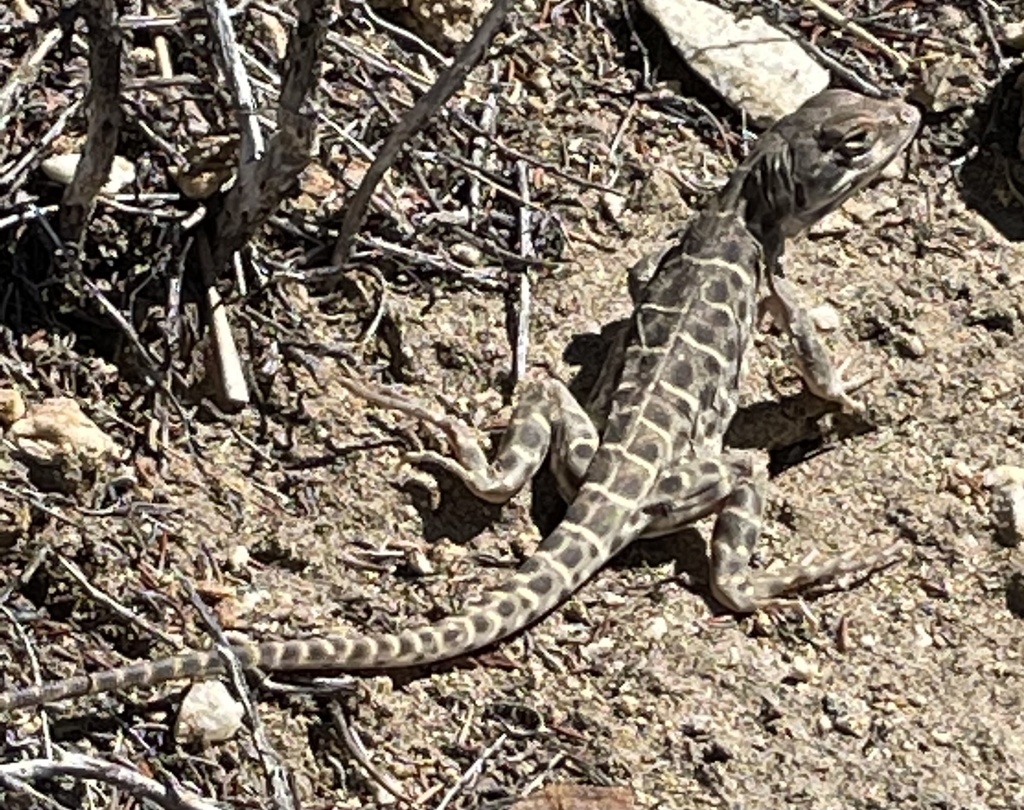
no rights reserved · CC0
Family: Crotaphytidae · Class: Reptilia · Order: Squamata
Gambelia wislizenii (Long-Nosed Leopard Lizard) is a California animal in the Crotaphytidae family.
The long-nosed leopard lizard is a large, distinctive reptile measuring 89 to 156 mm (3.5 to 6.1 inches) in snout-to-vent length, with total length including tail reaching up to 380 mm (15 inches). Adults display a grayish-brown to tan base coloration with dark brown or black crossbands and numerous small, light-colored spots scattered across the body and tail. The species is characterized by its elongated snout, large head relative to body size, and exceptionally long tail that comprises approximately 60% of total body length. Males develop orange or reddish coloration on the throat and sides during breeding season, while gravid females exhibit bright orange or red bars along the sides and underside. Historically distributed throughout much of California's Central Valley, southern San Joaquin Valley, and southeastern desert regions, the long-nosed leopard lizard has experienced significant range reduction. Current populations are primarily restricted to the western and southern San Joaquin Valley, including portions of Fresno, Kings, Kern, and Tulare counties, with isolated populations in the Carrizo Plain and scattered locations in the Mojave Desert region. The species also occurs in adjacent areas of Nevada, Arizona, Utah, and northwestern Mexico. This species inhabits sparsely vegetated shrubland, grassland, and desert scrub communities, typically in areas with 10 to 60% vegetation cover. Preferred habitat includes alkali desert scrub, valley saltbush scrub, and annual grasslands with scattered shrubs for basking and shelter. Long-nosed leopard lizards require open areas for hunting and thermoregulation, utilizing rodent burrows, rock crevices, and shrub bases for refuge. They occupy elevations from below sea level in Death Valley to approximately 1,200 meters (3,940 feet) in foothill regions. Long-nosed leopard lizards are active predators that hunt during daylight hours, feeding primarily on insects, spiders, and smaller lizards, including juvenile individuals of their own species. Adults are capable of capturing prey items up to 60% of their own body length. Breeding occurs from May through July, with females depositing 2 to 6 eggs in shallow burrows during June and July. Eggs incubate for 50 to 70 days, with hatchlings emerging in late summer. The species exhibits strong site fidelity, with individuals maintaining territories of 0.5 to 2 hectares. While not federally listed, the long-nosed leopard lizard is considered a species of special concern by the California Department of Fish and Wildlife due to significant habitat loss and population decline. Primary threats include conversion of native shrubland and grassland to agriculture, urban development, and energy infrastructure projects. Habitat fragmentation has isolated remaining populations, reducing genetic diversity and colonization potential. An estimated 95% of suitable habitat in the San Joaquin Valley has been lost to development and intensive agriculture since the early 1900s.
Classification
Class: Reptilia · Order: Squamata · Family: Crotaphytidae
Frequently asked questions
How is Gambelia wislizenii classified?
Gambelia wislizenii belongs to class Reptilia, order Squamata, family Crotaphytidae.
What family does Gambelia wislizenii belong to?
Gambelia wislizenii is in the Crotaphytidae family.
What is Gambelia wislizenii?
The long-nosed leopard lizard is a large, distinctive reptile measuring 89 to 156 mm (3.5 to 6.1 inches) in snout-to-vent length, with total length including tail reaching up to 380 mm (15 inches).
Is Gambelia wislizenii found in California?
Yes. Gambelia wislizenii is recorded in California in The California Species Project's catalogue.
Related species
Other California species in the same genus, family, or bioregion.
Data from The California Species Project — 14,000+ California species with verified data from CNPS, CDFW, USFWS, and more.