Gavia immer
Common Loon
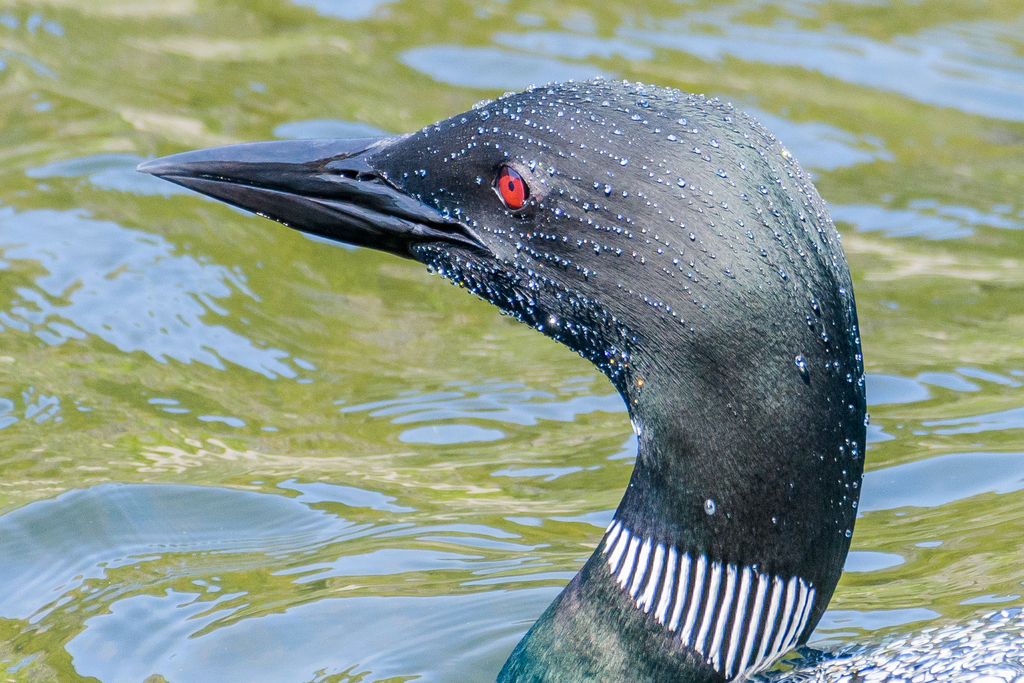
(c) Andrew Hrycyna, some rights reserved (CC BY) · licence
Family: Gaviidae · Class: Aves · Order: Gaviiformes
Conservation status: G5 S1
Gavia immer (Common Loon) is a California animal in the Gaviidae family.
The Common Loon is a large aquatic bird measuring 61 to 100 cm (24 to 39 inches) in length with a wingspan of 127 to 147 cm (50 to 58 inches). Adults weigh 1.6 to 8 kg (3.5 to 18 pounds), with males typically larger than females. During breeding season, adults display distinctive black and white plumage with a solid black head and neck marked by a white collar band. The back features an intricate pattern of white spots and bars on a black background. The bill is thick, pointed, and dagger-like, colored dark gray to black. Non-breeding adults and juveniles appear more subdued, with brownish-gray upperparts and white underparts. The species' streamlined body and legs positioned far back on the body reflect adaptations for underwater pursuit of prey. The Common Loon breeds across northern North America from Alaska to Newfoundland, with the southern breeding range extending into northern California, Idaho, Montana, Minnesota, Wisconsin, Michigan, New York, Vermont, New Hampshire, and Maine. In California, the species has extremely limited breeding distribution, restricted primarily to clear mountain lakes in the Sierra Nevada and Cascade ranges. The global rank of G5 indicates the species is secure overall, but California's S1 rank reflects its rarity as a breeding species within the state, where it occurs at the extreme southern edge of its range. Common Loons require clear, fish-bearing lakes typically larger than 5 hectares (12 acres) for successful breeding. They prefer lakes with minimal human disturbance, irregular shorelines providing sheltered bays, and depths sufficient to support diverse fish populations. Nesting occurs on small islands, floating vegetation mats, or shoreline sites with direct water access. During winter, the species inhabits coastal marine waters, large inland lakes, and reservoirs. In California, wintering birds are found along the Pacific coast and on larger inland water bodies including San Francisco Bay, Monterey Bay, and major reservoirs. Common Loons are piscivorous, diving underwater to capture fish using powerful leg propulsion and wing-assisted swimming. Primary prey includes perch, pike, sunfish, trout, and other fish species 10 to 25 cm in length, though they also consume crustaceans, mollusks, and aquatic insects. Breeding pairs establish territories on individual lakes, with elaborate courtship displays including synchronized swimming and vocalizations. The species produces distinctive wailing calls that can carry several kilometers across water. Females lay 1 to 3 olive-brown eggs with dark spots in ground nests near water's edge. Incubation lasts 26 to 31 days, with both parents sharing duties. Young remain on natal territories for 10 to 12 weeks before fledging. While globally secure, Common Loons face various conservation challenges including habitat loss from shoreline development, water level fluctuations from dam operations, lead poisoning from fishing tackle, and disturbance from recreational activities. In California, the small breeding population is particularly vulnerable to climate change impacts on mountain lake ecosystems and increased human recreational pressure on high-elevation waters.
Classification
Class: Aves · Order: Gaviiformes · Family: Gaviidae
Conservation status
G5 S1
Frequently asked questions
How is Gavia immer classified?
Gavia immer belongs to class Aves, order Gaviiformes, family Gaviidae.
What family does Gavia immer belong to?
Gavia immer is in the Gaviidae family.
Is Gavia immer protected or of conservation concern?
Gavia immer carries the following status: G5 S1.
What is Gavia immer?
The Common Loon is a large aquatic bird measuring 61 to 100 cm (24 to 39 inches) in length with a wingspan of 127 to 147 cm (50 to 58 inches).
Is Gavia immer found in California?
Yes. Gavia immer is recorded in California in The California Species Project's catalogue.
Related species
Other California species in the same genus, family, or bioregion.
Data from The California Species Project — 14,000+ California species with verified data from CNPS, CDFW, USFWS, and more.