Gavia stellata
Red-throated Loon
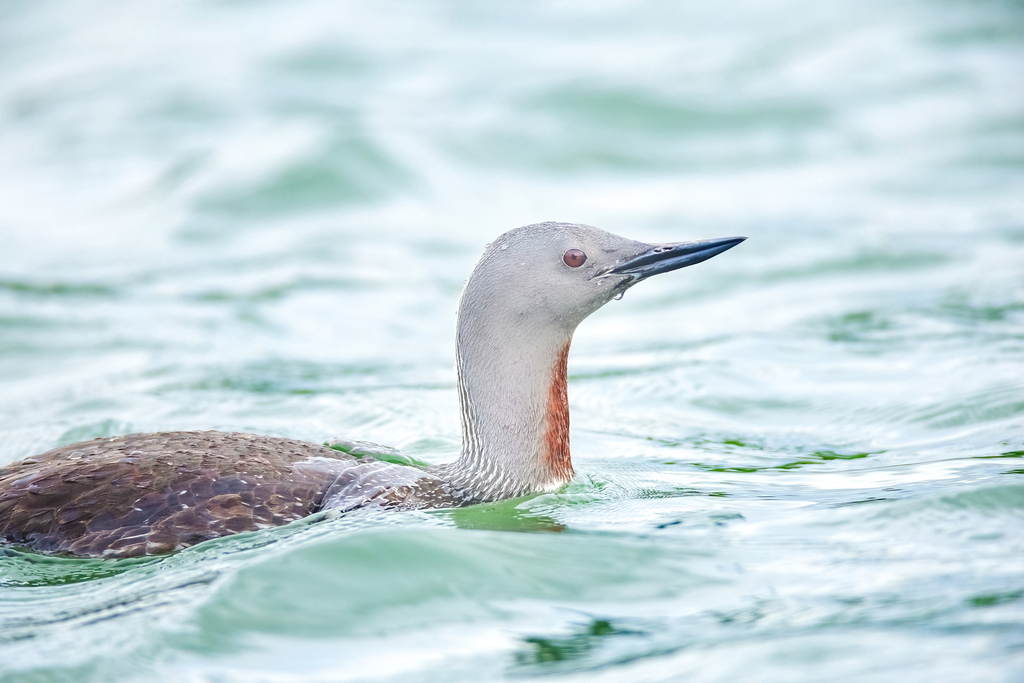
(c) egorbirder, some rights reserved (CC BY) · licence
Family: Gaviidae · Class: Aves · Order: Gaviiformes
Gavia stellata (Red-throated Loon) is a California animal in the Gaviidae family.
The Red-throated Loon is the smallest of the five loon species, measuring 53 to 69 cm (21 to 27 inches) in length with a wingspan of 91 to 110 cm (36 to 43 inches). Adults weigh between 1.0 to 2.7 kg (2.2 to 6.0 pounds). During breeding season, adults display a distinctive rusty-red throat patch, gray head and neck with fine white streaking, and dark brown upperparts with white spots. The bill is thin, straight, and dark gray to black. Non-breeding adults and juveniles lack the red throat coloration, showing instead a white throat and foreneck with gray-brown upperparts speckled with white. The Red-throated Loon breeds across Alaska and northern Canada, with the species' range extending into the Arctic tundra regions. In California, the species occurs as a regular winter visitor and migrant along the entire coast from October through April. Small numbers may be observed on inland lakes and reservoirs during migration, particularly in the Central Valley and mountain lakes. The species is most commonly seen in coastal waters from Humboldt County south to San Diego County. During winter months in California, Red-throated Loons inhabit marine environments including bays, estuaries, and nearshore coastal waters. They prefer areas with depths of 2 to 10 meters (6 to 33 feet) where they can effectively dive for prey. The species also utilizes larger freshwater lakes and reservoirs during migration, particularly those exceeding 40 hectares (100 acres) in surface area. Unlike other loon species, Red-throated Loons can take off from smaller water bodies due to their lighter body weight and different wing loading. Red-throated Loons are piscivorous, feeding primarily on small fish including herring, sardines, anchovies, and smelt in marine environments. They are pursuit divers, using their feet for propulsion underwater while hunting prey at depths typically ranging from 1 to 9 meters (3 to 30 feet). Dives generally last 25 to 45 seconds. During the breeding season on Arctic tundra, pairs nest on small ponds and lakes, with females laying 1 to 2 olive-brown eggs with dark spots. The species exhibits strong site fidelity to wintering areas. The Red-throated Loon is not federally listed under the Endangered Species Act and maintains stable populations across most of its range. The species is classified as Least Concern by the International Union for Conservation of Nature. However, climate change poses potential threats to Arctic breeding habitats through altered precipitation patterns and permafrost degradation. In California waters, threats include oil spills, plastic pollution, fishing net entanglement, and disturbance from recreational watercraft. Population monitoring through Christmas Bird Counts indicates relatively stable wintering numbers along the California coast, though long-term climate impacts on Arctic breeding success remain a conservation concern for the species.
Classification
Class: Aves · Order: Gaviiformes · Family: Gaviidae
Frequently asked questions
How is Gavia stellata classified?
Gavia stellata belongs to class Aves, order Gaviiformes, family Gaviidae.
What family does Gavia stellata belong to?
Gavia stellata is in the Gaviidae family.
What is Gavia stellata?
The Red-throated Loon is the smallest of the five loon species, measuring 53 to 69 cm (21 to 27 inches) in length with a wingspan of 91 to 110 cm (36 to 43 inches).
Is Gavia stellata found in California?
Yes. Gavia stellata is recorded in California in The California Species Project's catalogue.
Related species
Other California species in the same genus, family, or bioregion.
Data from The California Species Project — 14,000+ California species with verified data from CNPS, CDFW, USFWS, and more.