Gelochelidon nilotica
Gull-billed Tern
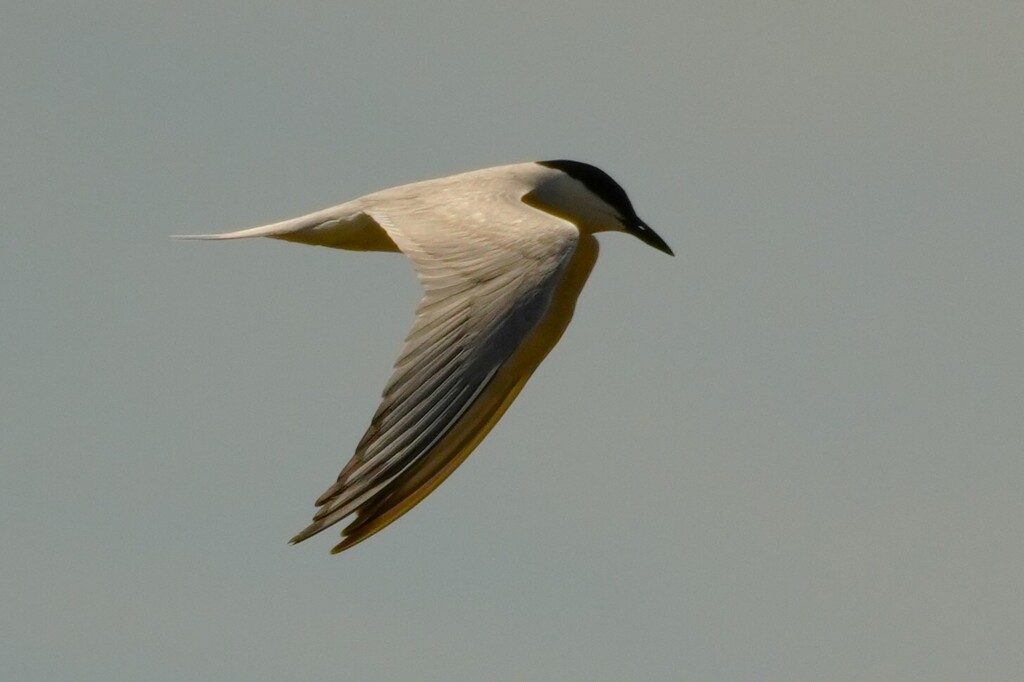
(c) Alin, some rights reserved (CC BY) · licence
Family: Laridae · Class: Aves · Order: Charadriiformes
Conservation status: G5 S1
Gelochelidon nilotica (Gull-billed Tern) is a California animal in the Laridae family.
The Gull-billed Tern is a medium-sized seabird measuring 33 to 43 cm (13 to 17 inches) in length with a wingspan of 76 to 91 cm (30 to 36 inches). Adults weigh between 200 and 300 grams. The species is distinguished by its robust, completely black bill that is noticeably thicker and more gull-like than other terns. During breeding season, adults display a solid black cap extending from the forehead to the nape, pale gray upperparts, and white underparts. The legs are black and relatively long for a tern. In winter plumage, the black cap is reduced to dark streaking behind the eye. Juveniles show brown scaling on the upperparts and a shorter, duller bill. Historically, Gull-billed Terns bred along the California coast from San Francisco Bay south to San Diego County, with additional colonies in the Central Valley. The species experienced dramatic population decline in California during the 20th century. Currently, the California breeding population is extremely small and irregular, with most recent nesting attempts documented in the San Francisco Bay area, particularly at salt ponds in Alameda and Santa Clara counties. Small numbers occasionally nest at other coastal locations including Morro Bay and the Salton Sea. Gull-billed Terns nest in open areas with sparse vegetation, including salt marsh islands, dredge spoil sites, and constructed nesting platforms. They prefer sites surrounded by shallow water that supports abundant prey. Foraging occurs over salt marshes, mudflats, agricultural fields, and shallow lagoons. Unlike most terns, this species rarely plunge-dives, instead picking prey from surfaces while flying or from the ground. The species exhibits varied foraging behavior, capturing fish, crabs, insects, small mammals, and amphibians. Breeding typically occurs from April through August in California. Gull-billed Terns nest colonially, often with other waterbirds, constructing shallow scrapes lined with vegetation and debris. Females lay 1 to 4 eggs, typically 2 to 3, which are incubated for 22 to 23 days. Both parents share incubation and chick-rearing duties. Young fledge at approximately 28 to 35 days but remain dependent on adults for several additional weeks. The Gull-billed Tern's California population is critically small, earning it a state rank of S1, indicating extreme rarity with typically fewer than 20 breeding pairs statewide. Primary threats include habitat loss from coastal development, human disturbance at nesting sites, predation by introduced mammals, and sea level rise affecting low-lying nesting areas. The species faces additional challenges from water management practices that alter prey availability in estuarine environments. Conservation efforts have included habitat restoration, predator control, and the construction of artificial nesting platforms in the San Francisco Bay area.
Classification
Class: Aves · Order: Charadriiformes · Family: Laridae
Conservation status
G5 S1
Frequently asked questions
How is Gelochelidon nilotica classified?
Gelochelidon nilotica belongs to class Aves, order Charadriiformes, family Laridae.
What family does Gelochelidon nilotica belong to?
Gelochelidon nilotica is in the Laridae family.
Is Gelochelidon nilotica protected or of conservation concern?
Gelochelidon nilotica carries the following status: G5 S1.
What is Gelochelidon nilotica?
The Gull-billed Tern is a medium-sized seabird measuring 33 to 43 cm (13 to 17 inches) in length with a wingspan of 76 to 91 cm (30 to 36 inches).
Is Gelochelidon nilotica found in California?
Yes. Gelochelidon nilotica is recorded in California in The California Species Project's catalogue.
Related species
Other California species in the same genus, family, or bioregion.
Data from The California Species Project — 14,000+ California species with verified data from CNPS, CDFW, USFWS, and more.