Geminaria canalis
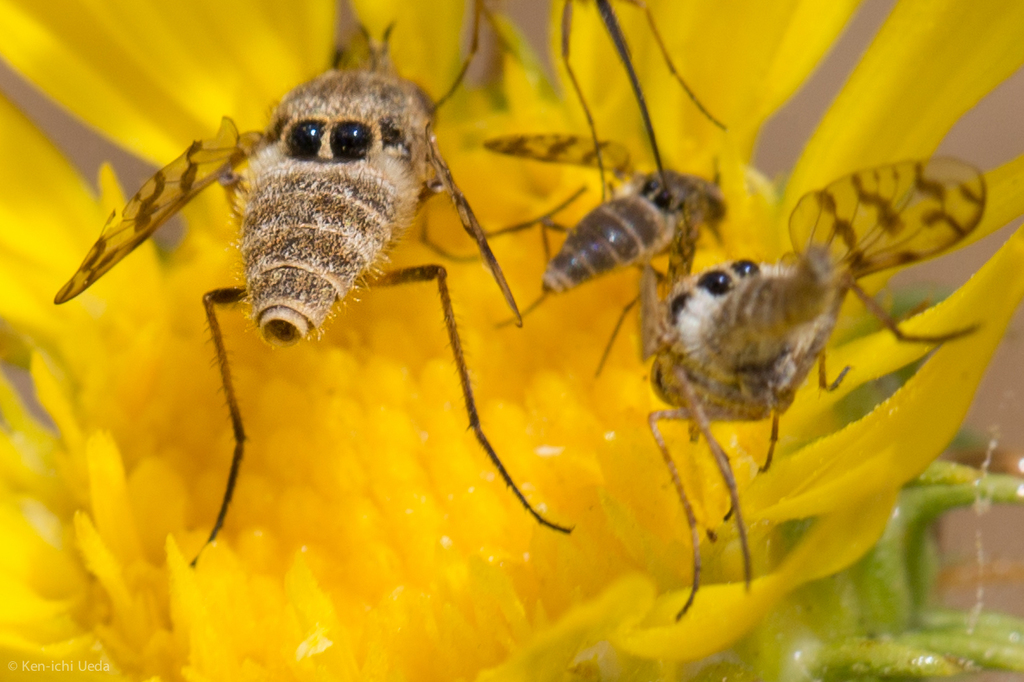
(c) Ken-ichi Ueda, some rights reserved (CC BY) · licence
Family: Bombyliidae · Class: Insecta · Order: Diptera
Geminaria canalis is a California animal in the Bombyliidae family.
Geminaria canalis is a fly species in the family Bombyliidae, commonly known as bee flies. This dipteran belongs to the order Diptera, representing one of the numerous bombyliid species found in North America. Like other members of this family, G. canalis likely exhibits the characteristic features of bee flies, including a robust, often hairy body and long proboscis adapted for nectar feeding. The distribution and range of Geminaria canalis have not been comprehensively documented in readily available scientific literature. The species appears to be relatively obscure within the extensive bombyliid fauna, with limited records in major entomological databases. Without detailed distributional studies, the specific geographic range within California or broader North America remains poorly defined. Habitat requirements for G. canalis are not well documented in current literature. Bombyliidae as a family typically inhabit diverse terrestrial environments, from arid regions to woodland areas, with many species showing preferences for areas with abundant flowering plants that provide nectar sources. Adult bee flies are commonly found in sunny, open areas where they can be observed hovering near flowers or resting on vegetation. The ecology and behavior of Geminaria canalis follows the general bombyliid pattern, though specific details remain undocumented. Adult bee flies are typically diurnal insects that feed primarily on nectar from various flowering plants. Many bombyliid species exhibit hovering flight behavior similar to hummingbirds, allowing them to access nectar while remaining airborne. The larval stages of most bee flies are parasitoids or parasites of other insects, particularly the larvae of beetles, moths, or other flies, though the specific host relationships for G. canalis have not been established. Reproductive behavior in bombyliids generally involves females depositing eggs near or on the hosts of their larvae. The larvae then develop as internal parasites or parasitoids, eventually pupating and emerging as adults. Seasonal activity patterns and specific breeding requirements for G. canalis have not been documented in available literature. No specific conservation status has been assigned to Geminaria canalis by federal or state agencies. The species does not appear on the U.S. Fish and Wildlife Service species lists or California Department of Fish and Wildlife tracking lists. The lack of comprehensive population data or distributional information makes assessment of conservation needs difficult. Like many invertebrate species, G. canalis may face threats from habitat loss, pesticide use, and climate change, though the magnitude of these impacts remains unknown without detailed ecological studies. Scientific documentation for this species remains extremely limited. The information presented here is based on general knowledge of bombyliid biology and taxonomy. Detailed ecological studies, distributional surveys, and host plant relationships for G. canalis are lacking in current entomological literature. We welcome contributions of verified scientific data, photographs, or field observations to enhance this species account.
Classification
Class: Insecta · Order: Diptera · Family: Bombyliidae
Frequently asked questions
How is Geminaria canalis classified?
Geminaria canalis belongs to class Insecta, order Diptera, family Bombyliidae.
What family does Geminaria canalis belong to?
Geminaria canalis is in the Bombyliidae family.
What is Geminaria canalis?
Geminaria canalis is a fly species in the family Bombyliidae, commonly known as bee flies.
Is Geminaria canalis found in California?
Yes. Geminaria canalis is recorded in California in The California Species Project's catalogue.
Related species
Other California species in the same genus, family, or bioregion.
Data from The California Species Project — 14,000+ California species with verified data from CNPS, CDFW, USFWS, and more.