Geococcyx californianus
Greater Roadrunner
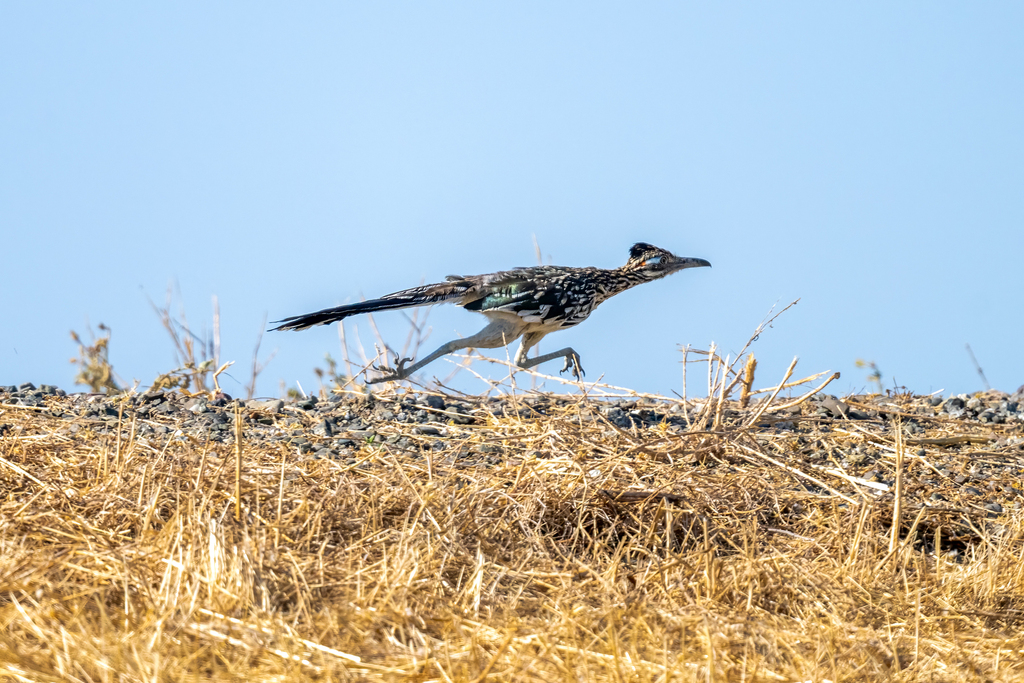
(c) Jonathan Eisen, some rights reserved (CC BY) · licence
Family: Cuculidae · Class: Aves · Order: Cuculiformes
Geococcyx californianus (Greater Roadrunner) is a California animal in the Cuculidae family.
The Greater Roadrunner is a large, terrestrial cuckoo measuring 50 to 62 centimeters (20 to 24 inches) in length, including its long tail, and weighing 221 to 538 grams (7.8 to 19 ounces). The species displays a distinctive appearance with streaked brown and white plumage, a prominent crest that can be raised or lowered, and long legs adapted for running. The tail is long and graduated, with white tips on the outer feathers that are conspicuous during flight or when the tail is fanned. Adults have bare blue and red skin behind the eye, with males showing brighter coloration during breeding season. The bill is long, straight, and slightly decurved. Greater Roadrunners inhabit the southwestern United States and Mexico, with their California range extending through the southern portions of the state. In California, they occur primarily in desert regions including the Mojave and Sonoran deserts, the Central Valley's southern end, and coastal areas from Monterey County southward. The species ranges from sea level to approximately 2,134 meters (7,000 feet) in elevation, though they are most common below 1,500 meters. The species occupies arid and semi-arid habitats characterized by open areas with scattered shrubs and trees. Preferred habitats include desert scrub, chaparral, oak woodlands, riparian areas, and agricultural lands with adequate cover. Roadrunners require a combination of open ground for hunting and elevated perches such as fence posts, rocks, or shrubs for surveillance and thermoregulation. They commonly inhabit areas with creosote bush, mesquite, palo verde, cholla, and other desert vegetation. Greater Roadrunners are primarily carnivorous, consuming a diverse diet that includes lizards, snakes (including venomous species), insects, small mammals, birds, eggs, and occasionally fruits and seeds. They are capable of killing and consuming prey up to the size of adult rattlesnakes. The species is well-adapted for cursorial hunting, reaching speeds of up to 32 kilometers per hour (20 miles per hour) when pursuing prey. Roadrunners are generally solitary outside of breeding season, which extends from March through September in California. Pairs construct platform nests of sticks in low trees or shrubs, typically 0.9 to 3 meters (3 to 10 feet) above ground. Females lay 2 to 6 white or pale yellow eggs, with incubation lasting 18 to 20 days. Both parents share nesting duties and care for young. The Greater Roadrunner is not federally or state listed as threatened or endangered. Populations appear stable across most of their range, though localized declines have occurred due to habitat loss from urban development and agricultural conversion. The species demonstrates adaptability to human-modified landscapes, often thriving in suburban areas with appropriate habitat features. Climate change may affect future distribution patterns, particularly in areas experiencing increased aridity or temperature extremes.
Classification
Class: Aves · Order: Cuculiformes · Family: Cuculidae
Frequently asked questions
How is Geococcyx californianus classified?
Geococcyx californianus belongs to class Aves, order Cuculiformes, family Cuculidae.
What family does Geococcyx californianus belong to?
Geococcyx californianus is in the Cuculidae family.
What is Geococcyx californianus?
The Greater Roadrunner is a large, terrestrial cuckoo measuring 50 to 62 centimeters (20 to 24 inches) in length, including its long tail, and weighing 221 to 538 grams (7.8 to 19 ounces).
Is Geococcyx californianus found in California?
Yes. Geococcyx californianus is recorded in California in The California Species Project's catalogue.
Related species
Other California species in the same genus, family, or bioregion.
Data from The California Species Project — 14,000+ California species with verified data from CNPS, CDFW, USFWS, and more.