Geocoris pallens
Western Big-eyed Bug
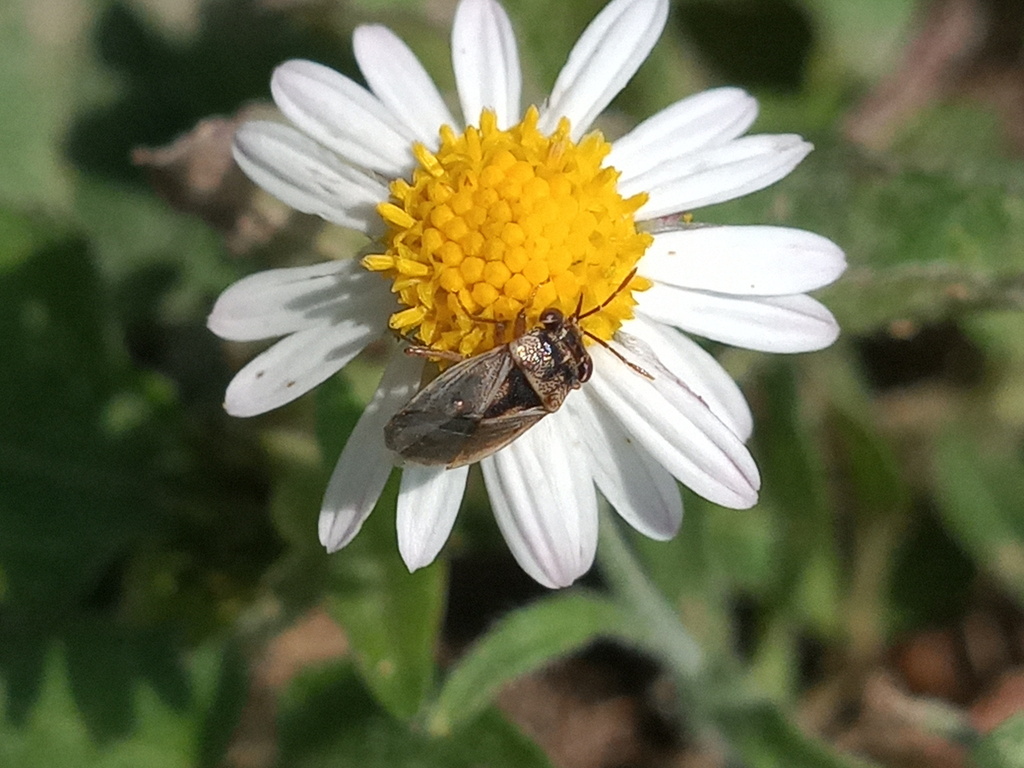
(c) Rodolfo Salinas Villarreal, some rights reserved (CC BY) · licence
Family: Geocoridae · Class: Insecta · Order: Hemiptera
Geocoris pallens (Western Big-eyed Bug) is a California animal in the Geocoridae family.
The Western Big-eyed Bug is a small predatory insect measuring approximately 3-4 mm in length. Adults are characterized by their distinctively large, prominent eyes relative to their body size, which give the family its common name. The body is typically pale brown to grayish in coloration with a somewhat flattened, oval shape. The head is relatively broad with conspicuous compound eyes, and the antennae are four-segmented. Like other members of the family Geocoridae, this species has well-developed wings and is capable of flight. Geocoris pallens occurs throughout much of North America, with particular abundance in western regions. According to BugGuide, this species is one of the most common big-eyed bugs along with G. punctipes, with documented occurrence across most of North America. The species is well-established in California and other western states, where it is frequently encountered in agricultural and natural systems. This species inhabits diverse terrestrial environments, showing a preference for areas with sparse vegetation. BugGuide reports that big-eyed bugs are typically found on ground between clumps of weeds and sparse grass, especially in sandy places, in woods and near streams. The Western Big-eyed Bug is commonly found in most crop systems throughout the southern United States and is well-adapted to agricultural landscapes. They favor open areas with low-growing vegetation and are often observed on soil surfaces or low plant material. As generalist predators, Western Big-eyed Bugs feed on small arthropods including aphids, mites, small caterpillars, and other soft-bodied insects (BugGuide). This makes them valuable beneficial insects in agricultural systems where they provide natural pest control. Adults overwinter and become active in spring when temperatures warm. Females lay eggs singly on leaves or stems, with each female capable of producing up to 300 eggs during the breeding season. Eggs hatch in approximately one week under favorable conditions. The species undergoes incomplete metamorphosis, with nymphs resembling adults but lacking fully developed wings. The Western Big-eyed Bug is not listed under federal or state conservation programs and appears to maintain stable populations across its range. NatureServe ranks the species as G4 (Apparently Secure), indicating that while the species may be quite rare in parts of its range, it is not at immediate risk of extinction. The Xerces Society includes big-eyed bugs in their habitat planning guides for beneficial insects, recognizing their importance as natural biological control agents. Their role as predators of agricultural pests makes them economically valuable, and their presence is generally encouraged through integrated pest management practices. The species benefits from diverse agricultural landscapes that provide both prey resources and overwintering habitat. Conservation efforts for beneficial insects like G. pallens typically focus on reducing pesticide impacts and maintaining habitat diversity rather than species-specific protection measures.
Classification
Class: Insecta · Order: Hemiptera · Family: Geocoridae
Frequently asked questions
How is Geocoris pallens classified?
Geocoris pallens belongs to class Insecta, order Hemiptera, family Geocoridae.
What family does Geocoris pallens belong to?
Geocoris pallens is in the Geocoridae family.
What is Geocoris pallens?
The Western Big-eyed Bug is a small predatory insect measuring approximately 3-4 mm in length.
Is Geocoris pallens found in California?
Yes. Geocoris pallens is recorded in California in The California Species Project's catalogue.
More California species
This species has no close relatives in our California data — here are other species to explore.
Data from The California Species Project — 14,000+ California species with verified data from CNPS, CDFW, USFWS, and more.