Geothlypis formosa
Kentucky Warbler
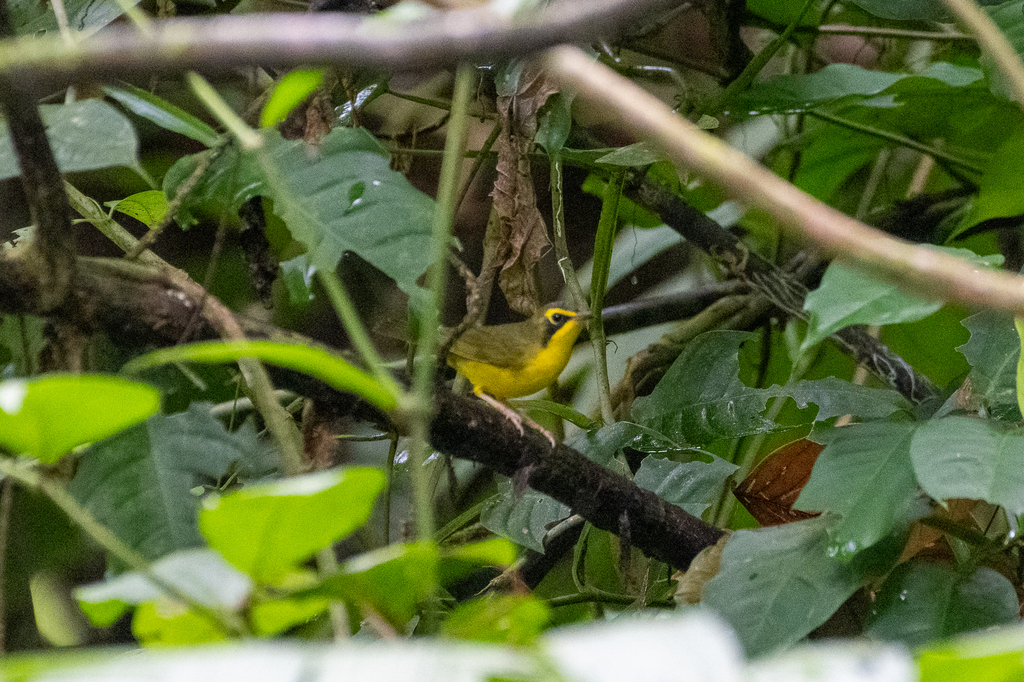
(c) Richard Littauer, some rights reserved (CC BY) · licence
Family: Parulidae · Class: Aves · Order: Passeriformes
Geothlypis formosa (Kentucky Warbler) is a California animal in the Parulidae family.
The Kentucky Warbler is a medium-sized songbird measuring 13 to 14 cm (5.1 to 5.5 inches) in length with a wingspan of 20 to 22 cm (7.9 to 8.7 inches). Adults weigh 12 to 15 grams. Males display bright yellow underparts and olive-green upperparts, with a distinctive black crown and black eyeline that extends from the bill through the eye and curves down behind the auricular region. This black marking creates a characteristic sideburn pattern that distinguishes the species from similar warblers. Females show similar plumage but with duller coloration and less distinct facial markings. Both sexes have pink legs and a straight, pointed bill typical of insectivorous birds. Historically, Kentucky Warblers bred across the eastern United States from southern New York and southern New England west to southeastern Nebraska and eastern Kansas, and south to northern Georgia and eastern Texas. The species winters primarily in Central America from southern Mexico to Panama, with some individuals reaching northern South America. In California, Kentucky Warbler is an extremely rare vagrant, with fewer than 20 documented records since 1900. Most California sightings occur during fall migration from August through October along the coast and in desert oases, with scattered spring records from April through June. California records span elevations from sea level to approximately 1,500 meters, with most occurrences below 500 meters in coastal areas and desert locations. Kentucky Warblers inhabit mature deciduous and mixed forests with dense understory vegetation. They prefer areas with closed canopy cover and thick shrub layers, typically at elevations below 600 meters in their breeding range. The species favors forest ravines, hillsides with rich soils, and areas near streams or other water sources. During migration, individuals may appear in various habitats including riparian woodlands, parks, and desert oases with adequate cover. This species forages primarily on or near the ground, walking deliberately through leaf litter and low vegetation to capture insects and spiders. Kentucky Warblers are highly territorial during breeding season, with males establishing territories of 0.5 to 2 hectares. Breeding occurs from May through July, with females constructing cup-shaped nests on or near the ground, often concealed by vegetation or fallen logs. Clutches typically contain 3 to 5 eggs, which are incubated for 12 to 13 days. Young fledge after 8 to 10 days but remain dependent on parents for an additional two weeks. The Kentucky Warbler is not federally listed but has experienced significant population declines throughout its range. According to the North American Breeding Bird Survey, populations declined by approximately 66% between 1966 and 2015. Primary threats include forest fragmentation, loss of mature forest habitat, cowbird parasitism, and habitat degradation on wintering grounds. The species is particularly vulnerable to forest management practices that reduce understory density. Climate change may further impact the species by altering forest composition and affecting insect prey availability during critical breeding periods.
Classification
Class: Aves · Order: Passeriformes · Family: Parulidae
Frequently asked questions
How is Geothlypis formosa classified?
Geothlypis formosa belongs to class Aves, order Passeriformes, family Parulidae.
What family does Geothlypis formosa belong to?
Geothlypis formosa is in the Parulidae family.
What is Geothlypis formosa?
The Kentucky Warbler is a medium-sized songbird measuring 13 to 14 cm (5.1 to 5.5 inches) in length with a wingspan of 20 to 22 cm (7.9 to 8.7 inches).
Is Geothlypis formosa found in California?
Yes. Geothlypis formosa is recorded in California in The California Species Project's catalogue.
Related species
Other California species in the same genus, family, or bioregion.
Data from The California Species Project — 14,000+ California species with verified data from CNPS, CDFW, USFWS, and more.