Geothlypis tolmiei
MacGillivray's Warbler
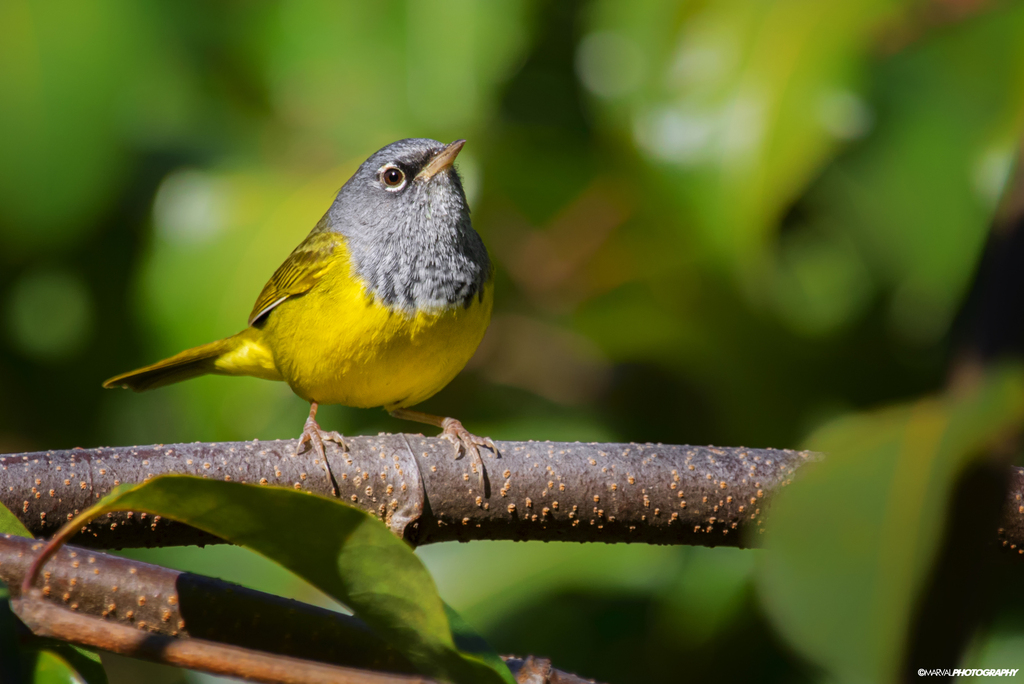
(c) MarvalPhotography19, some rights reserved (CC BY) · licence
Family: Parulidae · Class: Aves · Order: Passeriformes
Geothlypis tolmiei (MacGillivray's Warbler) is a California animal in the Parulidae family.
MacGillivray's Warbler is a medium-sized songbird measuring 13 centimeters (5.1 inches) in length with a wingspan of approximately 18 centimeters (7.1 inches). Adults weigh 9 to 13 grams. Males in breeding plumage display a distinctive gray hood covering the head and throat, contrasting with a bright yellow breast and belly. The back and wings are olive-green, and a prominent white eye-ring, often broken above and below the eye, distinguishes this species from the similar Mourning Warbler. Females and non-breeding males show duller gray coloration on the head with a paler throat. MacGillivray's Warbler breeds across western North America from southeastern Alaska south to central California. In California, the species occurs primarily in the Sierra Nevada, Cascade Range, and northern Coast Ranges. During migration, birds can be found throughout California, while wintering grounds extend from Mexico through Central America. The species typically breeds at elevations from 900 to 3,000 meters (2,950 to 9,840 feet). Breeding habitat consists of dense understory vegetation in coniferous and mixed forests, particularly areas with thick shrub layers including willow, elderberry, and snowberry. The species favors forest edges, clearings, and areas with dense cover near water sources such as streams or meadows. During migration, MacGillivray's Warblers utilize riparian woodlands, chaparral, and mountain mahogany scrub habitats. MacGillivray's Warblers are insectivorous, foraging primarily in dense vegetation within one to three meters of the ground. Their diet consists of caterpillars, beetles, flies, aphids, and other small arthropods, supplemented by some berries during fall migration. Breeding occurs from May through July, with females constructing cup-shaped nests in dense shrubs or low tree branches, typically 0.3 to 1.5 meters above ground. Clutch size ranges from three to five eggs, which are incubated for 11 to 13 days. Both parents feed nestlings, which fledge after 8 to 10 days. The species exhibits secretive behavior, remaining hidden in dense vegetation and rarely venturing into open areas. Males sing from concealed perches within thick cover, producing a distinctive series of clear notes ending in a trill. MacGillivray's Warblers are neotropical migrants, departing breeding grounds in August and September and returning in late April through May. MacGillivray's Warbler is not federally or state listed and maintains stable populations across most of its range. According to the North American Breeding Bird Survey, populations have shown slight increases since 1966. However, localized threats include habitat loss from logging, fire suppression leading to forest succession, and development pressure in riparian areas. Climate change may affect breeding habitat suitability at higher elevations and alter migration timing.
Classification
Class: Aves · Order: Passeriformes · Family: Parulidae
Frequently asked questions
How is Geothlypis tolmiei classified?
Geothlypis tolmiei belongs to class Aves, order Passeriformes, family Parulidae.
What family does Geothlypis tolmiei belong to?
Geothlypis tolmiei is in the Parulidae family.
What is Geothlypis tolmiei?
MacGillivray's Warbler is a medium-sized songbird measuring 13 centimeters (5.1 inches) in length with a wingspan of approximately 18 centimeters (7.1 inches).
Is Geothlypis tolmiei found in California?
Yes. Geothlypis tolmiei is recorded in California in The California Species Project's catalogue.
Related species
Other California species in the same genus, family, or bioregion.
Data from The California Species Project — 14,000+ California species with verified data from CNPS, CDFW, USFWS, and more.