Gibbobruchus mimus
Redbud Seed Weevil
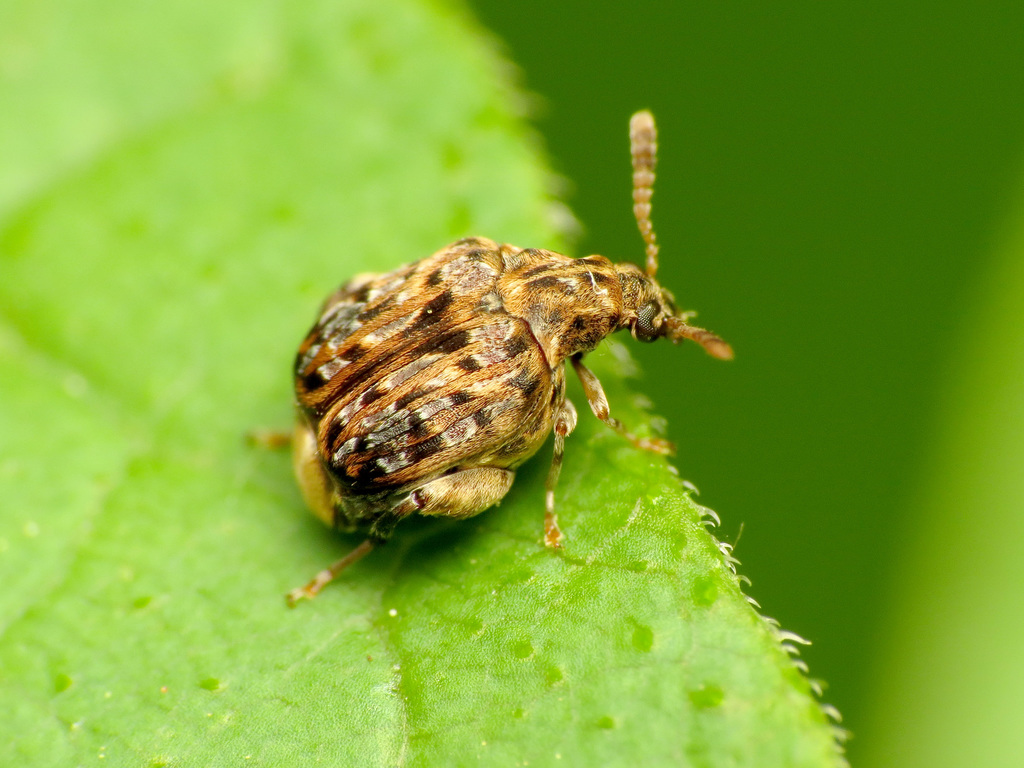
(c) Katja Schulz, some rights reserved (CC BY) · licence
Family: Chrysomelidae · Class: Insecta · Order: Coleoptera
Gibbobruchus mimus (Redbud Seed Weevil) is a California animal in the Chrysomelidae family.
The Redbud Seed Weevil (Gibbobruchus mimus) is a small beetle in the family Chrysomelidae, subfamily Bruchinae, that specializes in developing within the seeds of redbud trees (Cercis species). Adults are compact bruchid beetles measuring approximately 3-5 mm in length, with the typical robust body form characteristic of seed weevils. The species exhibits the brown to reddish-brown coloration common among bruchids, with a slightly mottled appearance. Gibbobruchus mimus occurs across a broad range of North America, from southwestern Oregon south through California to the Big Sur region, and extends eastward across much of the continental United States. The species has been documented in multiple states including Louisiana and New York, where it appears on Species of Greatest Conservation Need lists (BugGuide 2016). In California, observations have been recorded in Los Angeles County, including urban environments such as Monrovia. This weevil is closely associated with redbud trees (Cercis species), which serve as its primary host plants. The species occurs in areas where redbuds grow naturally as well as in landscaped environments where these trees have been planted. Observations suggest the species can persist in fragmented habitats, with documented occurrences on isolated redbud trees in urban settings. The weevil appears capable of maintaining populations even when host plants are scattered, indicating relatively flexible metapopulation dynamics that allow persistence in small habitat fragments (BugGuide 2024). Adult Redbud Seed Weevils emerge and mate on redbud seed pods during the growing season. Mating behavior includes a characteristic mate-guarding position where pairs remain motionless on seed pods for extended periods. Females lay eggs in developing redbud seeds, and larvae develop within the seeds, consuming the seed contents before emerging as adults. This development pattern is typical of bruchid beetles, which are specialized seed predators. The species appears to have one generation per year, synchronized with the fruiting cycle of its redbud hosts. Currently, Gibbobruchus mimus has no federal listing status under the Endangered Species Act and appears on NatureServe Explorer with no special conservation designation (NatureServe 2025). However, the species is included on state wildlife action plans in Louisiana and New York as a Species of Greatest Conservation Need, indicating some level of conservation concern in portions of its range. The primary conservation considerations likely relate to habitat fragmentation and the availability of suitable host plants, particularly as urban development affects natural redbud populations. The species' apparent ability to utilize planted redbuds in urban environments may provide some resilience against habitat loss, though long-term population trends have not been well documented.
Classification
Class: Insecta · Order: Coleoptera · Family: Chrysomelidae
Frequently asked questions
How is Gibbobruchus mimus classified?
Gibbobruchus mimus belongs to class Insecta, order Coleoptera, family Chrysomelidae.
What family does Gibbobruchus mimus belong to?
Gibbobruchus mimus is in the Chrysomelidae family.
What is Gibbobruchus mimus?
The Redbud Seed Weevil (Gibbobruchus mimus) is a small beetle in the family Chrysomelidae, subfamily Bruchinae, that specializes in developing within the seeds of redbud trees (Cercis species).
Is Gibbobruchus mimus found in California?
Yes. Gibbobruchus mimus is recorded in California in The California Species Project's catalogue.
Related species
Other California species in the same genus, family, or bioregion.
Data from The California Species Project — 14,000+ California species with verified data from CNPS, CDFW, USFWS, and more.