Gila bicolor ssp.
Hutton tui chub
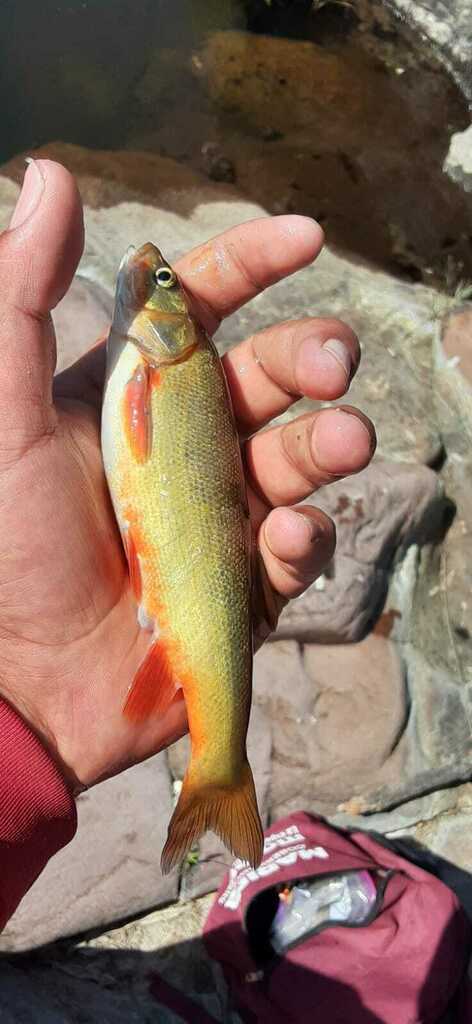
(c) Favian Flores Medina, some rights reserved (CC BY) · licence
Family: Unknown · Class: Unknown · Order: Unknown
Conservation status: Threatened
Gila bicolor ssp. (Hutton tui chub) is a California animal in the Unknown family.
The Hutton tui chub is a small freshwater fish endemic to southeastern Oregon, representing an undescribed subspecies of Gila bicolor that remains taxonomically distinct from other tui chub populations. This species typically measures 15 to 180 mm (0.6 to 7 inches) in length, displaying the characteristic tui chub body form with a compressed, elongated profile. Adults exhibit dusky-olive coloration on the dorsal surface with blue and gold lateral markings, a gold-colored head, and olive-brown to reddish-brown fins. The species can be distinguished from related tui chubs by specific scale characteristics, including lateral radii patterns and scale base morphology. Historically, the Hutton tui chub was restricted to the Warner Basin in southeastern Oregon, specifically occurring in Hutton Spring and associated waters. The species represents an allopatric population that became geographically isolated from other tui chub forms. According to the U.S. Fish and Wildlife Service, this isolation led to sufficient morphological and genetic differentiation to warrant recognition as a distinct subspecies, though formal taxonomic description remains incomplete (USFWS 1998). The Hutton tui chub inhabits spring-fed waters and associated outflow channels within the Warner Basin ecosystem. These aquatic systems are characterized by relatively stable water temperatures and consistent flow patterns typical of spring environments in the Great Basin region. The species occupies areas with varying substrate types and vegetation, though specific microhabitat preferences have not been extensively documented in available literature. Limited information exists regarding the species' feeding ecology and reproductive behavior. Like other tui chubs, the Hutton tui chub likely feeds opportunistically on aquatic invertebrates, plant material, and detritus. Spawning behavior and timing remain poorly documented, though related subspecies typically reproduce during spring and early summer periods when water temperatures and flow conditions are optimal. The U.S. Fish and Wildlife Service listed the Hutton tui chub as threatened under the Endangered Species Act in 1985, recognizing the species' restricted range and vulnerability to habitat modification (USFWS 1985). The primary threats to the species include habitat degradation, water diversions, and introduced species that may compete for resources or prey upon native fish. The Warner Basin's aquatic ecosystems have experienced significant alterations due to agricultural development and water management practices. Recovery efforts focus on habitat protection and restoration within the species' limited range. The Service developed a recovery plan for native fishes of the Warner Basin and Alkali Subbasin in 1998, with subsequent amendments addressing specific conservation needs for the Hutton tui chub (USFWS 2019). Current population estimates and trends remain uncertain due to limited monitoring data, though the species' extremely restricted distribution makes it particularly vulnerable to environmental changes and human activities within its range.
Classification
Class: Unknown · Order: Unknown · Family: Unknown
Conservation status
Threatened
Frequently asked questions
How is Gila bicolor ssp. classified?
Gila bicolor ssp. belongs to class Unknown, order Unknown, family Unknown.
What family does Gila bicolor ssp. belong to?
Gila bicolor ssp. is in the Unknown family.
Is Gila bicolor ssp. protected or of conservation concern?
Gila bicolor ssp. carries the following status: Threatened.
What is Gila bicolor ssp.?
The Hutton tui chub is a small freshwater fish endemic to southeastern Oregon, representing an undescribed subspecies of Gila bicolor that remains taxonomically distinct from other tui chub populations.
Is Gila bicolor ssp. found in California?
Yes. Gila bicolor ssp. is recorded in California in The California Species Project's catalogue.
Related species
Other California species in the same genus, family, or bioregion.
Data from The California Species Project — 14,000+ California species with verified data from CNPS, CDFW, USFWS, and more.