Gila intermedia
Gila chub
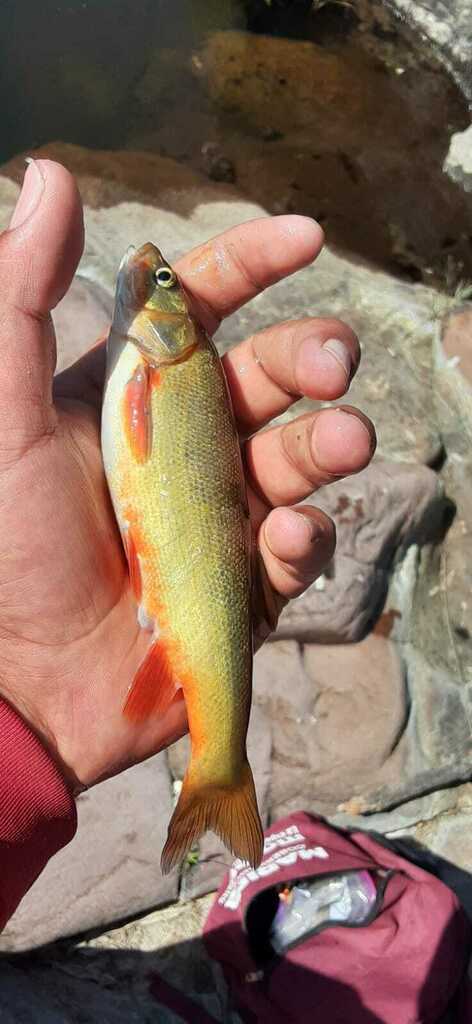
(c) Favian Flores Medina, some rights reserved (CC BY) · licence
Family: Unknown · Class: Unknown · Order: Unknown
Conservation status: Endangered
Gila intermedia (Gila chub) is a California animal in the Unknown family.
The Gila chub is a small, robust freshwater fish endemic to the southwestern United States and northwestern Mexico. Males average 6 inches (15 cm) in length, while females can reach 8 inches (20 cm). The species exhibits a deep, compressed body with a characteristically flat head and small fins, distinguishing it from other cyprinids in its range. The body shape is notably chubby, giving the species its common name. Historically, Gila chub occurred throughout river systems in Arizona, New Mexico, and Mexico. The species' range has contracted significantly from its historical distribution. Current populations are restricted to isolated stream reaches, primarily in Arizona and New Mexico. Critical habitat was designated by the U.S. Fish and Wildlife Service on November 2, 2005, recognizing the importance of specific stream segments for the species' survival and recovery. Gila chub inhabit stream environments characterized by shallow pools less than 2 feet deep, typically adjacent to or near areas of swift current. The species requires high-quality water with minimal human disturbance. Suitable habitat includes areas with rocky substrates, undercut banks, and moderate vegetation cover. These fish are adapted to natural flow regimes and depend on the connectivity between pools and riffle areas for their life cycle completion. As stream-dwelling cyprinids, Gila chub are primarily insectivorous, feeding on aquatic invertebrates and small prey items available in their pool and riffle habitats. The species exhibits seasonal movement patterns within stream systems, utilizing different habitat types for feeding, spawning, and overwintering. Reproduction typically occurs during spring months when water temperatures and flow conditions are optimal. The Gila chub was listed as endangered under the Endangered Species Act, with critical habitat designation reflecting the species' precarious conservation status. Primary threats include habitat degradation, water diversions, introduced non-native fish species, and stream channel modifications. Non-native species such as green sunfish, black bullhead, fathead minnow, and northern crayfish compete with and prey upon Gila chub, significantly impacting population viability. The species faces ongoing conservation challenges related to water management in arid southwestern watersheds. Taxonomic confusion has historically complicated conservation efforts for this species. Some populations formerly classified as Gila chub were reclassified as roundtail chub (Gila robusta) in 2014, though the American Fisheries Society does not recognize Gila chub as a distinct species. Despite this taxonomic uncertainty, federal endangered species protections remain in place. Recovery efforts focus on habitat restoration, non-native species control, and population monitoring to prevent extinction of remaining populations in Arizona and New Mexico watersheds.
Classification
Class: Unknown · Order: Unknown · Family: Unknown
Conservation status
Endangered
Frequently asked questions
How is Gila intermedia classified?
Gila intermedia belongs to class Unknown, order Unknown, family Unknown.
What family does Gila intermedia belong to?
Gila intermedia is in the Unknown family.
Is Gila intermedia protected or of conservation concern?
Gila intermedia carries the following status: Endangered.
What is Gila intermedia?
The Gila chub is a small, robust freshwater fish endemic to the southwestern United States and northwestern Mexico.
Is Gila intermedia found in California?
Yes. Gila intermedia is recorded in California in The California Species Project's catalogue.
Related species
Other California species in the same genus, family, or bioregion.
Data from The California Species Project — 14,000+ California species with verified data from CNPS, CDFW, USFWS, and more.