Gila orcuttii
Arroyo Chub
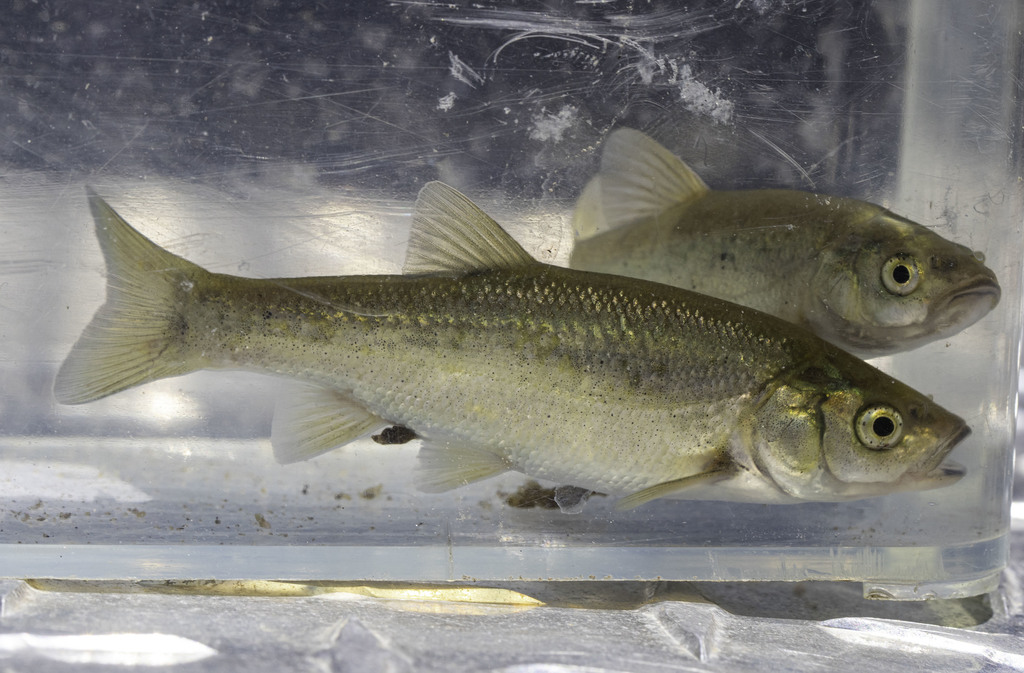
(c) Zack Abbey, some rights reserved (CC BY) · licence
Family: Leuciscidae · Class: Actinopterygii · Order: Cypriniformes
Conservation status: G1 S2
Gila orcuttii (Arroyo Chub) is a California animal in the Leuciscidae family.
The Arroyo Chub (Gila orcuttii) is a small cyprinid fish native to coastal drainages of southern California. Adults typically measure 70-100 mm (2.8-3.9 inches) in length, with a relatively deep body and caudal peduncle, large eyes for a cyprinid, and a short, rounded snout with a subterminal mouth. The body is silver or gray to olive green dorsally, white ventrally, and marked by a dull gray lateral band (Moyle 2002). The species exhibits the robust build characteristic of fish adapted to fluctuating stream conditions. Historically, Arroyo Chub occurred in coastal drainages across Los Angeles, Orange, Riverside, and San Diego counties in California. Recent surveys conducted from 2012-2014 and again in 2019 detected the species in 18 of 40 historically occupied streams (45%) within six of the seven native watersheds. The species has experienced significant range contractions, with populations disappearing from numerous locations due to habitat modification and introduced species competition. Arroyo Chub inhabit slow-moving sections of cool to warm streams, typically in temperatures ranging from 10-26°C (50-79°F). They prefer areas dominated by sand and silt substrates but demonstrate habitat flexibility, also utilizing pools with gravel, cobble, and boulder substrates (Feeney and Swift 2008). The species is adapted to survive the fluctuating conditions characteristic of southern California streams, including warm, hypoxic conditions during summer months when stream flows are reduced. These fish are opportunistic feeders, consuming aquatic invertebrates, algae, and detritus. Arroyo Chub exhibit remarkable physiological adaptations to their variable environment, tolerating wide ranges in temperature, dissolved oxygen, and salinity. They can survive in conditions that would be lethal to many other native fish species, including warm, shallow pools during drought periods. Spawning typically occurs during spring months when water temperatures and flows are optimal. The Arroyo Chub is classified as G1 (critically imperiled globally) and S2 (imperiled in California), reflecting its precarious conservation status. Primary threats include habitat loss and modification from urbanization, water diversions, and channelization of streams. The species faces significant pressure from introduced species, particularly in areas where non-native fish have been established. Notably, the illegal introduction of Arroyo Chub into the Mojave River system in the 1930s contributed to the decline of the native Mohave Tui Chub through competition and hybridization, demonstrating the complex conservation challenges facing California's native fish fauna. Conservation efforts focus on habitat restoration, removal of invasive species, and protection of remaining native populations. The species' ability to persist in modified habitats provides some hope for recovery, but continued monitoring and active management remain essential for long-term survival.
Classification
Class: Actinopterygii · Order: Cypriniformes · Family: Leuciscidae
Conservation status
G1 S2
Frequently asked questions
How is Gila orcuttii classified?
Gila orcuttii belongs to class Actinopterygii, order Cypriniformes, family Leuciscidae.
What family does Gila orcuttii belong to?
Gila orcuttii is in the Leuciscidae family.
Is Gila orcuttii protected or of conservation concern?
Gila orcuttii carries the following status: G1 S2.
What is Gila orcuttii?
The Arroyo Chub (Gila orcuttii) is a small cyprinid fish native to coastal drainages of southern California.
Is Gila orcuttii found in California?
Yes. Gila orcuttii is recorded in California in The California Species Project's catalogue.
Related species
Other California species in the same genus, family, or bioregion.
Data from The California Species Project — 14,000+ California species with verified data from CNPS, CDFW, USFWS, and more.