Gila robusta jordani
Pahranagat roundtail chub
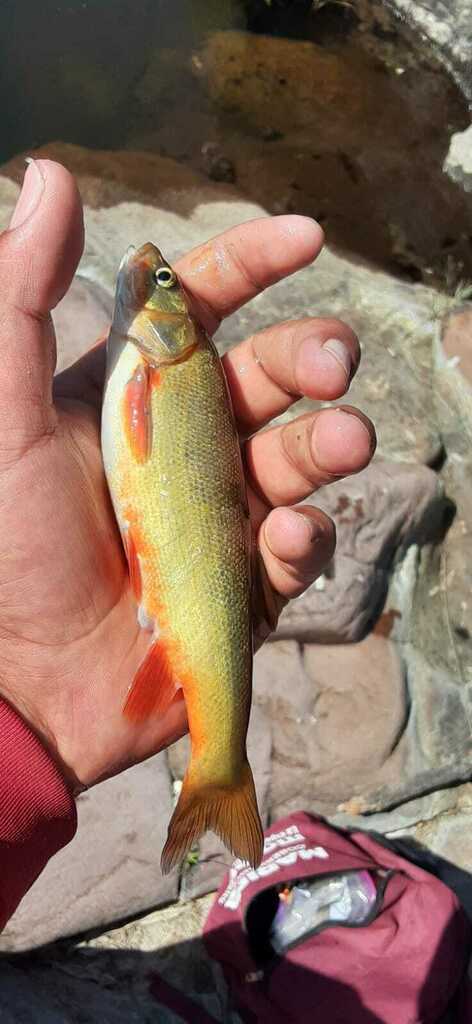
(c) Favian Flores Medina, some rights reserved (CC BY) · licence
Family: Unknown · Class: Unknown · Order: Unknown
Conservation status: Endangered
Gila robusta jordani (Pahranagat roundtail chub) is a California animal in the Unknown family.
The Pahranagat roundtail chub is a small cyprinid fish endemic to Nevada's Pahranagat Valley. Adults typically measure approximately 10 centimeters (4 inches) in maximum length and live 3 years or less. The species exhibits a streamlined body form characteristic of chubs, with a deeply forked tail and large, sickle-shaped fins. During spawning season, males may develop orange-red coloration on the mouth, gill covers, and fins. Historically, the Pahranagat roundtail chub occupied approximately 30 kilometers (18.6 miles) of aquatic habitat in Pahranagat Valley, Nevada, including Crystal, Hiko, and Ash Springs and their outflows, Pahranagat Creek and Ditch, and Maynard Lake at the valley's southern end (USFWS 1998). By 1950, the species was already reported as scarce, and its range has continued to contract significantly. Current distribution is limited to approximately 6.0 kilometers (3.8 miles) of Pahranagat Creek and associated irrigation ditches, including portions near Ash Springs, though populations are not contiguous throughout this range. The species inhabits spring-fed creek systems and associated artificial channels within the Pahranagat Valley. Adults occupy water depths ranging from 0.4 to 1.4 meters (1.3 to 4.6 feet), with a mean depth of 0.8 meters (2.6 feet). Water velocities in occupied areas range from 0.00 to 0.80 meters per second (0.0 to 2.6 feet per second), with a mean velocity of 0.32 meters per second (1.04 feet per second). Juveniles prefer areas with slightly lower water velocities, ranging from 0.00 to 0.60 meters per second (0.0 to 2.0 feet per second). The species shows preference for areas along creek edges and utilizes both natural spring outflows and human-modified irrigation infrastructure. Specific dietary and reproductive information for the Pahranagat roundtail chub remains poorly documented in available literature. Like other roundtail chub species, it likely feeds on aquatic invertebrates and plant material. The species' short lifespan of typically 3 years or less suggests rapid maturation and annual reproduction cycles. The U.S. Fish and Wildlife Service listed the Pahranagat roundtail chub as endangered on October 13, 1970. Population estimates indicate severe decline, with only 37 to 45 adult individuals documented in 1982 inhabiting 2.3 kilometers (1.4 miles) of Pahranagat Creek (Hardy 1982). Recent recovery reports classify the species' population trend as decreasing. Primary threats include habitat alteration from water diversions and infrastructure modifications, introduction of non-native fish species that compete for resources or prey upon native fish, and disease transmission. The species is covered under the Recovery Plan for the Aquatic and Riparian Species of Pahranagat Valley, finalized in May 1998, which aims to establish self-sustaining populations through habitat enhancement, monitoring, and threat reduction measures. Recovery efforts focus on maintaining and enhancing aquatic and riparian habitats, developing comprehensive monitoring protocols, and implementing public education programs.
Classification
Class: Unknown · Order: Unknown · Family: Unknown
Conservation status
Endangered
Frequently asked questions
How is Gila robusta jordani classified?
Gila robusta jordani belongs to class Unknown, order Unknown, family Unknown.
What family does Gila robusta jordani belong to?
Gila robusta jordani is in the Unknown family.
Is Gila robusta jordani protected or of conservation concern?
Gila robusta jordani carries the following status: Endangered.
What is Gila robusta jordani?
The Pahranagat roundtail chub is a small cyprinid fish endemic to Nevada's Pahranagat Valley.
Is Gila robusta jordani found in California?
Yes. Gila robusta jordani is recorded in California in The California Species Project's catalogue.
Related species
Other California species in the same genus, family, or bioregion.
Data from The California Species Project — 14,000+ California species with verified data from CNPS, CDFW, USFWS, and more.