Gila seminuda (=robusta)
Virgin River Chub
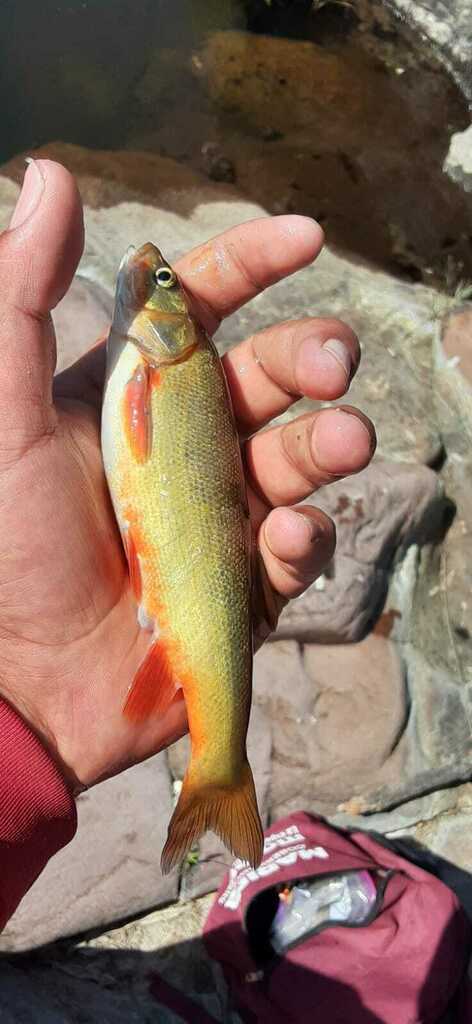
(c) Favian Flores Medina, some rights reserved (CC BY) · licence
Family: Unknown · Class: Unknown · Order: Unknown
Conservation status: Endangered
Gila seminuda (=robusta) (Virgin River Chub) is a California animal in the Unknown family.
The Virgin River chub is a silvery, medium-sized cyprinid fish that typically measures 20 centimeters (8 inches) in total length but can reach up to 45 centimeters (18 inches). The species displays olive shading on the dorsal surface with sometimes pale yellow-orange fins. Scales on the back and belly are unusually small and deeply embedded, with some individuals missing scales entirely. The body appears streamlined with a deeply forked tail and a trout-like mouth adapted for varied feeding. Historically, Virgin River chub occupied the Virgin River drainage system across Arizona, Nevada, and Utah. The species was historically most abundant in the Muddy River between the Warm Springs area and Logandale. Current populations are restricted to specific reaches of the Virgin River system and tributaries, including portions of the Muddy River and associated spring systems. A 1994 population census documented 8,251 chub in the upper Muddy River and five tributary spring systems. Virgin River chub inhabit deep channels and pools with sandy bottoms, seeking cover under large rocks, overhanging streambanks, or tree roots. The species avoids shallow riffle areas and has been collected in water temperatures ranging from 15 to 30 degrees Celsius (59 to 86 degrees Fahrenheit). Pool habitats are particularly important for the species' survival and reproduction. The diet consists of aquatic insects, algae, and crustaceans, reflecting their opportunistic feeding behavior in desert stream environments. Virgin River chub are adapted to the variable flow conditions and temperature fluctuations characteristic of southwestern desert rivers. Their streamlined body form and behavioral preferences for deeper water suggest adaptations to periodic high-flow events. The U.S. Fish and Wildlife Service listed the Virgin River chub as endangered on August 24, 1989, due to habitat modification, water diversions, and competition with non-native species. Primary threats include reduced flows from water management, establishment of tamarisk and other non-native riparian vegetation that reduces pool habitat, and predation or competition from introduced fish species such as blue tilapia. According to federal recovery reports, population status was considered stable as of 2008, though the species remains vulnerable to continued habitat degradation. Recovery efforts focus on habitat restoration, flow management, and non-native species control. The Moapa Valley National Wildlife Refuge provides protected habitat for the species, maintaining stable flows from thermal springs that create suitable conditions for Virgin River chub and other endemic fish. Continued monitoring and adaptive management are essential for maintaining viable populations throughout the species' remaining range in the Virgin River system.
Classification
Class: Unknown · Order: Unknown · Family: Unknown
Conservation status
Endangered
Frequently asked questions
How is Gila seminuda (=robusta) classified?
Gila seminuda (=robusta) belongs to class Unknown, order Unknown, family Unknown.
What family does Gila seminuda (=robusta) belong to?
Gila seminuda (=robusta) is in the Unknown family.
Is Gila seminuda (=robusta) protected or of conservation concern?
Gila seminuda (=robusta) carries the following status: Endangered.
What is Gila seminuda (=robusta)?
The Virgin River chub is a silvery, medium-sized cyprinid fish that typically measures 20 centimeters (8 inches) in total length but can reach up to 45 centimeters (18 inches).
Is Gila seminuda (=robusta) found in California?
Yes. Gila seminuda (=robusta) is recorded in California in The California Species Project's catalogue.
Related species
Other California species in the same genus, family, or bioregion.
Data from The California Species Project — 14,000+ California species with verified data from CNPS, CDFW, USFWS, and more.