Gillmeria pallidactyla
Yarrow Plume Moth
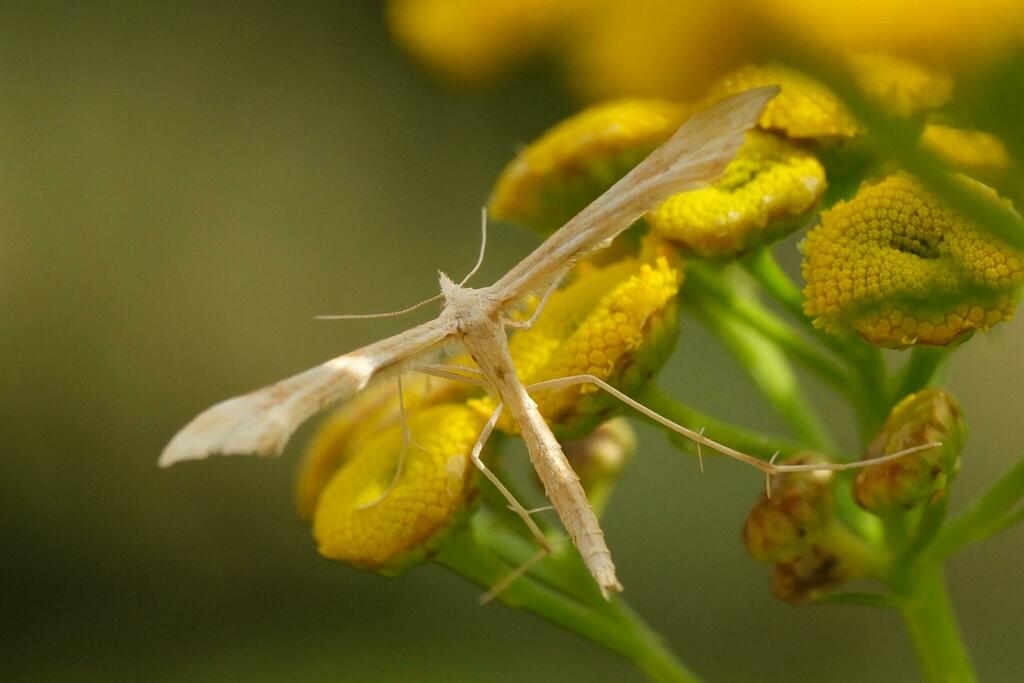
(c) Alexis Tinker-Tsavalas, some rights reserved (CC BY) · licence
Family: Pterophoridae · Class: Insecta · Order: Lepidoptera
Gillmeria pallidactyla (Yarrow Plume Moth) is a California animal in the Pterophoridae family.
The Yarrow Plume Moth is a small member of the plume moth family Pterophoridae, with a wingspan measuring 18 to 25 mm (0.7 to 1.0 inches). The species exhibits distinctive characteristics including a conical frontal tuft on the head and mottled forewings with narrow, pointed lobes. The forewings display light buff or cream buff coloration grading to drab or buffy brown distally, with a brown spot at mid-wing and dark brown speckles at two-thirds wing length extending from middle to costal edge. Wing tips are pointed and smudged brownish, featuring a faint yellowish diagonal line, while the fringe remains white. Hindwings appear yellowish-brown, and the legs are predominantly white except for brownish thighs (femora). The abdomen is light tan with slightly darker tan dots running intermittently down the middle (BugGuide). Gillmeria pallidactyla has a Holarctic distribution, occurring widely throughout North America and Eurasia (BugGuide). The species' North American range extends across much of the continent, though precise distribution records remain unclear due to historical taxonomic confusion with closely related species G. buscki and G. tenuidactylus. These species can occur sympatrically in some areas, complicating identification and range documentation (News of The Lepidopterists' Society 2020). The species inhabits dry or sandy waste ground and similar disturbed habitats. Adults seek refuge in low foliage during daylight hours, emerging to become active at dusk when they are readily attracted to artificial light sources. This habitat preference for open, disturbed areas makes the species well-adapted to anthropogenic environments including roadsides and agricultural margins (BugGuide). Yarrow Plume Moths exhibit a seasonal flight period with adults active during June and July. The species demonstrates typical plume moth behavior, remaining cryptic during the day before engaging in nocturnal activity patterns. Larvae feed primarily on yarrow (Achillea spp.) and possibly tansy (Tanacetum spp.), establishing the species' ecological association with plants in the Asteraceae family. This host plant relationship explains the species' common name and its occurrence in habitats where these herbaceous perennials are abundant (BugGuide). Currently, Gillmeria pallidactyla lacks formal conservation status designations at federal or state levels. The species appears to maintain stable populations across its broad geographic range, likely benefiting from its association with common host plants and tolerance for disturbed habitats. However, taxonomic uncertainties and potential misidentifications in historical records suggest that more detailed studies may be needed to fully assess population trends and conservation needs. The species' apparent adaptability to human-modified landscapes may contribute to its persistence, though comprehensive surveys would be valuable for confirming current distribution patterns and population status throughout its range.
Classification
Class: Insecta · Order: Lepidoptera · Family: Pterophoridae
Frequently asked questions
How is Gillmeria pallidactyla classified?
Gillmeria pallidactyla belongs to class Insecta, order Lepidoptera, family Pterophoridae.
What family does Gillmeria pallidactyla belong to?
Gillmeria pallidactyla is in the Pterophoridae family.
What is Gillmeria pallidactyla?
The Yarrow Plume Moth is a small member of the plume moth family Pterophoridae, with a wingspan measuring 18 to 25 mm (0.7 to 1.0 inches).
Is Gillmeria pallidactyla found in California?
Yes. Gillmeria pallidactyla is recorded in California in The California Species Project's catalogue.
Related species
Other California species in the same genus, family, or bioregion.
Data from The California Species Project — 14,000+ California species with verified data from CNPS, CDFW, USFWS, and more.