Glaucidium brasilianum cactorum
Cactus ferruginous pygmy-owl
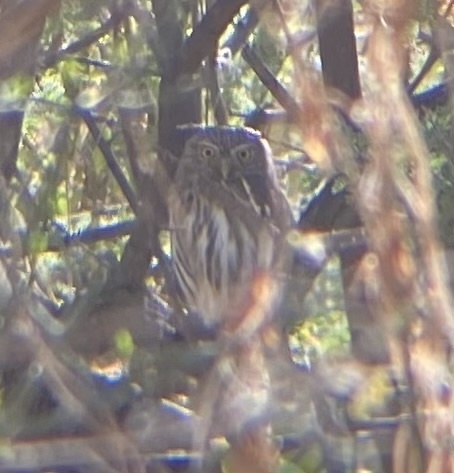
(c) Tristan A. McKnight, some rights reserved (CC BY) · licence
Family: Strigidae · Class: Aves · Order: Strigiformes
Conservation status: Threatened
Glaucidium brasilianum cactorum (Cactus ferruginous pygmy-owl) is a California animal in the Strigidae family.
The cactus ferruginous pygmy-owl is a small owl measuring approximately 15 to 18 cm (6 to 7 inches) in length with a wingspan of 35 to 38 cm (14 to 15 inches). Adults weigh between 60 to 75 grams (2.1 to 2.6 ounces). The species displays rusty-brown (ferruginous) plumage with distinctive streaking on the underparts and white spotting on the wings and back. The facial disc is poorly defined compared to larger owl species, and the eyes are bright yellow. Two prominent false eyespots on the back of the head serve as a defensive mechanism against potential predators. The tail is proportionally long and shows distinct barring patterns. The cactus ferruginous pygmy-owl occurs in Arizona, Texas, and Mexico, representing the northernmost subspecies of the ferruginous pygmy-owl complex. In the United States, the subspecies historically occupied desert regions of southern Arizona and extreme southern Texas. The species' range extends southward through Mexico, where larger populations persist. According to USFWS, current U.S. populations are extremely limited, with the largest remaining population in Texas found in live oak woodlands. This subspecies inhabits desert scrub communities dominated by saguaro cacti, paloverde, mesquite, and ironwood trees in Arizona. In Texas, the species occurs primarily in live oak woodlands and riparian areas with dense shrub understories. The owl requires cavities for nesting, typically utilizing holes excavated by woodpeckers in saguaro cacti or tree trunks. Habitat requirements include areas with sufficient prey abundance and adequate nesting sites, generally occurring from sea level to 1,400 meters (4,593 feet) elevation in the United States and Mexico. Cactus ferruginous pygmy-owls are primarily diurnal, unlike most owl species, actively hunting during daylight hours. Their diet consists mainly of insects, small reptiles including lizards and snakes, small mammals, and occasionally small birds. Post-fledging families utilize territories ranging from 9.3 to 60 hectares until young disperse (Proudfoot and Johnson 2000). Breeding occurs in spring, with pairs nesting in cavities excavated by woodpeckers or formed by limb decay. The species exhibits site fidelity, often returning to previously used territories. The U.S. Fish and Wildlife Service listed the cactus ferruginous pygmy-owl as threatened on August 21, 2023, under the Endangered Species Act. The subspecies was previously listed as endangered in 1997 but was removed from the list in 2006. Primary threats include habitat loss due to urban development, agriculture, and water diversions that alter riparian ecosystems. Climate change poses additional challenges through increased temperatures and altered precipitation patterns affecting prey availability and nesting habitat quality. Critical habitat was designated in 1999, encompassing areas in Arizona essential for the subspecies' conservation. Current population estimates suggest fewer than 2,000 individuals remain in the United States, with the species facing continued decline without active conservation intervention.
Classification
Class: Aves · Order: Strigiformes · Family: Strigidae
Conservation status
Threatened
Frequently asked questions
How is Glaucidium brasilianum cactorum classified?
Glaucidium brasilianum cactorum belongs to class Aves, order Strigiformes, family Strigidae.
What family does Glaucidium brasilianum cactorum belong to?
Glaucidium brasilianum cactorum is in the Strigidae family.
Is Glaucidium brasilianum cactorum protected or of conservation concern?
Glaucidium brasilianum cactorum carries the following status: Threatened.
What is Glaucidium brasilianum cactorum?
The cactus ferruginous pygmy-owl is a small owl measuring approximately 15 to 18 cm (6 to 7 inches) in length with a wingspan of 35 to 38 cm (14 to 15 inches).
Is Glaucidium brasilianum cactorum found in California?
Yes. Glaucidium brasilianum cactorum is recorded in California in The California Species Project's catalogue.
Related species
Other California species in the same genus, family, or bioregion.
Data from The California Species Project — 14,000+ California species with verified data from CNPS, CDFW, USFWS, and more.