Glaucidium gnoma
Northern Pygmy Owl
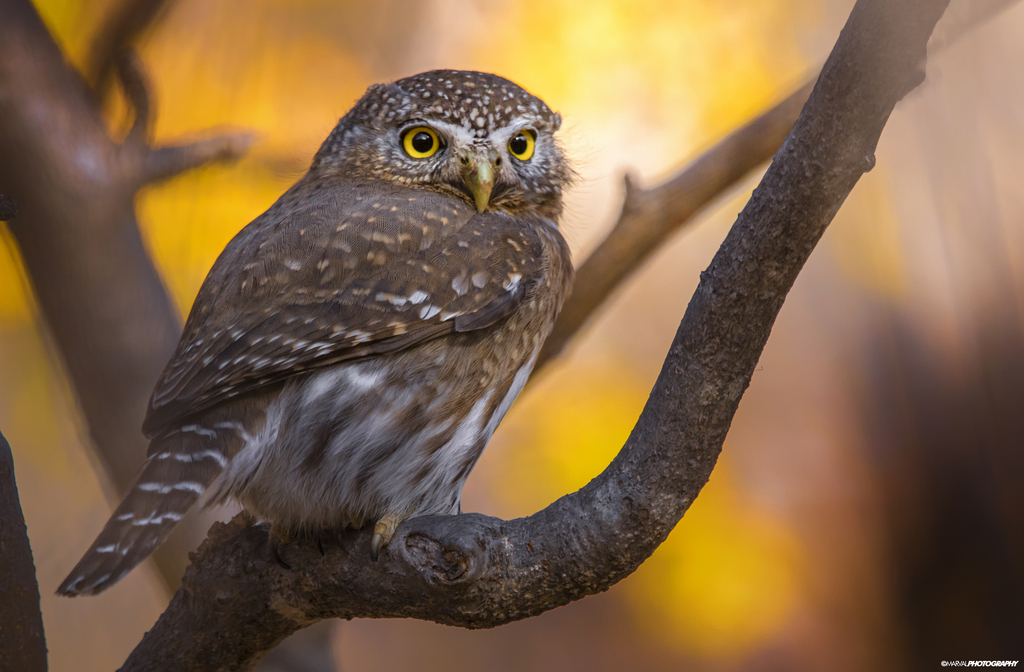
(c) MarvalPhotography19, some rights reserved (CC BY) · licence
Family: Strigidae · Class: Aves · Order: Strigiformes
Glaucidium gnoma (Northern Pygmy Owl) is a California animal in the Strigidae family.
The Northern Pygmy Owl is one of the smallest owls in North America, measuring 15 to 18 cm (6 to 7 inches) in length with a wingspan of 35 to 41 cm (14 to 16 inches). Adults weigh 55 to 75 grams (1.9 to 2.6 ounces). The species exhibits a compact, rounded body with a relatively large head and short tail. Plumage varies from grayish-brown to reddish-brown dorsally, with white spotting on the wings and back. The underparts are white with dark brown streaking. A distinctive feature is the pair of false eyespots on the back of the neck, which may serve to deter predators or confuse prey. The facial disc is less pronounced than in most owl species, and the eyes are bright yellow. The Northern Pygmy Owl occurs throughout western North America, from southern British Columbia south to Central America. In California, the species is found primarily in mountainous regions including the Sierra Nevada, Cascade Range, Coast Ranges, and scattered mountains in southern California. The distribution extends from the Oregon border south through the Transverse and Peninsular Ranges. Elevational range in California typically spans from 300 to 2,800 meters (1,000 to 9,200 feet), though they are most common between 1,200 and 2,400 meters (4,000 to 8,000 feet). Northern Pygmy Owls inhabit coniferous and mixed coniferous-deciduous forests. Primary habitat includes Douglas fir, ponderosa pine, white fir, and mixed oak-pine woodlands. The species prefers areas with dense canopy cover interspersed with openings and edge habitats. Old-growth and mature forests with large trees provide essential nesting cavities, typically excavated by woodpeckers. Habitat requirements include snags and dead trees for roosting and nesting, as well as nearby openings for hunting. Unlike most owls, Northern Pygmy Owls are primarily diurnal, hunting during dawn, dusk, and daylight hours. Their diet consists mainly of small birds, which according to Birds of the World comprise a significant portion of their prey. Common prey includes chickadees, nuthatches, wrens, and finches. They also consume small mammals such as voles, shrews, and chipmunks, as well as insects and reptiles. The species exhibits disproportionate hunting ability relative to its size, capable of taking prey larger than themselves. Breeding occurs from April through June, with females laying 2 to 7 white eggs in tree cavities 3 to 15 meters (10 to 50 feet) above ground. According to ornithological studies, incubation lasts 28 to 30 days, performed entirely by the female while the male provides food. The Northern Pygmy Owl has no federal or state conservation listing in California and maintains stable populations throughout most of its range. According to North American Breeding Bird Survey data, populations have remained relatively stable over recent decades. Primary threats include habitat loss from logging and urban development, particularly the removal of mature forests with suitable nesting cavities. Fire suppression practices that reduce natural forest dynamics may also impact habitat quality. Climate change could potentially shift suitable habitat to higher elevations. The species benefits from forest management practices that maintain mature forest structure and snag retention.
Classification
Class: Aves · Order: Strigiformes · Family: Strigidae
Frequently asked questions
How is Glaucidium gnoma classified?
Glaucidium gnoma belongs to class Aves, order Strigiformes, family Strigidae.
What family does Glaucidium gnoma belong to?
Glaucidium gnoma is in the Strigidae family.
What is Glaucidium gnoma?
The Northern Pygmy Owl is one of the smallest owls in North America, measuring 15 to 18 cm (6 to 7 inches) in length with a wingspan of 35 to 41 cm (14 to 16 inches).
Is Glaucidium gnoma found in California?
Yes. Glaucidium gnoma is recorded in California in The California Species Project's catalogue.
Related species
Other California species in the same genus, family, or bioregion.
Data from The California Species Project — 14,000+ California species with verified data from CNPS, CDFW, USFWS, and more.