Glaucopsyche lygdamus palosverdesensis
Palos Verdes blue butterfly
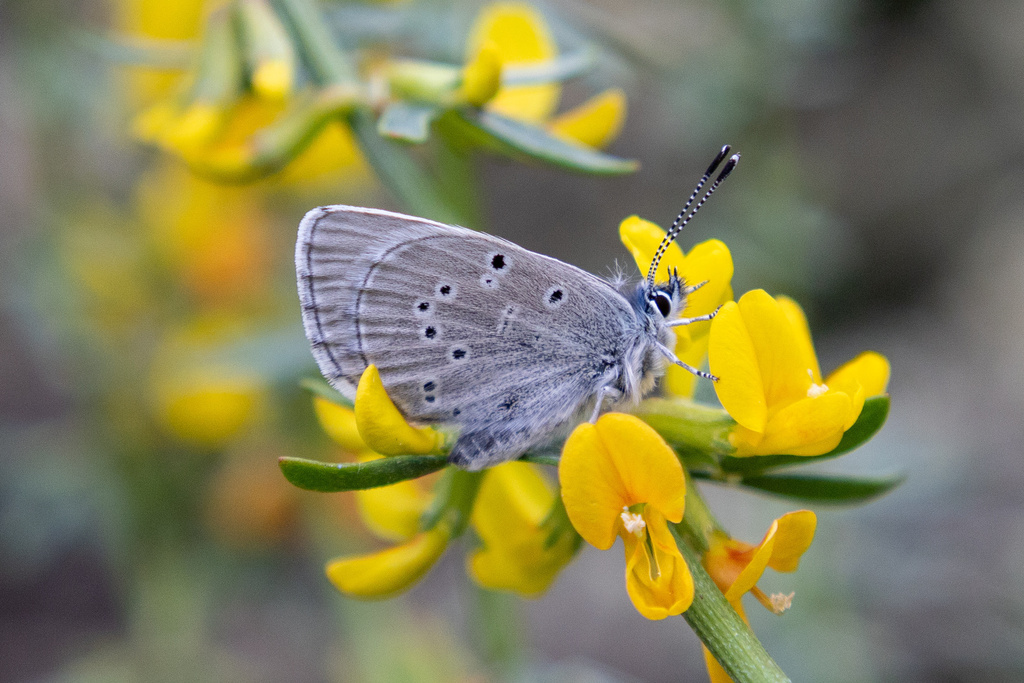
(c) Roberto Daniel Avila, some rights reserved (CC BY) · licence
Family: Lycaenidae · Class: Insecta · Order: Lepidoptera
Conservation status: Endangered · G5T1 S1
Glaucopsyche lygdamus palosverdesensis (Palos Verdes blue butterfly) is a California animal in the Lycaenidae family.
The Palos Verdes blue butterfly (Glaucopsyche lygdamus palosverdesensis) is a small lycaenid butterfly endemic to the Palos Verdes Peninsula in Los Angeles County, California. Males display iridescent blue dorsal wing surfaces with narrow black borders, while females are predominantly brown with blue scaling near the wing bases. The ventral wing surfaces of both sexes are gray with distinctive white-ringed black spots and orange marginal crescents. Adults measure 22 to 32 millimeters (0.9 to 1.3 inches) in wingspan. This subspecies occurs exclusively on the Palos Verdes Peninsula, representing one of the most geographically restricted butterflies in North America. Historically, the population inhabited coastal sage scrub and chaparral communities across the peninsula's bluffs and canyons. Current populations are confined to remnant habitat patches, primarily within the Palos Verdes Nature Preserve and Defense Fuel Support Point San Pedro. The species requires coastal sage scrub habitat containing its primary larval host plant, deerweed (Acmispon glaber, formerly Lotus scoparius). Adults are also associated with secondary nectar sources including buckwheat (Eriogonum species) and other native flowering plants. The butterfly occurs at elevations from sea level to approximately 400 meters (1,300 feet) on south-facing slopes and canyon bottoms with well-drained soils. Palos Verdes blue butterflies have a single generation per year, with adults flying from February through May, peaking in March and April. Females deposit eggs singly on young deerweed growth, and larvae develop through five instars over approximately eight weeks. Mature larvae pupate in soil or leaf litter, with pupae entering diapause during summer and emerging the following spring. The species exhibits a facultative mutualistic relationship with native ants, which tend the larvae in exchange for honeydew secretions. The U.S. Fish and Wildlife Service listed the Palos Verdes blue butterfly as endangered in 1980, making it one of the first insects to receive federal protection. The species was presumed extinct from 1983 until its rediscovery in 1994 when a small population was found at the Defense Fuel Support Point. According to recent monitoring data, the population remains critically low, with annual counts typically ranging from fewer than 50 to several hundred individuals depending on weather conditions and habitat management. Primary threats include habitat loss from urban development, invasive plant species that displace native host plants, and edge effects from surrounding urban areas. Non-native grasses and forbs reduce deerweed abundance and alter fire regimes. Small population size makes the species vulnerable to stochastic events and genetic bottlenecks. Conservation efforts include habitat restoration, invasive species control, captive breeding programs, and population monitoring. The Palos Verdes Peninsula Land Conservancy and federal agencies collaborate on recovery activities including deerweed propagation and habitat enhancement projects.
Classification
Class: Insecta · Order: Lepidoptera · Family: Lycaenidae
Conservation status
Endangered · G5T1 S1
Frequently asked questions
How is Glaucopsyche lygdamus palosverdesensis classified?
Glaucopsyche lygdamus palosverdesensis belongs to class Insecta, order Lepidoptera, family Lycaenidae.
What family does Glaucopsyche lygdamus palosverdesensis belong to?
Glaucopsyche lygdamus palosverdesensis is in the Lycaenidae family.
Is Glaucopsyche lygdamus palosverdesensis protected or of conservation concern?
Glaucopsyche lygdamus palosverdesensis carries the following status: Endangered · G5T1 S1.
What is Glaucopsyche lygdamus palosverdesensis?
The Palos Verdes blue butterfly (Glaucopsyche lygdamus palosverdesensis) is a small lycaenid butterfly endemic to the Palos Verdes Peninsula in Los Angeles County, California.
Is Glaucopsyche lygdamus palosverdesensis found in California?
Yes. Glaucopsyche lygdamus palosverdesensis is recorded in California in The California Species Project's catalogue.
Related species
Other California species in the same genus, family, or bioregion.
Data from The California Species Project — 14,000+ California species with verified data from CNPS, CDFW, USFWS, and more.