Glaucopsyche piasus
Arrowhead Blue
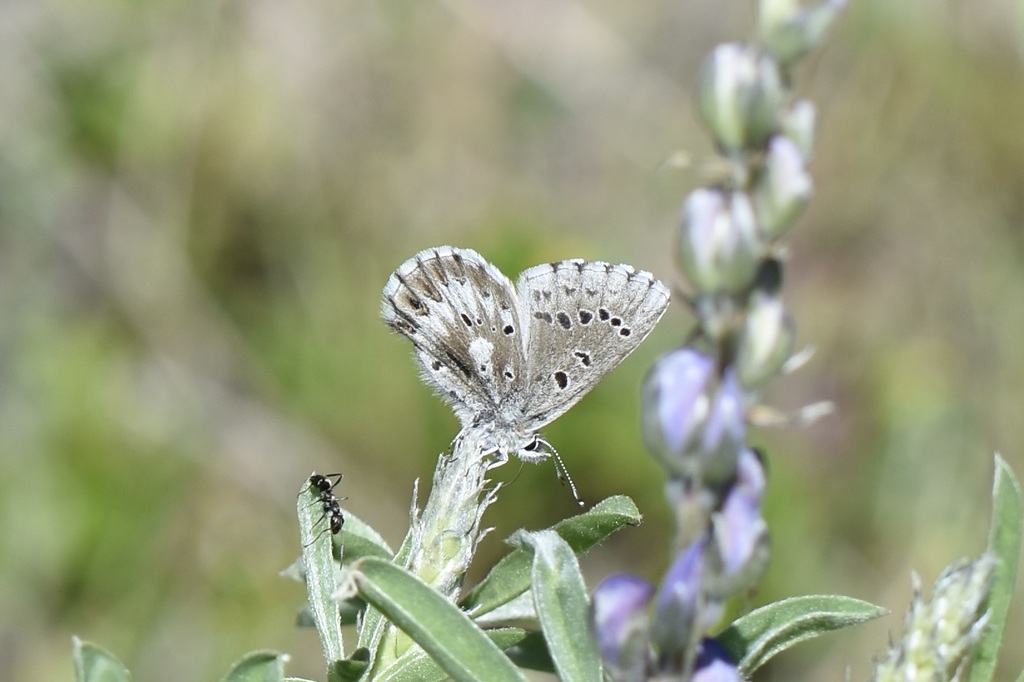
no rights reserved · CC0
Family: Lycaenidae · Class: Insecta · Order: Lepidoptera
Glaucopsyche piasus (Arrowhead Blue) is a California animal in the Lycaenidae family.
The Arrowhead Blue (Glaucopsyche piasus) is a small butterfly in the Lycaenidae family, commonly known as the blues, gossamer-wings, or copper butterflies. Adults have a wingspan ranging from 22 to 28 mm (0.9 to 1.1 inches). Males display iridescent blue dorsal wing surfaces with narrow dark borders, while females are typically brownish-gray with variable amounts of blue scaling near the wing bases. The ventral wing surfaces of both sexes are pale gray to white with distinctive black spots surrounded by white halos, and orange-red submarginal spots along the hindwing edges. The species derives its common name from the pointed, arrow-like shape of the male's forewings. The Arrowhead Blue occurs across western North America, ranging from British Columbia and southern Alberta south through the mountains to southern California, northern Arizona, and western Nebraska. In California, the species is found primarily in mountainous regions of the Sierra Nevada, Cascade Range, and scattered locations in the Coast Ranges. Populations are generally local and uncommon throughout the range, with the species showing patchy distribution patterns typical of specialized herbivores. This butterfly inhabits open woodlands, mountain meadows, and forest clearings at elevations typically ranging from 300 to 3,000 meters (1,000 to 9,800 feet). The species requires areas where its host plants grow in association with specific ant species. Preferred habitats include ponderosa pine forests, mixed coniferous forests, and subalpine meadows where lupines and milkvetches occur naturally. The butterfly shows a strong preference for sunny, sheltered locations with access to nectar sources and suitable ant colonies. Arrowhead Blue larvae are obligate feeders on lupine (Ludinus) and milkvetch (Astragalus) species in the pea family (Fabaceae). The species exhibits a complex ecological relationship with ants, particularly those in the genus Formica. Larvae produce honeydew and pheromones that attract ants, which provide protection from predators and parasitoids in exchange for the nutritious secretions. Adults typically emerge in late spring to early summer, with flight periods varying by elevation and latitude. Females lay eggs singly on flower buds or young leaves of host plants. The species overwinters as pupae, with some populations exhibiting extended diapause during unfavorable years. The Arrowhead Blue is not currently listed under federal or state endangered species acts, but populations face pressures from habitat loss and fragmentation. Forest management practices, grazing, and development can disrupt the delicate balance between host plants, ant colonies, and butterfly populations. Climate change poses additional threats through altered precipitation patterns and temperature regimes that may affect host plant phenology and ant colony dynamics. The species' specialized ecological requirements and patchy distribution make individual populations vulnerable to local extirpations. Conservation efforts focus on maintaining intact forest and meadow ecosystems where the complex relationships between lupines, ants, and butterflies can persist.
Classification
Class: Insecta · Order: Lepidoptera · Family: Lycaenidae
Frequently asked questions
How is Glaucopsyche piasus classified?
Glaucopsyche piasus belongs to class Insecta, order Lepidoptera, family Lycaenidae.
What family does Glaucopsyche piasus belong to?
Glaucopsyche piasus is in the Lycaenidae family.
What is Glaucopsyche piasus?
The Arrowhead Blue (Glaucopsyche piasus) is a small butterfly in the Lycaenidae family, commonly known as the blues, gossamer-wings, or copper butterflies.
Is Glaucopsyche piasus found in California?
Yes. Glaucopsyche piasus is recorded in California in The California Species Project's catalogue.
Related species
Other California species in the same genus, family, or bioregion.
Data from The California Species Project — 14,000+ California species with verified data from CNPS, CDFW, USFWS, and more.