Glena quinquelinearia
Five-lined Gray
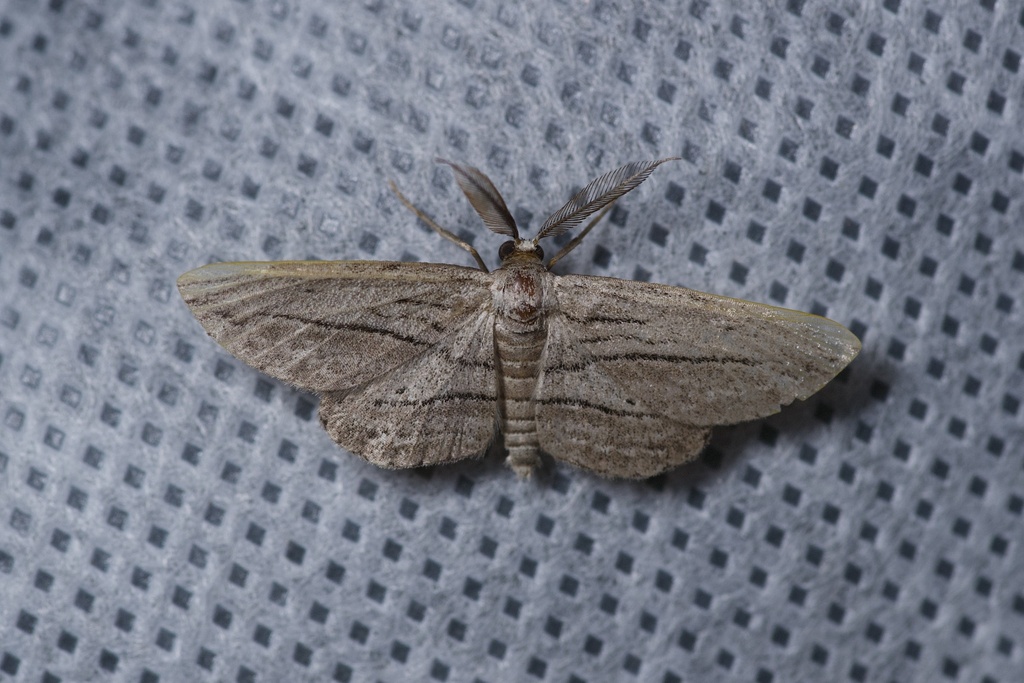
(c) Nate Sabo, some rights reserved (CC BY) · licence
Family: Geometridae · Class: Insecta · Order: Lepidoptera
Glena quinquelinearia (Five-lined Gray) is a California animal in the Geometridae family.
The Five-lined Gray (Glena quinquelinearia) is a geometrid moth in the family Geometridae, subfamily Ennominae. This species belongs to the tribe Boarmiini and represents one of the lesser-documented members of the genus Glena in North America. Adult Five-lined Gray moths display the characteristic wing patterns typical of geometrid species, with forewings that exhibit subtle gray coloration marked by distinctive linear patterns. The species name "quinquelinearia" refers to the five-line pattern visible on the wings, though detailed morphological descriptions of wing span, body size, and specific markings remain poorly documented in the scientific literature. Like other geometrids, adults likely have a slender body form with broad, horizontally-held wings when at rest. The geographic distribution of Glena quinquelinearia appears to be restricted to eastern North America, with documented occurrences primarily in the northeastern United States. According to BugGuide, the species has been recorded from New York State, where it appears on the New York State Rare Animal Status List maintained by the New York State Department of Environmental Conservation. The extent of the species' range beyond New York remains unclear due to limited survey data and potential confusion with closely related Glena species. Specific habitat requirements for the Five-lined Gray have not been well documented in available literature. Based on the ecology of related geometrid species, adults likely occur in forested environments where they utilize tree canopy for roosting during daylight hours. The species presumably requires specific host plants for larval development, though these associations have not been definitively established through scientific study. Life cycle details for Glena quinquelinearia remain largely undocumented. Adult flight periods, larval host plants, overwintering strategies, and reproductive behavior require further investigation. Like most geometrids, larvae likely function as foliage feeders and may exhibit the characteristic "inchworm" locomotion typical of the family. The number of generations per year and seasonal activity patterns have not been reported in available sources. The conservation status of the Five-lined Gray reflects the broader challenge of assessing cryptic moth species with limited distributional data. Its inclusion on New York State's Rare Animal Status List suggests potential conservation concern at the state level, though no federal listing status has been assigned. The species may face threats common to forest-dwelling Lepidoptera, including habitat fragmentation, forest management practices, and climate change impacts on host plant availability. However, specific population trends and conservation needs remain poorly understood due to insufficient survey effort and taxonomic uncertainty within the genus Glena. Comprehensive surveys incorporating modern molecular techniques would help clarify the species' true distribution, abundance, and conservation requirements.
Classification
Class: Insecta · Order: Lepidoptera · Family: Geometridae
Frequently asked questions
How is Glena quinquelinearia classified?
Glena quinquelinearia belongs to class Insecta, order Lepidoptera, family Geometridae.
What family does Glena quinquelinearia belong to?
Glena quinquelinearia is in the Geometridae family.
What is Glena quinquelinearia?
The Five-lined Gray (Glena quinquelinearia) is a geometrid moth in the family Geometridae, subfamily Ennominae.
Is Glena quinquelinearia found in California?
Yes. Glena quinquelinearia is recorded in California in The California Species Project's catalogue.
Related species
Other California species in the same genus, family, or bioregion.
Data from The California Species Project — 14,000+ California species with verified data from CNPS, CDFW, USFWS, and more.