Globicephala macrorhynchus
Short-finned Pilot Whale
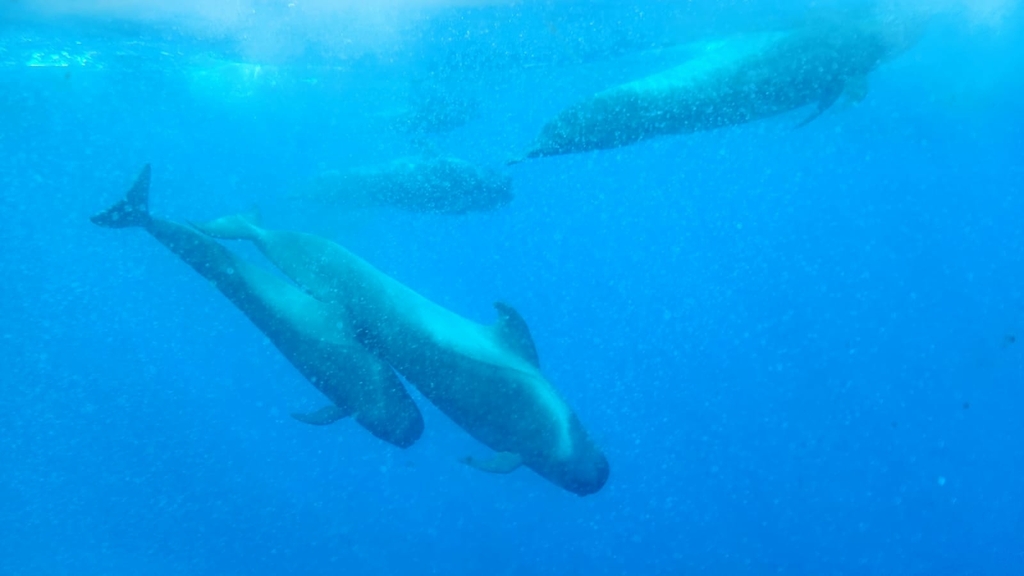
(c) ktslash, some rights reserved (CC BY) · licence
Family: Delphinidae · Class: Mammalia · Order: Artiodactyla
Globicephala macrorhynchus (Short-finned Pilot Whale) is a California animal in the Delphinidae family.
The short-finned pilot whale is a robust, medium-sized cetacean measuring 3.7 to 7.2 meters (12 to 24 feet) in length, with males significantly larger than females. Adults weigh between 1,000 to 4,000 kilograms (2,200 to 8,800 pounds). The species exhibits pronounced sexual dimorphism, with mature males developing a prominent, bulbous melon and broader dorsal fin. The body is predominantly dark gray to black, with a distinctive pale gray or white anchor-shaped patch on the throat and chest. A light gray saddle pattern may be present behind the dorsal fin. The dorsal fin is low, broad-based, and positioned forward on the body, typically measuring less than 40 centimeters (16 inches) in height. Short-finned pilot whales inhabit tropical and warm temperate waters worldwide. In the eastern North Pacific, they range from British Columbia to the equator, including California waters. The species is commonly observed in the Southern California Bight, particularly around the Channel Islands and offshore basins. They occur year-round in California waters, with seasonal movements following prey availability and oceanographic conditions. Populations demonstrate site fidelity to specific regions, with some individuals tracked returning to the same areas across multiple years. This pelagic species primarily inhabits deep oceanic waters beyond the continental shelf, typically in areas deeper than 1,000 meters (3,280 feet). Short-finned pilot whales prefer waters with steep bathymetric gradients, submarine canyons, and upwelling zones where prey concentrates. They occasionally venture into nearshore waters when following prey or during periods of warm water intrusion. The species shows strong association with specific water masses and temperature ranges between 16 to 30 degrees Celsius (61 to 86 degrees Fahrenheit). Short-finned pilot whales are highly social animals, forming stable matrilineal pods of 15 to 30 individuals, though larger aggregations of several hundred animals have been documented. Their diet consists primarily of squid, particularly species in deep scattering layers, supplemented by deep-water fish including lanternfish and hake. Foraging occurs primarily at night in association with the vertical migration of the deep scattering layer. Females reach sexual maturity at 7 to 12 years of age, with a gestation period of approximately 15 months. Calving intervals average 5 to 8 years, and calves may nurse for several years. The species demonstrates complex social behaviors including cooperative care of young and mass stranding events. Short-finned pilot whales are not federally listed under the Endangered Species Act and are not designated as a species of special concern in California. According to NOAA Fisheries, the species is protected under the Marine Mammal Protection Act, which prohibits harassment, hunting, capture, or killing. Current population estimates for the eastern North Pacific stock range from 26,000 to 30,000 individuals. Primary threats include entanglement in fishing gear, particularly drift gillnets and longlines, vessel strikes, pollution including plastic ingestion, and noise disturbance from shipping and military sonar. Climate change may affect prey distribution and abundance, potentially impacting foraging success and population dynamics.
Classification
Class: Mammalia · Order: Artiodactyla · Family: Delphinidae
Frequently asked questions
How is Globicephala macrorhynchus classified?
Globicephala macrorhynchus belongs to class Mammalia, order Artiodactyla, family Delphinidae.
What family does Globicephala macrorhynchus belong to?
Globicephala macrorhynchus is in the Delphinidae family.
What is Globicephala macrorhynchus?
The short-finned pilot whale is a robust, medium-sized cetacean measuring 3.7 to 7.2 meters (12 to 24 feet) in length, with males significantly larger than females.
Is Globicephala macrorhynchus found in California?
Yes. Globicephala macrorhynchus is recorded in California in The California Species Project's catalogue.
Related species
Other California species in the same genus, family, or bioregion.
Data from The California Species Project — 14,000+ California species with verified data from CNPS, CDFW, USFWS, and more.