Gluphisia lintneri
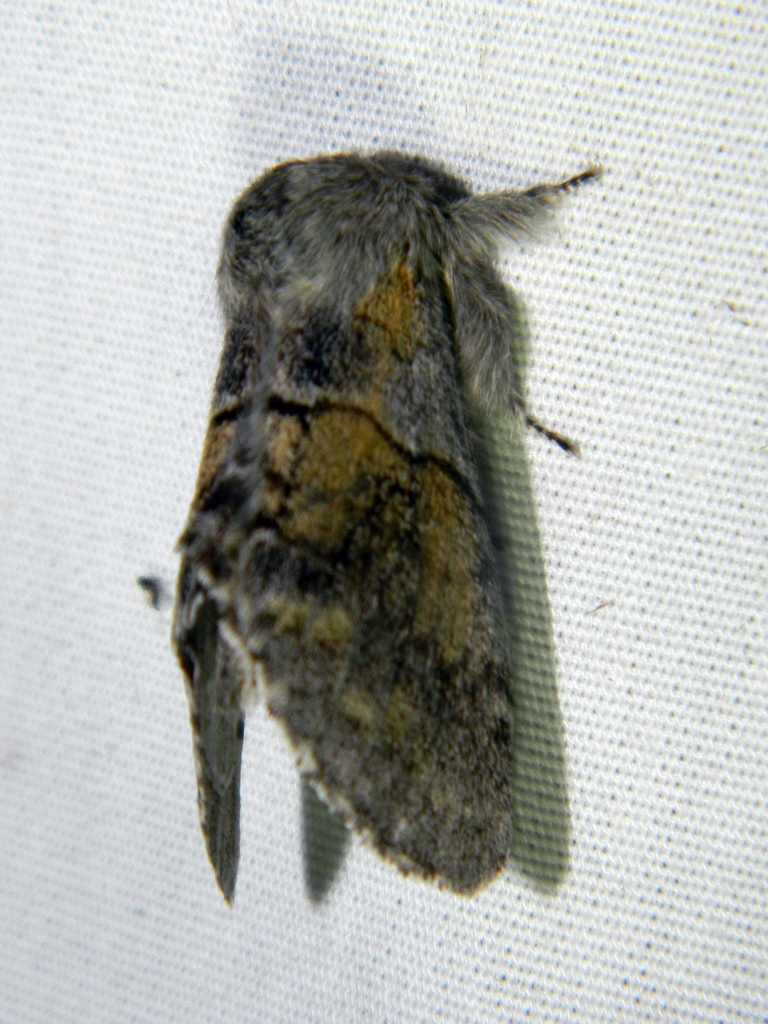
(c) Louis Imbeau, some rights reserved (CC BY) · licence
Family: Notodontidae · Class: Insecta · Order: Lepidoptera
Gluphisia lintneri is a California animal in the Notodontidae family.
Gluphisia lintneri is a medium-sized moth in the family Notodontidae, commonly known as prominent moths. Adults have a wingspan of approximately 30-40 mm (1.2-1.6 inches), with forewings displaying a mottled pattern of gray, brown, and white scales that provides effective camouflage against tree bark. The forewings typically show darker cross-lines and a distinctive white patch near the costa. The hindwings are pale gray to whitish with reduced markings. Males possess feathery antennae, while females have thread-like antennae. The thorax is robust and covered in dense, brownish scales. Gluphisia lintneri occurs across eastern North America, with its range extending from southern Canada south to northern Florida and west to the Great Plains. In the western United States, populations are found in scattered locations including parts of the Rocky Mountain region. The species appears to have a disjunct distribution, with isolated populations in mountainous areas of the western states. Records from California are limited and require verification, as the species is more commonly documented in eastern deciduous forests. The species inhabits deciduous and mixed forests, particularly areas dominated by poplar, aspen, and willow trees. Adults are typically found in forest edges, riparian corridors, and woodland clearings where host plants are abundant. The species shows a preference for cooler, moist environments and is often associated with higher elevation sites in its western range. Larvae develop on various Salicaceae, including Populus species (poplars and aspens) and Salix species (willows). Gluphisia lintneri is univoltine, producing one generation per year. Adults are active from late spring through early summer, typically flying from May through July depending on elevation and latitude. The species is nocturnal, with adults attracted to artificial lights during warm evenings. Females deposit eggs singly or in small clusters on host plant foliage. Larvae are solitary feeders that consume leaves of their host plants. The caterpillars are characterized by prominent dorsal humps, typical of the Notodontidae family. Mature larvae pupate in shallow underground chambers or leaf litter, overwintering as pupae. The conservation status of Gluphisia lintneri has not been formally assessed by federal or state agencies. Population trends are poorly documented due to limited systematic surveys of this nocturnal species. Like many forest-dependent moths, the species may face threats from habitat loss due to logging, urban development, and forest fragmentation. Climate change could potentially affect the species through alterations to forest composition and the distribution of host plants. The apparent rarity of records from some portions of its range suggests that populations may be naturally sparse or declining in certain areas. Additional research is needed to determine the species' current distribution, population status, and conservation needs, particularly in western states where records are scarce.
Classification
Class: Insecta · Order: Lepidoptera · Family: Notodontidae
Frequently asked questions
How is Gluphisia lintneri classified?
Gluphisia lintneri belongs to class Insecta, order Lepidoptera, family Notodontidae.
What family does Gluphisia lintneri belong to?
Gluphisia lintneri is in the Notodontidae family.
What is Gluphisia lintneri?
Gluphisia lintneri is a medium-sized moth in the family Notodontidae, commonly known as prominent moths.
Is Gluphisia lintneri found in California?
Yes. Gluphisia lintneri is recorded in California in The California Species Project's catalogue.
Related species
Other California species in the same genus, family, or bioregion.
Data from The California Species Project — 14,000+ California species with verified data from CNPS, CDFW, USFWS, and more.