Gluphisia wrightii
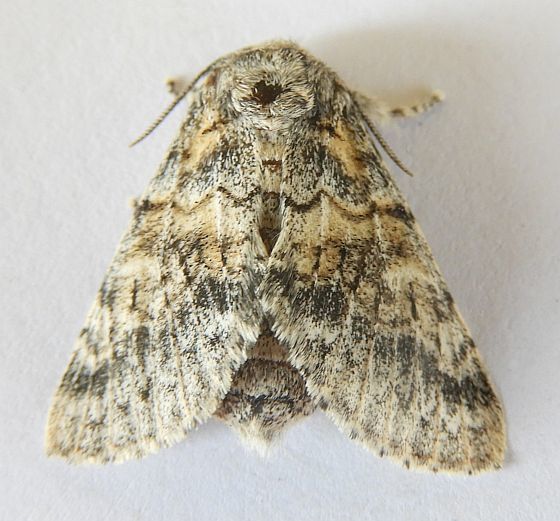
(c) jimeckert49, some rights reserved (CC BY) · licence
Family: Notodontidae · Class: Insecta · Order: Lepidoptera
Gluphisia wrightii is a California animal in the Notodontidae family.
Gluphisia wrightii is a moth species in the family Notodontidae, commonly known as the prominent moths. This species belongs to a group of medium-sized moths characterized by their cryptic coloration and distinctive wing patterns that provide effective camouflage against tree bark and woody substrates. Adult G. wrightii moths typically display muted earth tones, with forewings featuring complex patterns of browns, grays, and subtle darker markings. The forewings are elongated and narrow, typical of the Notodontidae family, while the hindwings are generally paler with reduced patterning. The body is robust and covered in dense scales, with antennae that are feathery in males and thread-like in females. Wing span measurements range from approximately 25 to 35 millimeters (1.0 to 1.4 inches), placing this species in the medium size category for North American Notodontidae. The distribution of G. wrightii appears to be primarily associated with western North American forests, though comprehensive range data remains limited in the scientific literature. The species likely occurs in montane and foothill regions where suitable host plants and habitat conditions are present, following distribution patterns typical of related Gluphisia species. Habitat preferences for G. wrightii include forested areas with deciduous trees, particularly those supporting the larval host plants. The species typically inhabits elevations ranging from foothill zones to mid-montane forests, where oak woodlands, mixed coniferous forests, and riparian corridors provide suitable microclimate conditions. Adults are attracted to areas with diverse plant communities that support both larval development and adult nectar sources. Like other Notodontidae species, G. wrightii undergoes complete metamorphosis with distinct egg, larval, pupal, and adult stages. Adults are primarily nocturnal, with flight periods likely occurring during late spring through mid-summer months, depending on elevation and local climate conditions. Larvae develop on host plants, where they feed on foliage before pupating in soil or leaf litter. The caterpillars typically display cryptic coloration and may exhibit defensive behaviors such as rearing up when disturbed, characteristic of many prominent moth species. Females deposit eggs singly or in small clusters on host plant foliage, with larval development spanning several weeks during the growing season. Overwintering likely occurs in the pupal stage, as is common among temperate Notodontidae species. The conservation status of G. wrightii has not been formally assessed by state or federal agencies, and the species lacks specific protection measures. Limited distributional and ecological data makes it difficult to evaluate population trends or identify specific conservation concerns. As with many lesser-known moth species, habitat loss through urbanization, altered fire regimes, and climate change may pose potential threats to local populations. The species would benefit from targeted surveys to better understand its distribution, host plant associations, and habitat requirements.
Classification
Class: Insecta · Order: Lepidoptera · Family: Notodontidae
Frequently asked questions
How is Gluphisia wrightii classified?
Gluphisia wrightii belongs to class Insecta, order Lepidoptera, family Notodontidae.
What family does Gluphisia wrightii belong to?
Gluphisia wrightii is in the Notodontidae family.
What is Gluphisia wrightii?
Gluphisia wrightii is a moth species in the family Notodontidae, commonly known as the prominent moths.
Is Gluphisia wrightii found in California?
Yes. Gluphisia wrightii is recorded in California in The California Species Project's catalogue.
Related species
Other California species in the same genus, family, or bioregion.
Data from The California Species Project — 14,000+ California species with verified data from CNPS, CDFW, USFWS, and more.