Gnophaela vermiculata
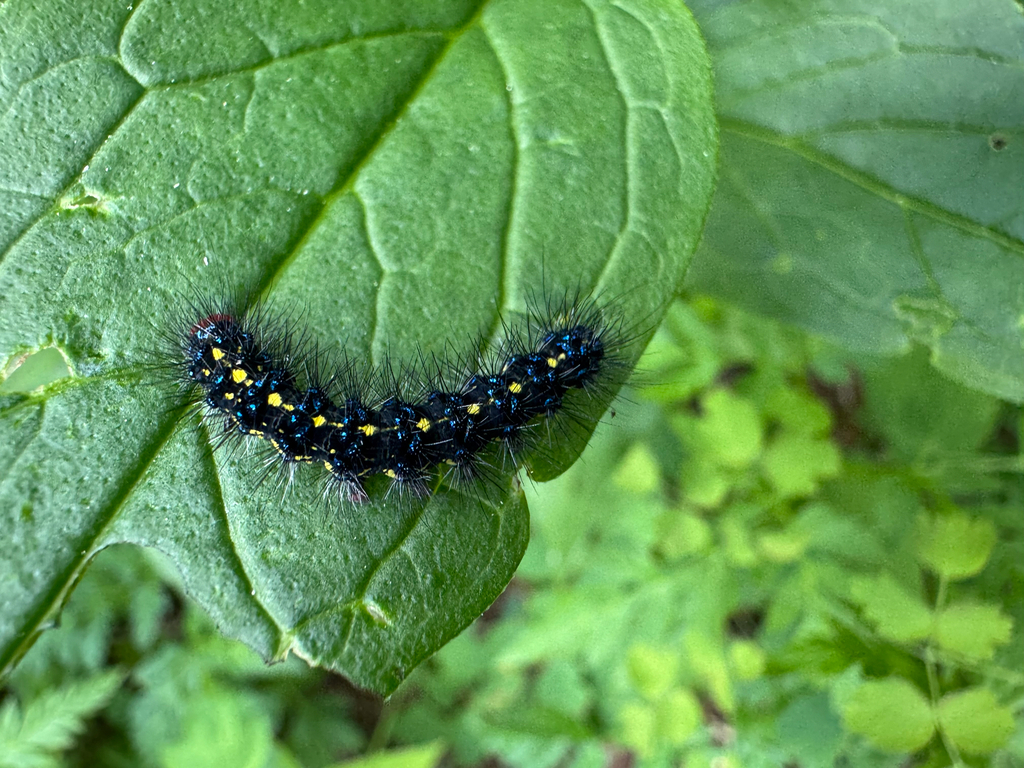
(c) Caleb Catto, some rights reserved (CC BY) · licence
Family: Erebidae · Class: Insecta · Order: Lepidoptera
Gnophaela vermiculata is a California animal in the Erebidae family.
Gnophaela vermiculata, commonly known as the Police Car Moth, is a distinctive day-flying moth in the family Erebidae. Adults have a wingspan of 35-45 mm (1.4-1.8 inches), with striking black wings marked by metallic blue-green iridescent patches and white spots. The forewings display prominent white markings that create a pattern resembling police car markings, giving the species its common name. The hindwings are similarly patterned but smaller. The body is robust and black with metallic blue-green reflections. Unlike most moths, this species is active during daylight hours and can be easily mistaken for a butterfly due to its flight pattern and coloration. Gnophaela vermiculata occurs across western North America, ranging from British Columbia south through California and east to Colorado and New Mexico. In California, the species is found primarily in mountainous regions of the Sierra Nevada, Cascade Range, and coastal mountains. Populations occur at elevations from approximately 1,200 to 3,000 meters (4,000 to 10,000 feet), with records from counties including Shasta, Plumas, El Dorado, Tuolumne, and Fresno. The species inhabits coniferous and mixed forests, particularly areas with Douglas fir, true firs, and pine. Adults are commonly observed in forest clearings, meadows, and along forest edges where wildflowers are abundant. The moth shows a preference for areas with morning sun exposure and protection from strong winds. Habitat requirements include the presence of host plants and adequate nectar sources for adult feeding. Larvae feed on various plants in the family Rubiaceae, particularly bedstraw species (Galium spp.). The caterpillars are typically found on northern bedstraw (Galium boreale) and other related species that grow in forest understories. Adults are active from June through August, with peak flight activity in July. The species exhibits strong site fidelity, with adults often returning to the same meadows and clearings year after year. Males engage in territorial behavior, patrolling specific areas and investigating other flying insects. Adults feed on nectar from various wildflowers, showing preferences for composites, mints, and other flowers with accessible nectar. The species undergoes complete metamorphosis with one generation per year. Eggs are laid on or near host plants in late summer. Larvae overwinter and pupate in spring, emerging as adults in early to mid-summer. The day-flying behavior is unusual among moths in this family and may represent an adaptation to avoid nocturnal predators such as bats. Gnophaela vermiculata is not currently listed under state or federal conservation programs. The species appears stable across most of its range, though local populations may be affected by forest management practices and habitat fragmentation. Climate change could potentially impact high-elevation populations by altering the distribution of suitable forest habitat. The species' dependence on specific host plants and forest ecosystem integrity makes it potentially vulnerable to significant habitat modifications, though current population trends suggest the species remains secure throughout its range.
Classification
Class: Insecta · Order: Lepidoptera · Family: Erebidae
Frequently asked questions
How is Gnophaela vermiculata classified?
Gnophaela vermiculata belongs to class Insecta, order Lepidoptera, family Erebidae.
What family does Gnophaela vermiculata belong to?
Gnophaela vermiculata is in the Erebidae family.
What is Gnophaela vermiculata?
Gnophaela vermiculata, commonly known as the Police Car Moth, is a distinctive day-flying moth in the family Erebidae.
Is Gnophaela vermiculata found in California?
Yes. Gnophaela vermiculata is recorded in California in The California Species Project's catalogue.
Related species
Other California species in the same genus, family, or bioregion.
Data from The California Species Project — 14,000+ California species with verified data from CNPS, CDFW, USFWS, and more.