Gobiesox maeandricus
Northern Clingfish
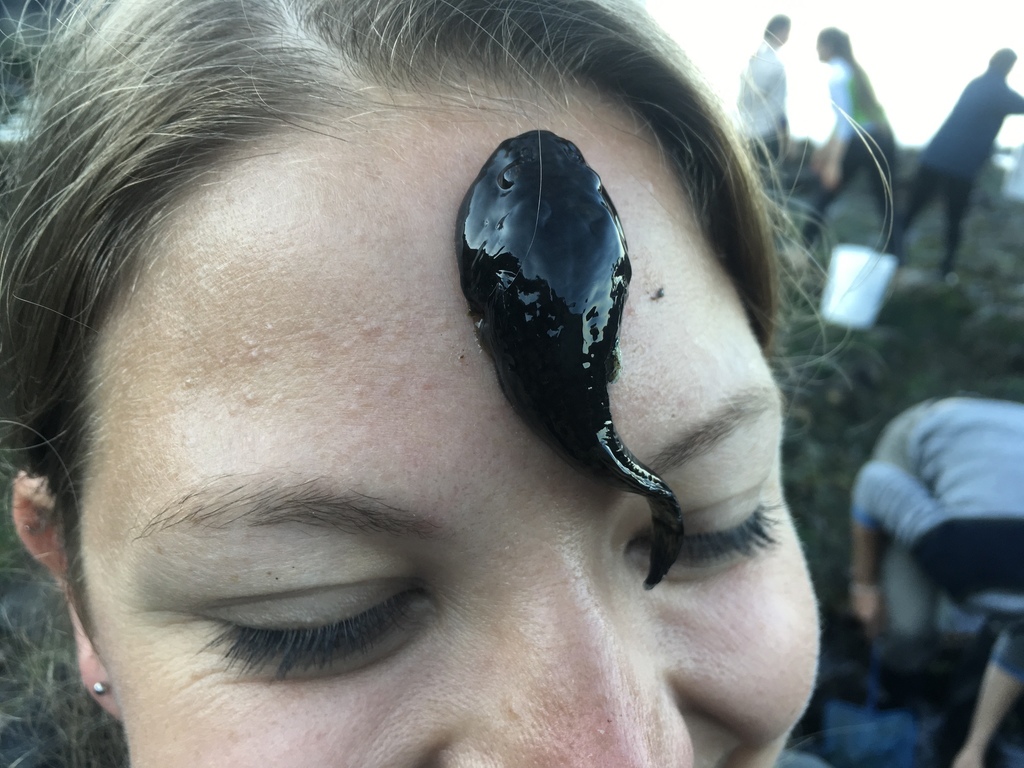
no rights reserved · CC0
Family: Gobiesocidae · Class: Actinopterygii · Order: Blenniiformes
Gobiesox maeandricus (Northern Clingfish) is a California animal in the Gobiesocidae family.
The Northern clingfish is a small marine fish endemic to the northeastern Pacific Ocean. Adults typically measure 6 to 15 centimeters (2.4 to 5.9 inches) in total length, with a robust, tadpole-like body form characteristic of the clingfish family. The species exhibits sexual dimorphism in coloration, with breeding males developing bright red to orange hues on the ventral surface and fins, while females and non-breeding males remain brownish-green with mottled patterns. The most distinctive feature is a large adhesive disc on the ventral surface, formed by modified pelvic fins, which allows the fish to cling firmly to rocky surfaces in high-energy wave environments. The Northern clingfish ranges along the Pacific coast from southeastern Alaska to central California, with the southern extent of its range reaching approximately Point Conception, Santa Barbara County. The species is most abundant in the cooler waters of northern California, Oregon, Washington, and British Columbia. Within California, populations occur along the rocky coastlines of Mendocino, Humboldt, and Del Norte counties, with occasional records extending south to Monterey County. This species inhabits rocky intertidal and shallow subtidal zones, typically at depths ranging from the low tide line to approximately 37 meters (120 feet). Northern clingfish prefer areas with high wave action and strong currents, where they use their adhesive disc to maintain position on rock surfaces, in crevices, and under boulders. They are commonly found in tidepools and among kelp holdfasts, particularly in areas dominated by coralline algae and encrusting invertebrates. The species shows strong site fidelity, often remaining in the same small area for extended periods. Northern clingfish are opportunistic carnivores that feed primarily on small invertebrates including amphipods, copepods, isopods, and small gastropods. Research in the Strait of Juan de Fuca documented postlarval specimens with nearly empty stomachs, suggesting feeding behavior may vary with life stage and season (Simenstad et al. 1977). The species exhibits complex reproductive behavior, with males establishing and defending small territories during the breeding season, typically from late spring through early fall. Females deposit adhesive eggs in protected crevices, which are subsequently guarded by males until hatching. Larvae are planktonic before settling to the benthos as juveniles. The Northern clingfish is not currently listed under state or federal endangered species legislation. According to NatureServe, the species maintains a global conservation rank of G4-G5, indicating it is apparently secure to secure across its range. The species' specialized habitat requirements make it potentially vulnerable to coastal development, pollution, and climate change impacts such as ocean acidification and warming temperatures. However, its occurrence in protected marine areas and rocky intertidal zones that are less suitable for development provides some natural protection. Population trends have not been systematically monitored, but the species appears stable throughout most of its range as of December 2025.
Classification
Class: Actinopterygii · Order: Blenniiformes · Family: Gobiesocidae
Frequently asked questions
How is Gobiesox maeandricus classified?
Gobiesox maeandricus belongs to class Actinopterygii, order Blenniiformes, family Gobiesocidae.
What family does Gobiesox maeandricus belong to?
Gobiesox maeandricus is in the Gobiesocidae family.
What is Gobiesox maeandricus?
The Northern clingfish is a small marine fish endemic to the northeastern Pacific Ocean.
Is Gobiesox maeandricus found in California?
Yes. Gobiesox maeandricus is recorded in California in The California Species Project's catalogue.
Related species
Other California species in the same genus, family, or bioregion.
Data from The California Species Project — 14,000+ California species with verified data from CNPS, CDFW, USFWS, and more.