Gonidea angulata
Western Ridged Mussel
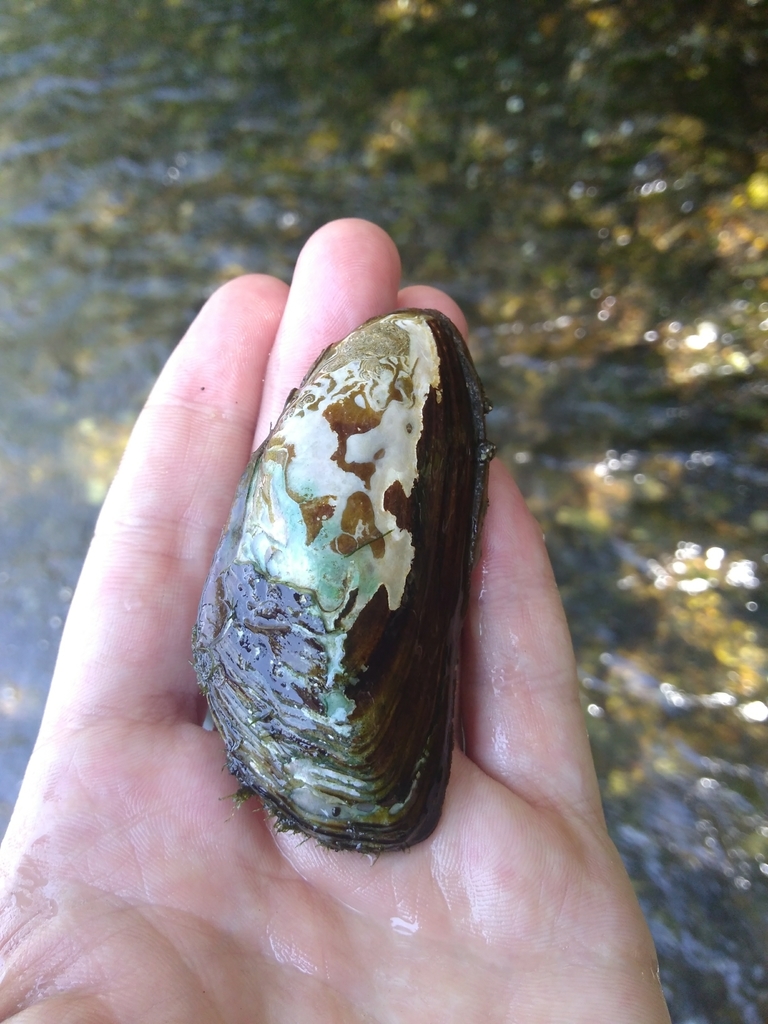
no rights reserved · CC0
Family: Unionidae · Class: Bivalvia · Order: Unionoida
Conservation status: G3 S2
Gonidea angulata (Western Ridged Mussel) is a California animal in the Unionidae family.
The western ridged mussel is the sole species within the genus Gonidea, making it unique among North American freshwater mussel fauna. Adults reach approximately 5 inches (127 mm) in length and display an obovate to trapezoidal shell shape that is slightly laterally compressed. The species is distinguished by a prominent angular ridge running from the beak to the basal portion of the posterior margin, with the ventral margin typically straight. The shell is notably heavier than other native northwestern mussels and possesses pseudocardinal teeth below the beak, a feature shared with only one other western species, Margaritifera falcata (Xerces Society 2012). Historically, the western ridged mussel occurred throughout river basins in California, Oregon, Washington, Idaho, Nevada, and British Columbia. The species once ranged as far south as San Diego County, California, but malacologists warned as early as 1912 that water management practices would lead to extirpation from southern California. Current distribution has contracted by 43% from historical range, with the species no longer found in rivers south of San Francisco Bay (USFWS 2024). The mussel remains present in portions of the Sacramento-San Joaquin system, Columbia River basin, and select coastal drainages. Western ridged mussels inhabit the bottom substrates of streams and rivers, requiring areas with low shear stress, stable substrates, and flow refuges for survival. The species occurs in both lentic and lotic environments, filtering phytoplankton and zooplankton suspended in the water column. Substrate stability and moderate flow conditions are critical habitat requirements, as high-velocity currents can dislodge individuals from their positions (Vannote & Minshall 1982). Like other native northwestern mussels, Gonidea angulata exhibits a complex life cycle involving a parasitic larval stage (glochidia) that requires specific fish hosts for development. The species demonstrates slow growth rates and exceptional longevity, with individuals potentially living 20 to 30 years (COSEWIC 2003). Adults function as filter feeders, processing substantial volumes of water daily and serving as natural biofilters that remove sediment, pollution, and pathogens from aquatic ecosystems. The western ridged mussel currently holds no federal protection under the U.S. Endangered Species Act, despite a 2020 petition for listing. The species maintains a Global rank of G3 (vulnerable) and California state rank of S2 (imperiled), reflecting significant conservation concern. In Canada, the species is listed as Special Concern under the Species at Risk Act, with proposals for reclassification to Endangered status. Primary threats include habitat modification through dam construction and water diversions, water quality degradation, sedimentation, and potential impacts from invasive species. The loss of suitable fish hosts due to declining salmon populations may further compromise reproductive success in some watersheds. Conservation efforts focus on habitat protection, water quality improvement, and maintaining natural flow regimes essential for mussel survival.
Classification
Class: Bivalvia · Order: Unionoida · Family: Unionidae
Conservation status
G3 S2
Frequently asked questions
How is Gonidea angulata classified?
Gonidea angulata belongs to class Bivalvia, order Unionoida, family Unionidae.
What family does Gonidea angulata belong to?
Gonidea angulata is in the Unionidae family.
Is Gonidea angulata protected or of conservation concern?
Gonidea angulata carries the following status: G3 S2.
What is Gonidea angulata?
The western ridged mussel is the sole species within the genus Gonidea, making it unique among North American freshwater mussel fauna.
Is Gonidea angulata found in California?
Yes. Gonidea angulata is recorded in California in The California Species Project's catalogue.
Related species
Other California species in the same genus, family, or bioregion.
Data from The California Species Project — 14,000+ California species with verified data from CNPS, CDFW, USFWS, and more.