Gopherus agassizii
Desert tortoise
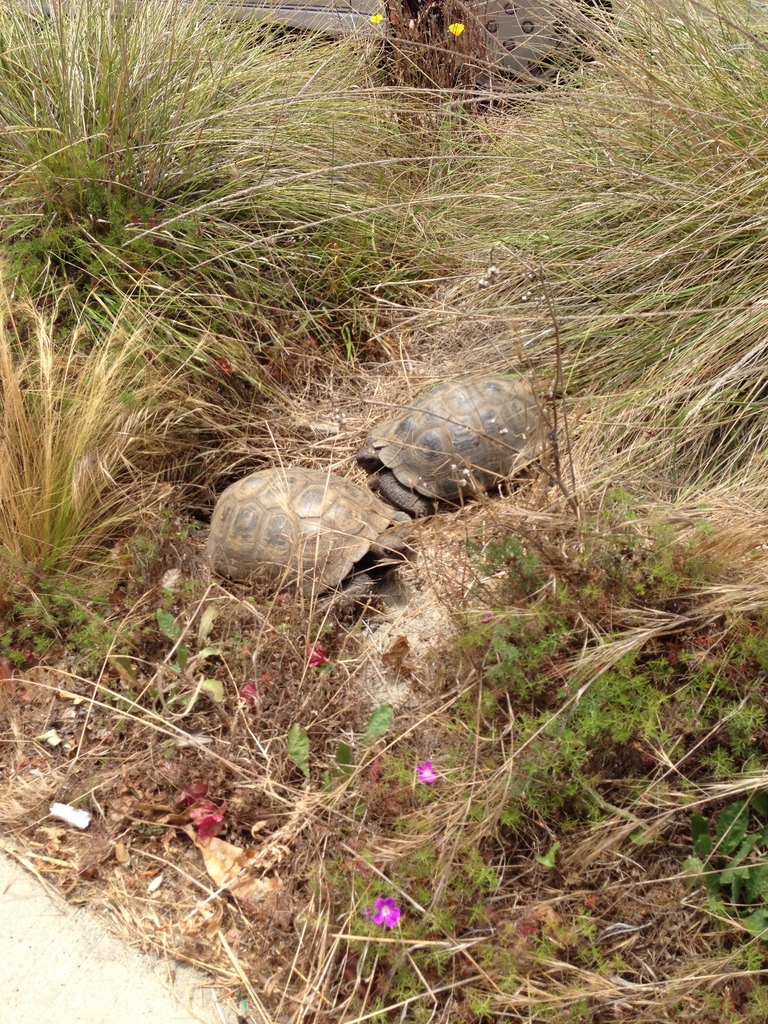
(c) Richard Smart (he, him, his), some rights reserved (CC BY) · licence
Family: Testudinidae · Class: Reptilia · Order: Testudines
Conservation status: SCE ST · Threatened · G3 S2S3
Gopherus agassizii (Desert tortoise) is a California animal in the Testudinidae family.
The desert tortoise is a large terrestrial reptile and California's official state reptile. Adults typically measure 20 to 36 centimeters (8 to 14 inches) in carapace length and weigh 3 to 7 kilograms (6.6 to 15.4 pounds). The high-domed carapace ranges from brown to gray-black, often with growth rings visible on each scute. The plastron is yellowish with dark markings along scute seams. Front legs are heavily scaled and flattened for digging, while hind legs are stumpy and elephantine. Males are distinguished by a longer gular horn projecting from the front of the plastron and a concave plastron. In California, desert tortoises inhabit portions of the Mojave Desert in San Bernardino, Riverside, Kern, Los Angeles, and Inyo counties. The species occurs from below sea level in Death Valley to elevations of approximately 1,070 meters (3,500 feet). Historically, populations extended throughout suitable habitat in the western Mojave Desert, but current distribution is fragmented and reduced from historical levels. Desert tortoises occupy creosote bush scrub, Joshua tree woodland, and mixed desert shrub communities. They require friable soils for burrow construction and diverse plant communities for foraging. Tortoises excavate burrows up to 10 meters (33 feet) long and 3 meters (10 feet) deep, which provide thermal refugia and protection from predators. These burrows maintain relatively constant temperatures and humidity levels critical for survival in extreme desert conditions. Desert tortoises are herbivorous, consuming grasses, forbs, cacti, and shrubs. Peak activity occurs during spring when annual plants are most abundant. The species exhibits temperature-dependent activity patterns, remaining active when soil temperatures range from 18 to 26 degrees Celsius (64 to 79 degrees Fahrenheit). Tortoises enter winter dormancy from October through March and may estivate during hot summer months. Sexual maturity occurs between 12 to 20 years of age. Females typically lay 2 to 14 eggs in sandy soils from April through July, with incubation lasting 90 to 120 days. The U.S. Fish and Wildlife Service listed the Mojave population of desert tortoise as threatened under the Endangered Species Act in 1990. California simultaneously listed the species as threatened under the California Endangered Species Act. According to USFWS, populations have declined by approximately 90 percent since the 1980s due to habitat loss, disease, predation, and human activities. Primary threats include urban development, off-road vehicle use, livestock grazing, renewable energy development, and upper respiratory tract disease. Ravens, subsidized by human activities, cause significant juvenile mortality through predation. Climate change poses additional threats through altered precipitation patterns and increased temperature extremes. Recovery efforts focus on habitat protection, disease management, raven control, and population monitoring through designated critical habitat and habitat conservation plans.
Classification
Class: Reptilia · Order: Testudines · Family: Testudinidae
Conservation status
SCE ST · Threatened · G3 S2S3
Frequently asked questions
How is Gopherus agassizii classified?
Gopherus agassizii belongs to class Reptilia, order Testudines, family Testudinidae.
What family does Gopherus agassizii belong to?
Gopherus agassizii is in the Testudinidae family.
Is Gopherus agassizii protected or of conservation concern?
Gopherus agassizii carries the following status: SCE ST · Threatened · G3 S2S3.
What is Gopherus agassizii?
The desert tortoise is a large terrestrial reptile and California's official state reptile.
Is Gopherus agassizii found in California?
Yes. Gopherus agassizii is recorded in California in The California Species Project's catalogue.
More California species
This species has no close relatives in our California data — here are other species to explore.
Data from The California Species Project — 14,000+ California species with verified data from CNPS, CDFW, USFWS, and more.