Grammia complicata
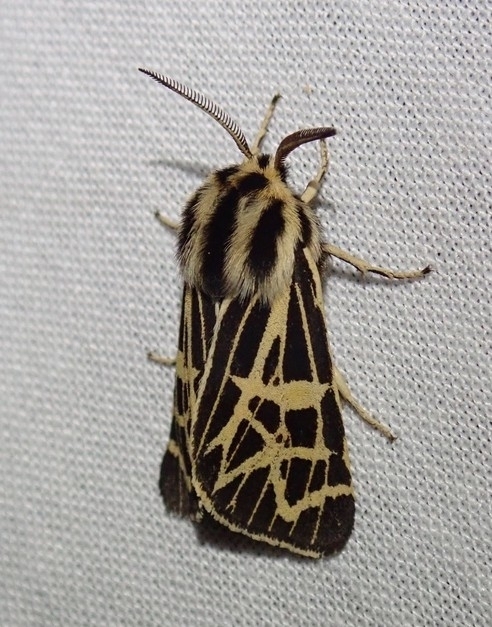
(c) Simone Littledale, some rights reserved (CC BY) · licence
Family: Erebidae · Class: Insecta · Order: Lepidoptera
Grammia complicata is a California animal in the Erebidae family.
Grammia complicata is a moth species in the family Erebidae, subfamily Arctiinae, commonly known as tiger moths. This species belongs to the genus Grammia, which comprises numerous North American arctiid moths characterized by distinctive wing patterns and coloration. Adult moths typically display the characteristic tiger moth morphology with robust bodies and broad wings, though specific measurements for G. complicata are not well-documented in the literature. The historical and current range of Grammia complicata in California remains poorly documented, with limited collection records available in museum databases and scientific literature. The species appears to have a restricted distribution within the state, though the exact geographic boundaries are unclear due to limited survey efforts and potential confusion with closely related Grammia species. Many Grammia moths have fragmented ranges in western North America, often associated with specific habitat types or elevational zones. Habitat requirements for Grammia complicata are not well-established, though related Grammia species typically inhabit areas with diverse herbaceous vegetation that support their larval host plants. Tiger moths in this genus often occur in grasslands, meadows, shrublands, and forest openings where their caterpillars can access suitable food sources. The elevation range and specific microhabitat preferences for G. complicata remain undocumented, representing a significant knowledge gap for this species. The larval stage, like other Grammia species, likely feeds on a variety of herbaceous plants, though specific host plant relationships for G. complicata have not been definitively established. Grammia caterpillars are typically generalist feeders that consume leaves of various forbs and low-growing plants. Adult moths are presumed to be active during warmer months, with flight periods likely occurring from late spring through early fall, consistent with patterns observed in related species. Mating behavior, egg-laying preferences, and overwintering strategies for G. complicata are not documented in available literature. The conservation status of Grammia complicata is uncertain due to limited data on distribution, population trends, and ecological requirements. The species does not appear on federal or state endangered species lists, nor does it have a formal conservation ranking from NatureServe or other conservation organizations. This absence from conservation assessments likely reflects insufficient biological and distributional data rather than confirmed population stability. The lack of recent collection records and taxonomic uncertainty surrounding some Grammia species complicate efforts to assess conservation needs. Primary information gaps include basic life history data, habitat associations, host plant relationships, and current distribution patterns. Without adequate baseline information, it is difficult to identify potential threats or develop appropriate conservation strategies. Climate change, habitat loss, and pesticide use could pose risks to G. complicata populations, as these factors affect many moth species, but species-specific vulnerability assessments are not possible given current knowledge limitations. Further taxonomic work and targeted surveys are needed to clarify the status and conservation requirements of this poorly known California moth species.
Classification
Class: Insecta · Order: Lepidoptera · Family: Erebidae
Frequently asked questions
How is Grammia complicata classified?
Grammia complicata belongs to class Insecta, order Lepidoptera, family Erebidae.
What family does Grammia complicata belong to?
Grammia complicata is in the Erebidae family.
What is Grammia complicata?
Grammia complicata is a moth species in the family Erebidae, subfamily Arctiinae, commonly known as tiger moths.
Is Grammia complicata found in California?
Yes. Grammia complicata is recorded in California in The California Species Project's catalogue.
Related species
Other California species in the same genus, family, or bioregion.
Data from The California Species Project — 14,000+ California species with verified data from CNPS, CDFW, USFWS, and more.