Grammia ornata
Ornate Tiger Moth
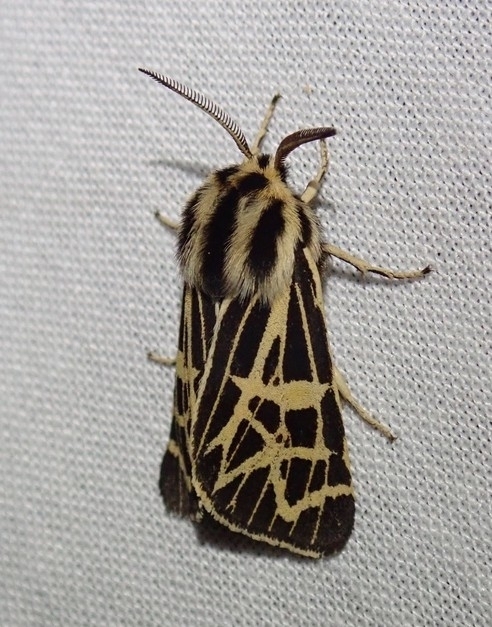
(c) Simone Littledale, some rights reserved (CC BY) · licence
Family: Erebidae · Class: Insecta · Order: Lepidoptera
Grammia ornata (Ornate Tiger Moth) is a California animal in the Erebidae family.
The ornate tiger moth is a member of the family Erebidae, described by Packard in 1864. This species exhibits the characteristic tiger moth pattern with contrasting wing coloration, though specific morphological details require further documentation in the scientific literature. Grammia ornata occurs across a broad range in western North America, from southern British Columbia through the Pacific Northwest to southern California, extending eastward to northern Utah, western Wyoming, and Montana (iNaturalist). The species' distribution spans multiple biogeographic regions, indicating considerable ecological adaptability across diverse western landscapes. The ornate tiger moth occupies a wide range of habitats, including open woodland environments (iNaturalist). This habitat flexibility suggests the species can utilize various plant communities and elevation zones throughout its range. However, specific microhabitat requirements, preferred vegetation associations, and elevation ranges have not been well documented in available literature. Like other tiger moths in the genus Grammia, this species likely follows a typical erebid life cycle with egg, larval, pupal, and adult stages. The larval stage presumably feeds on herbaceous plants, as is common among tiger moths, though specific host plant relationships have not been definitively established for this species. Adult flight periods, mating behaviors, overwintering strategies, and generation timing require further scientific investigation. Taxonomic relationships within the Grammia complex remain subjects of ongoing research. NatureServe notes that related species Grammia hewletti and G. complicata have been treated variably as separate species from G. ornata or as subspecies, though Schmidt (2009) retained them as distinct species. This taxonomic uncertainty reflects the broader challenges in defining species boundaries within tiger moth groups, where morphological variation and potential hybridization complicate systematic relationships. The conservation status of Grammia ornata has not been formally assessed by federal or state agencies. The species lacks federal listing status and does not appear on California's sensitive species lists. Population trends, abundance estimates, and specific conservation threats remain undocumented in available sources. The broad geographic range and apparent habitat flexibility may provide some resilience against localized disturbances, though this assessment requires empirical validation. Primary knowledge gaps for this species include detailed morphological descriptions, host plant relationships, seasonal phenology, population demographics, and ecological interactions. The wide distribution suggests the species encounters diverse environmental conditions and potential threats across its range, from urban development in California to habitat fragmentation in the Pacific Northwest. Scientific documentation for this species remains limited. The information presented here is based on available sources including iNaturalist observations and NatureServe records. If you have additional verified information about this species' biology, distribution, or ecology, please contact us to help improve this species account.
Classification
Class: Insecta · Order: Lepidoptera · Family: Erebidae
Frequently asked questions
How is Grammia ornata classified?
Grammia ornata belongs to class Insecta, order Lepidoptera, family Erebidae.
What family does Grammia ornata belong to?
Grammia ornata is in the Erebidae family.
What is Grammia ornata?
The ornate tiger moth is a member of the family Erebidae, described by Packard in 1864.
Is Grammia ornata found in California?
Yes. Grammia ornata is recorded in California in The California Species Project's catalogue.
Related species
Other California species in the same genus, family, or bioregion.
Data from The California Species Project — 14,000+ California species with verified data from CNPS, CDFW, USFWS, and more.