Graphocephala atropunctata
Blue-green Sharpshooter
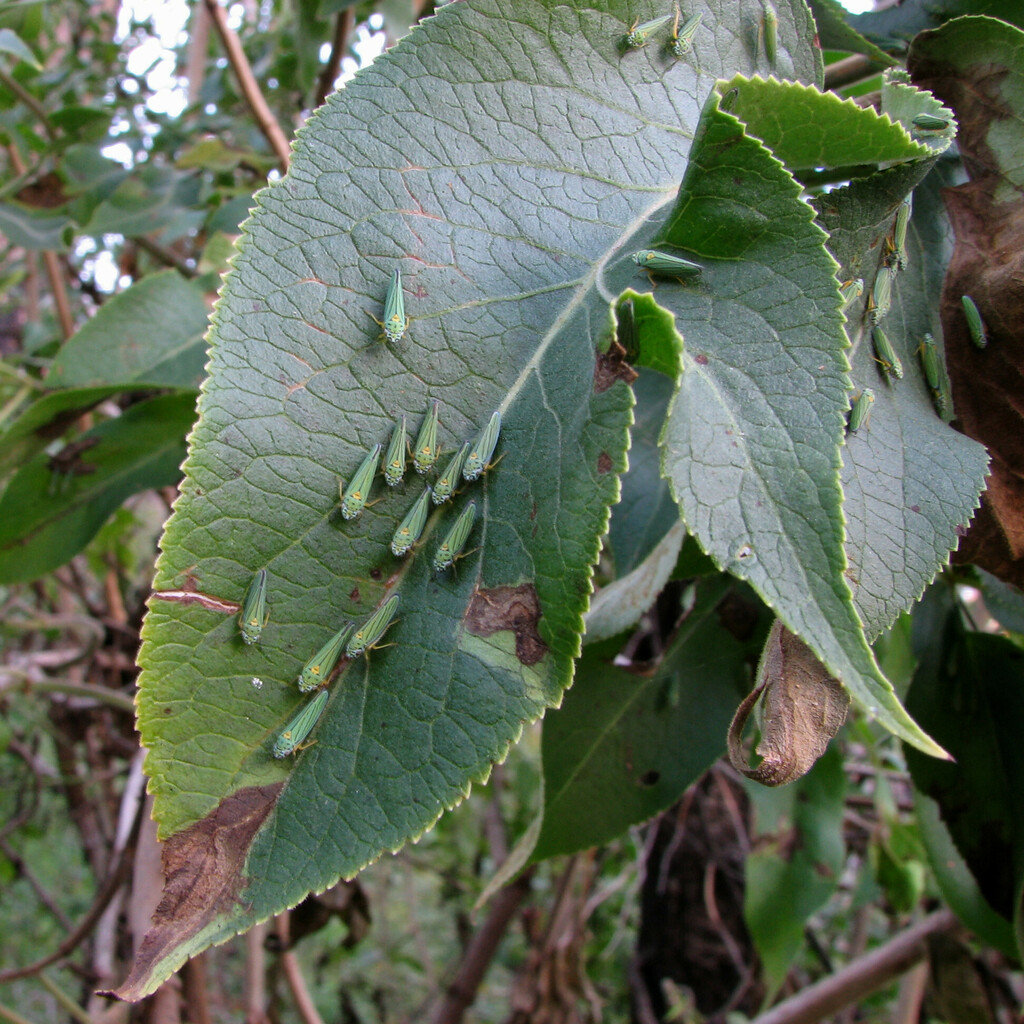
(c) Katja Schulz, some rights reserved (CC BY) · licence
Family: Cicadellidae · Class: Insecta · Order: Hemiptera
Graphocephala atropunctata (Blue-green Sharpshooter) is a California animal in the Cicadellidae family.
The blue-green sharpshooter (Graphocephala atropunctata) is a small leafhopper in the family Cicadellidae, subfamily Cicadellinae. Adults measure approximately 6-8 mm in length with a distinctive bright metallic blue-green coloration on the head and thorax, contrasting with yellow to pale green wing covers. The species exhibits sexual dimorphism, with males displaying more vibrant blue-green hues while females tend toward pale to bright yellow coloration (BugGuide 2020). Nymphs are white to pale yellow with yellow markings on the abdomen that develop with age. The blue-green sharpshooter is widespread throughout the western United States, with populations recorded from California north to British Columbia and extending through Mexico and Central America, though southern populations may represent a separate cryptic species (BugGuide 2020). In California, the species occurs from sea level to montane elevations, with genetic structure studies revealing distinct population patterns across the state's natural range (Ballman et al. 2011). This species typically inhabits humid riparian areas but demonstrates significant habitat flexibility, occurring in a wide range of environments including agricultural landscapes, urban gardens, and various plant communities (BugGuide 2020). The blue-green sharpshooter shows particular association with woody and herbaceous vegetation in moist conditions, where it finds suitable host plants for feeding and reproduction. As a phloem-feeding insect, the blue-green sharpshooter uses its piercing-sucking mouthparts to extract plant juices from a broad range of host plants. The species is polyphagous, feeding on numerous plant families including both native and introduced species. Adults are active throughout much of the year in suitable climates, with peak activity during warmer months. Like other sharpshooters, this species can vector plant pathogens, though it is generally considered less economically significant than related species such as the glassy-winged sharpshooter. The blue-green sharpshooter holds particular agricultural significance in California's vineyard regions, where it has been identified as a local vineyard pest capable of transmitting Pierce's disease, a bacterial infection fatal to grapevines (Xerces Society 2018). Unlike the more notorious glassy-winged sharpshooter, the blue-green sharpshooter's impact on viticulture is generally considered moderate. However, its presence in agricultural systems requires monitoring, particularly in integrated pest management programs that balance pest control with pollinator conservation. Currently, the blue-green sharpshooter holds no special conservation status and appears to maintain stable populations throughout its range. Its adaptability to various habitats and broad host plant range contribute to its ecological success. The species' widespread distribution and apparent population stability suggest it faces no immediate conservation concerns. Research continues on the genetic structure of populations and their relationship to potentially cryptic southern species, which may have implications for understanding the full extent of this species' range and taxonomic identity.
Classification
Class: Insecta · Order: Hemiptera · Family: Cicadellidae
Frequently asked questions
How is Graphocephala atropunctata classified?
Graphocephala atropunctata belongs to class Insecta, order Hemiptera, family Cicadellidae.
What family does Graphocephala atropunctata belong to?
Graphocephala atropunctata is in the Cicadellidae family.
What is Graphocephala atropunctata?
The blue-green sharpshooter (Graphocephala atropunctata) is a small leafhopper in the family Cicadellidae, subfamily Cicadellinae.
Is Graphocephala atropunctata found in California?
Yes. Graphocephala atropunctata is recorded in California in The California Species Project's catalogue.
Related species
Other California species in the same genus, family, or bioregion.
Data from The California Species Project — 14,000+ California species with verified data from CNPS, CDFW, USFWS, and more.