Gulo gulo
Wolverine
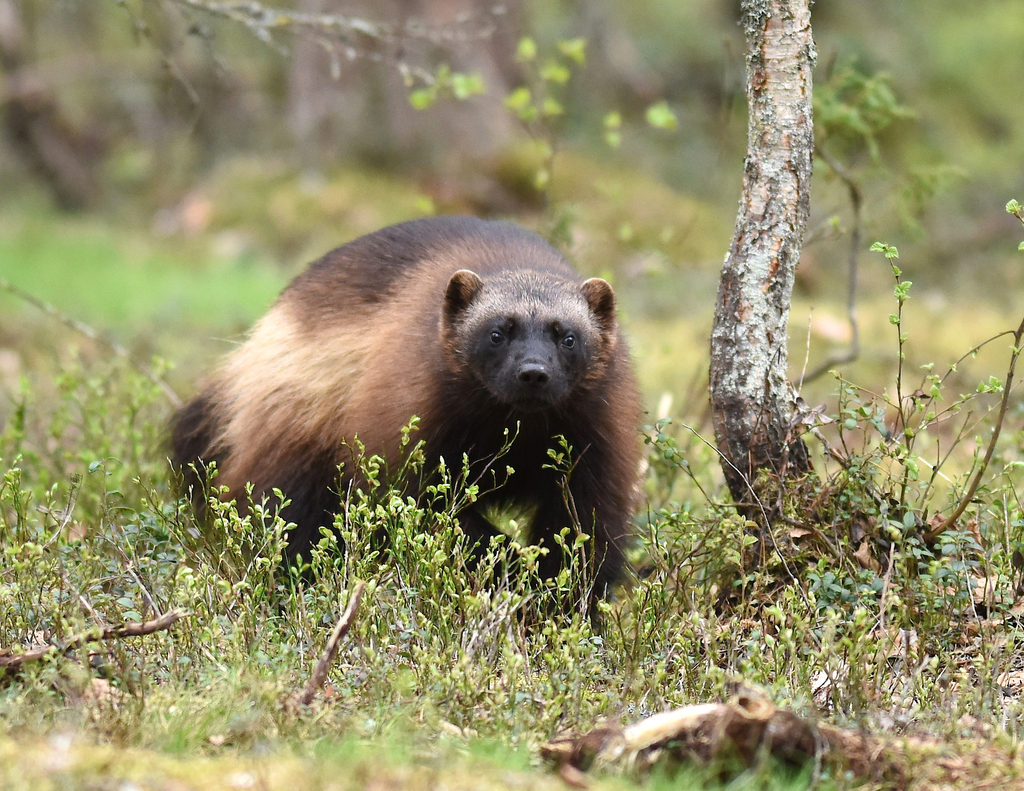
(c) Dennis Vollmar, some rights reserved (CC BY) · licence
Family: Mustelidae · Class: Mammalia · Order: Carnivora
Conservation status: FP · Threatened · G4 S1
Gulo gulo (Wolverine) is a California animal in the Mustelidae family.
The wolverine is the largest terrestrial member of the weasel family, with males weighing 12 to 18 kilograms (26 to 40 pounds) and females weighing 8 to 12 kilograms (18 to 26 pounds). Adults measure 65 to 87 centimeters (26 to 34 inches) in body length with a bushy tail adding another 17 to 26 centimeters. The species displays dense, dark brown to blackish fur with distinctive pale yellowish-brown stripes extending from the shoulders to the base of the tail along each side. The broad head features small eyes, rounded ears, and powerful jaws equipped with specialized teeth adapted for crushing bones and frozen meat. Historically, wolverines ranged throughout the Sierra Nevada and Cascade Range in California, with populations documented in the northern Coast Ranges. The species was extirpated from California by the 1920s due to trapping and habitat loss. In 2008, a single male wolverine was detected in the Tahoe National Forest, marking the first confirmed presence in the state in over 80 years. This individual, designated M56, was tracked via GPS collar until 2018. In 2023, researchers confirmed the presence of a second wolverine in California's Sierra Nevada, suggesting potential natural recolonization from northern populations. Wolverines require large territories encompassing high-elevation wilderness areas with persistent snow cover. In California, suitable habitat occurs primarily above 2,400 meters (8,000 feet) elevation in subalpine and alpine zones of the Sierra Nevada. The species depends on spring snow persistence for denning, typically selecting sites with snow depth exceeding 1.5 meters that remain until late May. Wolverines utilize avalanche chutes, boulder fields, and dense coniferous forests dominated by whitebark pine, mountain hemlock, and subalpine fir. Wolverines are solitary carnivores with enormous home ranges spanning 200 to 800 square kilometers for males and 50 to 350 square kilometers for females. They are powerful scavengers capable of detecting carrion beneath several meters of snow, but also hunt small mammals, birds, and occasionally prey on ungulate calves. Breeding occurs from May through August, with delayed implantation resulting in births the following February through April. Females produce litters of one to five kits in snow dens, with young remaining dependent for 12 to 18 months. The U.S. Fish and Wildlife Service listed the North American wolverine as threatened under the Endangered Species Act in 2023, citing climate change as the primary threat. Rising temperatures reduce snow persistence essential for successful reproduction. In California, the species is listed as threatened and designated as a Fully Protected species, prohibiting take except for scientific research. The California Department of Fish and Wildlife estimates that fewer than 300 wolverines remain in the contiguous United States, with the California population consisting of potentially one to two individuals. Recovery efforts focus on habitat protection, climate change mitigation, and monitoring natural recolonization from stable populations in Montana, Idaho, and Washington.
Classification
Class: Mammalia · Order: Carnivora · Family: Mustelidae
Conservation status
FP · Threatened · G4 S1
Frequently asked questions
How is Gulo gulo classified?
Gulo gulo belongs to class Mammalia, order Carnivora, family Mustelidae.
What family does Gulo gulo belong to?
Gulo gulo is in the Mustelidae family.
Is Gulo gulo protected or of conservation concern?
Gulo gulo carries the following status: FP · Threatened · G4 S1.
What is Gulo gulo?
The wolverine is the largest terrestrial member of the weasel family, with males weighing 12 to 18 kilograms (26 to 40 pounds) and females weighing 8 to 12 kilograms (18 to 26 pounds).
Is Gulo gulo found in California?
Yes. Gulo gulo is recorded in California in The California Species Project's catalogue.
Related species
Other California species in the same genus, family, or bioregion.
Data from The California Species Project — 14,000+ California species with verified data from CNPS, CDFW, USFWS, and more.