Gymnogyps californianus
California condor
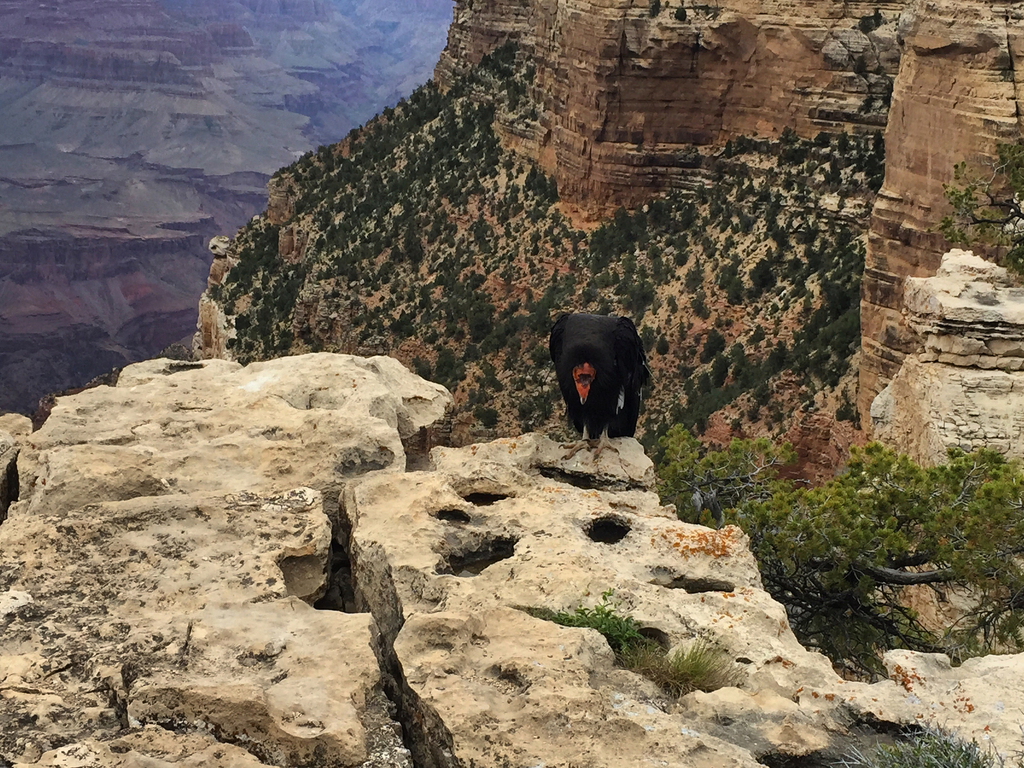
(c) Marcus Rosten, some rights reserved (CC BY) · licence
Family: Cathartidae · Class: Aves · Order: Cathartiformes
Conservation status: FP · Endangered · G1 S2
Gymnogyps californianus (California condor) is a California animal in the Cathartidae family.
The California condor is North America's largest flying land bird, with adults measuring 117 to 134 cm (46 to 53 inches) in length and weighing 7 to 14 kg (15 to 31 pounds). The wingspan reaches 2.7 to 3.0 meters (8.9 to 9.8 feet). Adults display black plumage with white triangular patches under the wings and a distinctive bare head and neck that ranges from orange to red in mature birds. Juveniles have darker heads that gradually transition to the adult coloration over several years. The species possesses a large, hooked beak adapted for tearing carrion and broad wings designed for soaring flight. Historically, California condors ranged from British Columbia to Baja California and east to Arizona and New Mexico. By the 1980s, the wild population was confined to a small area in southern California. Current populations exist in California, Arizona, Nevada, and Utah through reintroduction efforts. In California, condors inhabit coastal ranges, the Central Valley, and the Sierra Nevada foothills. The Arizona population primarily occupies the Grand Canyon region and surrounding areas, while smaller populations exist in southern Utah and Nevada. California condors inhabit diverse terrain including oak woodlands, chaparral, grasslands, and coniferous forests at elevations ranging from sea level to 4,600 meters (15,000 feet). The species requires large territories with suitable roosting sites such as tall trees or cliff faces, and open areas for foraging. Condors utilize thermal air currents for energy-efficient soaring flight across vast distances while searching for carrion. California condors are obligate scavengers, feeding exclusively on carrion from marine mammals, deer, cattle, and other large animals. Their powerful digestive systems can process decomposed meat that would be toxic to other species. Condors are highly social, often feeding in groups and engaging in complex social behaviors at communal roosts. The species exhibits delayed sexual maturity, not breeding until 5 to 8 years of age. Pairs typically produce a single egg every two years, with incubation lasting approximately 58 days. Both parents participate in rearing the chick, which remains dependent on adults for up to two years. The California condor was listed as federally endangered in 1967 and became one of the world's rarest birds. By 1987, only 27 individuals remained, prompting capture of all wild birds for captive breeding. According to the U.S. Fish and Wildlife Service, as of December 2024, the total population includes approximately 561 birds, with about 344 flying free in California, Arizona, Utah, and Nevada. The remainder are maintained in captive breeding facilities. Primary threats include lead poisoning from ammunition fragments in carcasses, habitat loss, power line collisions, and microtrash ingestion. Recovery efforts focus on captive breeding, release programs, lead ammunition reduction, and habitat protection. The species remains critically dependent on intensive management for survival.
Classification
Class: Aves · Order: Cathartiformes · Family: Cathartidae
Conservation status
FP · Endangered · G1 S2
Frequently asked questions
How is Gymnogyps californianus classified?
Gymnogyps californianus belongs to class Aves, order Cathartiformes, family Cathartidae.
What family does Gymnogyps californianus belong to?
Gymnogyps californianus is in the Cathartidae family.
Is Gymnogyps californianus protected or of conservation concern?
Gymnogyps californianus carries the following status: FP · Endangered · G1 S2.
What is Gymnogyps californianus?
The California condor is North America's largest flying land bird, with adults measuring 117 to 134 cm (46 to 53 inches) in length and weighing 7 to 14 kg (15 to 31 pounds).
Is Gymnogyps californianus found in California?
Yes. Gymnogyps californianus is recorded in California in The California Species Project's catalogue.
Related species
Other California species in the same genus, family, or bioregion.
Data from The California Species Project — 14,000+ California species with verified data from CNPS, CDFW, USFWS, and more.