Gymnorhinus cyanocephalus
Pinyon Jay
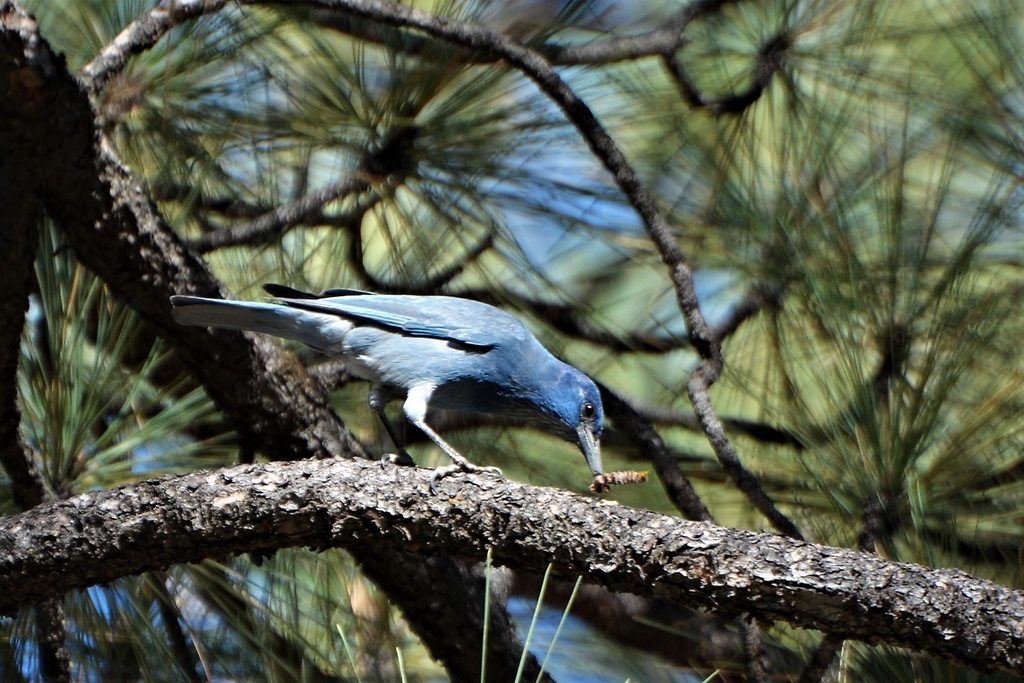
(c) Diego Maldonado de la Torre, some rights reserved (CC BY) · licence
Family: Corvidae · Class: Aves · Order: Passeriformes
Gymnorhinus cyanocephalus (Pinyon Jay) is a California animal in the Corvidae family.
The Pinyon Jay is a distinctive medium-sized corvid measuring 24 to 29 centimeters (9.4 to 11.4 inches) in length with a wingspan of 43 to 46 centimeters (17 to 18 inches). Adults weigh between 85 to 120 grams (3 to 4.2 ounces). The species exhibits minimal sexual dimorphism, with both sexes displaying grayish-blue plumage that is darker on the head, wings, and tail. The bill is relatively long and pointed compared to other jays, adapted for extracting seeds from pine cones. Juveniles appear duller with more grayish coloration. Pinyon Jays historically ranged throughout the Great Basin and intermountain regions of western North America, including portions of eastern California. In California, the species occurs primarily in the eastern Sierra Nevada, Modoc Plateau, and scattered locations in the Transverse and Peninsular Ranges. Their range has contracted significantly over recent decades, with many historical populations no longer present. The species inhabits pinyon-juniper woodlands, typically at elevations between 1,200 to 2,400 meters (4,000 to 8,000 feet). Pinyon Jays show strong association with pinyon pine (Pinus monophylla and Pinus edulis) forests, though they also utilize ponderosa pine, Jeffrey pine, and mixed conifer habitats. They require open canopy conditions with scattered trees for foraging and nesting, often in areas with 10 to 40 percent tree cover. Pinyon Jays are highly social, living in permanent flocks of 50 to 500 individuals year-round. They exhibit cooperative breeding behavior and maintain complex social hierarchies. The species is specialized for harvesting and caching pine seeds, particularly pinyon pine nuts, which comprise up to 90 percent of their annual diet. Individual birds can cache up to 20,000 seeds annually, demonstrating exceptional spatial memory capabilities for relocating stored food. Breeding occurs from February through May, with females laying 3 to 5 eggs in stick nests built in pine trees. The species exhibits irregular nomadic movements following pine cone crop failures. Although not federally listed, Pinyon Jays have experienced substantial population declines across their range. According to the North American Breeding Bird Survey, populations declined by approximately 85 percent between 1970 and 2014. Partners in Flight estimates the global population at fewer than 4 million individuals, down from historical estimates of 15 to 20 million. In 2023, the U.S. Fish and Wildlife Service initiated a status review following a petition for Endangered Species Act listing. Primary threats include habitat loss from development, wildfire suppression altering natural fire regimes, woodland expansion reducing suitable open habitat, climate change affecting pinyon pine productivity, and West Nile virus mortality. Conservation efforts focus on habitat restoration, prescribed burning to maintain open woodland conditions, and monitoring remaining populations to assess population trends and habitat requirements.
Classification
Class: Aves · Order: Passeriformes · Family: Corvidae
Frequently asked questions
How is Gymnorhinus cyanocephalus classified?
Gymnorhinus cyanocephalus belongs to class Aves, order Passeriformes, family Corvidae.
What family does Gymnorhinus cyanocephalus belong to?
Gymnorhinus cyanocephalus is in the Corvidae family.
What is Gymnorhinus cyanocephalus?
The Pinyon Jay is a distinctive medium-sized corvid measuring 24 to 29 centimeters (9.4 to 11.4 inches) in length with a wingspan of 43 to 46 centimeters (17 to 18 inches).
Is Gymnorhinus cyanocephalus found in California?
Yes. Gymnorhinus cyanocephalus is recorded in California in The California Species Project's catalogue.
Related species
Other California species in the same genus, family, or bioregion.
Data from The California Species Project — 14,000+ California species with verified data from CNPS, CDFW, USFWS, and more.