Gymnothorax mordax
California Moray
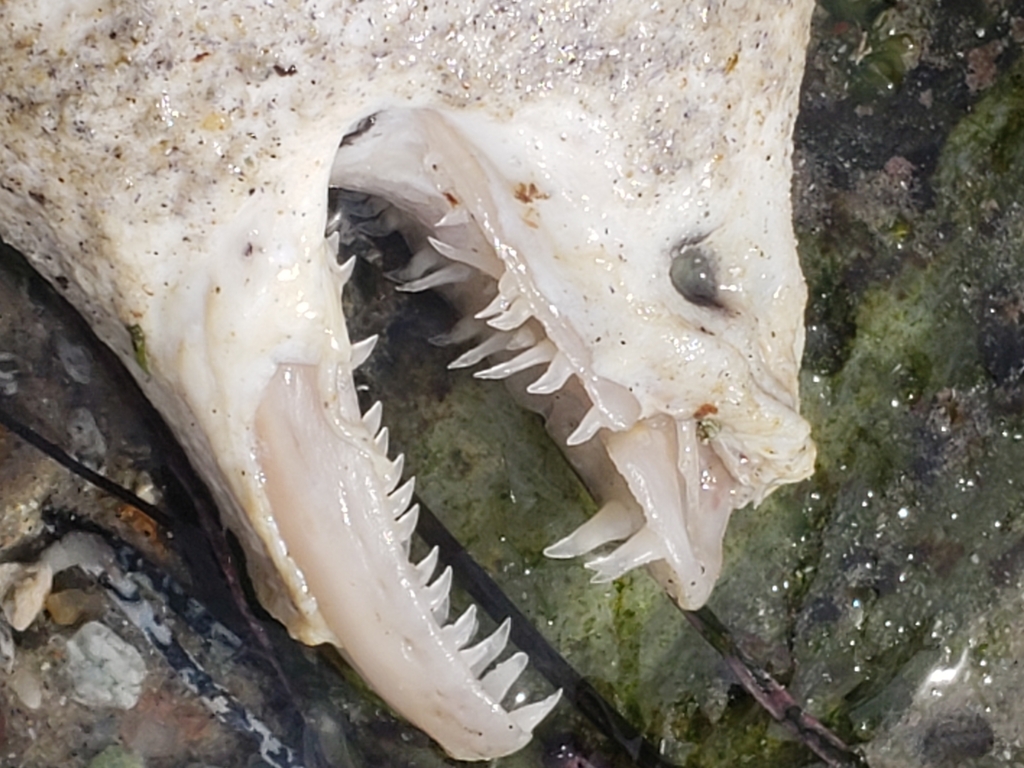
(c) Steve Addison, some rights reserved (CC BY) · licence
Family: Muraenidae · Class: Actinopterygii · Order: Anguilliformes
Gymnothorax mordax (California Moray) is a California animal in the Muraenidae family.
The California moray (Gymnothorax mordax) is a large, eel-like marine fish belonging to the family Muraenidae. Adults can reach lengths up to 152 cm (5 feet), with a distinctive snake-like body lacking pectoral and pelvic fins (FishBase). The body is scaleless with no visible lateral line. Coloration ranges from light to dark brown or green, often with mottled patterns. The species possesses numerous translucent, canine-type teeth and a round gill opening. Respiration requires constant opening and closing of the mouth to push oxygenated water over the gills. The California moray occurs in the eastern Pacific Ocean, with its range extending from Point Conception in California south to Magdalena Bay, Baja California, Mexico. The species is also known from the Galápagos Islands (FishBase). Population density is greatest in southern California waters, with highest concentrations around the Southern Channel Islands and Catalina Island (Animal Diversity Web). This species inhabits rocky reefs and kelp forests from the intertidal zone to depths of 40 meters (131 feet), though it is most commonly found between 0.6 and 20 meters depth (Animal Diversity Web). California morays live within cracks and crevices in rocky substrates, typically with only their head protruding from their shelter. They show a strong preference for reef environments with adequate hiding places. California morays are nocturnal predators that feed primarily on small reef fishes, octopi, shrimp, crabs, lobsters, and sea urchins. They rely on their well-developed sense of smell to locate prey in the darkness. The species exhibits a notable mutualistic relationship with the red rock shrimp (Lysmata californica), which cleans the moray of dead skin and parasites in exchange for protection within the moray's crevice (Animal Diversity Web). Reproduction occurs through external fertilization, with eggs hatching into specialized planktonic larvae called leptocephali. These larvae eventually settle to the bottom, with juveniles sometimes found in tidal pools before moving to deeper waters upon maturation. The species is long-lived, with individuals potentially reaching 30 years of age or more. Research suggests that California morays in southern California waters may not reproduce locally due to cold temperatures, instead relying on larvae transported northward by ocean currents from Baja California populations. The California moray is currently listed as Least Concern by the IUCN Red List, assessed in August 2011 (FishBase). The species has no special federal or state conservation status. While generally non-aggressive toward humans, California morays can inflict serious lacerations with their sharp teeth if provoked or handled. They are occasionally harvested for subsistence fisheries and are displayed in public aquariums. The species serves an important ecological role as both predator and participant in cleaning symbioses within rocky reef ecosystems along the Pacific coast.
Classification
Class: Actinopterygii · Order: Anguilliformes · Family: Muraenidae
Frequently asked questions
How is Gymnothorax mordax classified?
Gymnothorax mordax belongs to class Actinopterygii, order Anguilliformes, family Muraenidae.
What family does Gymnothorax mordax belong to?
Gymnothorax mordax is in the Muraenidae family.
What is Gymnothorax mordax?
The California moray (Gymnothorax mordax) is a large, eel-like marine fish belonging to the family Muraenidae.
Is Gymnothorax mordax found in California?
Yes. Gymnothorax mordax is recorded in California in The California Species Project's catalogue.
More California species
This species has no close relatives in our California data — here are other species to explore.
Data from The California Species Project — 14,000+ California species with verified data from CNPS, CDFW, USFWS, and more.