Habrodais grunus
Golden Hairstreak
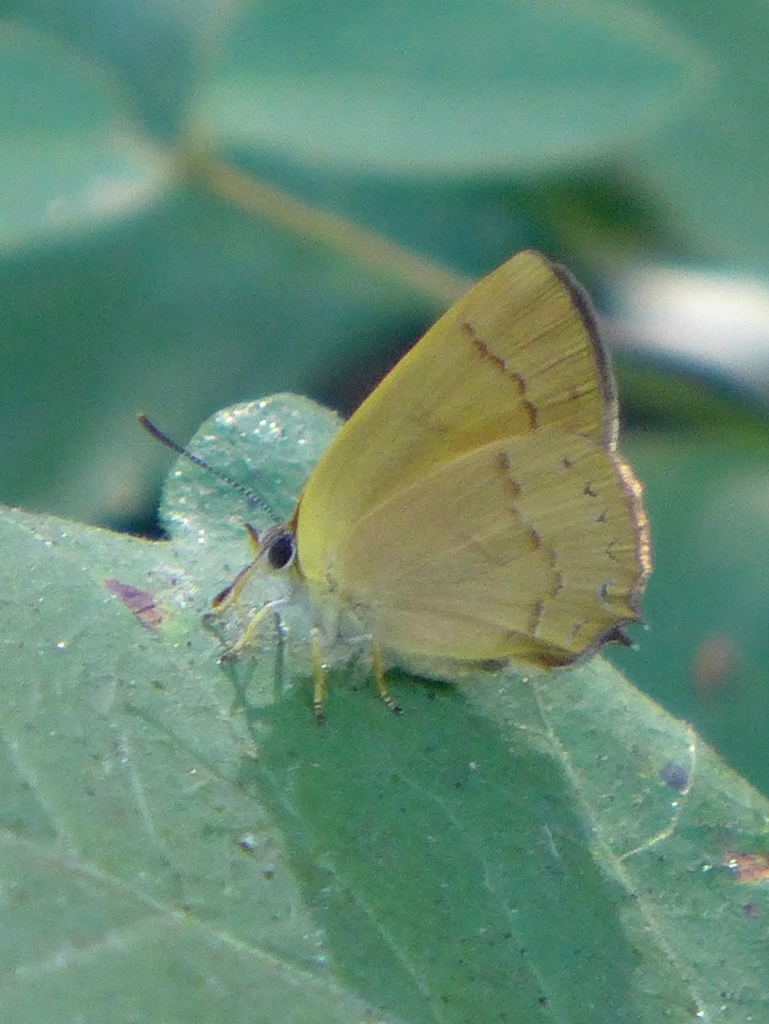
(c) John Hibbard, some rights reserved (CC BY) · licence
Family: Lycaenidae · Class: Insecta · Order: Lepidoptera
Habrodais grunus (Golden Hairstreak) is a California animal in the Lycaenidae family.
The Golden Hairstreak is a small butterfly native to western North America, characterized by its distinctive golden-bronze coloration and delicate hairlike projections on the hindwings. Adults have a wingspan of approximately 25-32 mm (1.0-1.3 inches), with males typically smaller than females. The dorsal wing surfaces display a rich golden-bronze color with darker borders, while the ventral surfaces are pale gray-brown with subtle markings. Two thin, dark hairlike tails extend from the posterior margin of each hindwing, a characteristic feature of the hairstreak subfamily. The species occurs across Southern Arizona, Oregon, and California, representing a fragmented distribution pattern typical of oak-associated butterflies in western montane regions. In California, populations are documented from the Sierra Nevada, Coast Ranges, and Transverse Ranges, typically at elevations between 300-2,400 meters (1,000-8,000 feet). The distribution closely mirrors that of its primary host plants, reflecting the species' specialized ecological requirements. Golden Hairstreaks inhabit oak woodlands, mixed evergreen forests, and chaparral communities where their host plants occur. The species demonstrates strong fidelity to canyon live oak (Quercus chrysolepis), huckleberry oak (Q. vaccinifolia), and tan oak (Lithocarpus densiflorus). Adults are typically found in sunny openings within or adjacent to oak stands, often on ridgetops and south-facing slopes where host plants receive maximum sunlight. The species shows preference for mature oak stands with well-developed canopy structure. Adult flight period extends from late May through August, with peak activity occurring in June and July. Males establish territories on hilltops and ridges, engaging in aerial encounters with other males and pursuing females. Mating occurs during afternoon hours when temperatures are optimal. Females deposit single eggs on young oak leaves, typically selecting terminal growth or recently emerged foliage. Larvae feed exclusively on oak foliage, developing through five instars over approximately 3-4 weeks. The species overwinters as a pupa, with pupation occurring in leaf litter or shallow soil beneath host trees. Adults are nectarivores, visiting various flowering plants including buckwheat (Eriogonum species), yerba santa (Eriodictyon species), and native mints. The Golden Hairstreak lacks formal conservation status designation at state or federal levels, but faces habitat pressures common to oak-dependent species. Primary threats include habitat fragmentation from urban development, altered fire regimes that affect oak regeneration, and climate change impacts on montane oak ecosystems. Oak woodland conversion for agriculture and residential development has reduced available habitat in some regions. The species' specialized host plant requirements and relatively limited dispersal capability make populations vulnerable to localized habitat loss. Conservation efforts focus on protecting intact oak woodland systems and maintaining connectivity between habitat patches to support metapopulation dynamics.
Classification
Class: Insecta · Order: Lepidoptera · Family: Lycaenidae
Frequently asked questions
How is Habrodais grunus classified?
Habrodais grunus belongs to class Insecta, order Lepidoptera, family Lycaenidae.
What family does Habrodais grunus belong to?
Habrodais grunus is in the Lycaenidae family.
What is Habrodais grunus?
The Golden Hairstreak is a small butterfly native to western North America, characterized by its distinctive golden-bronze coloration and delicate hairlike projections on the hindwings.
Is Habrodais grunus found in California?
Yes. Habrodais grunus is recorded in California in The California Species Project's catalogue.
Related species
Other California species in the same genus, family, or bioregion.
Data from The California Species Project — 14,000+ California species with verified data from CNPS, CDFW, USFWS, and more.