Habronattus hirsutus
Hirsute Paradise Spider
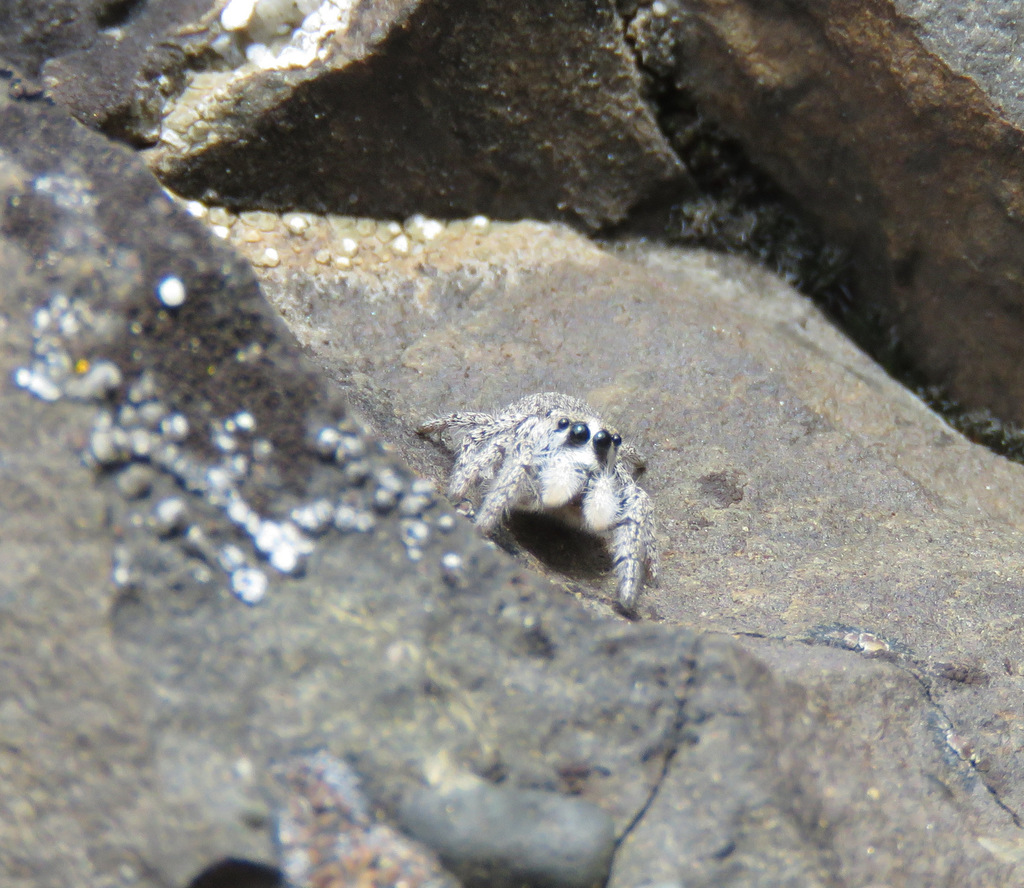
no rights reserved · CC0
Family: Salticidae · Class: Arachnida · Order: Araneae
Habronattus hirsutus (Hirsute Paradise Spider) is a California animal in the Salticidae family.
Habronattus hirsutus is a small jumping spider in the family Salticidae, belonging to the tranquillus species group within the genus Habronattus. Males measure approximately 5 mm in body length, while females are typically slightly larger. The species exhibits sexual dimorphism typical of jumping spiders, with males displaying more elaborate coloration and ornamentation. Males possess distinctive palpal structures used for species identification, while females are characterized by their specific epigyne morphology. The common name "Hirsute Paradise Spider" reflects the species' hairy appearance, though detailed morphological descriptions of coloration patterns require further documentation. This species exhibits one of the broadest geographic distributions within the genus Habronattus, ranging from British Columbia south through California into Mexico, and extending eastward to Kansas and Texas (BugGuide.Net). Within California, the species occurs across multiple counties and elevation zones, though specific distributional data within the state requires additional survey work to fully document. Habitat preferences for H. hirsutus appear to be diverse, reflecting its wide geographic range. The species has been documented from various elevations, including montane environments such as Mount Lemmon in Arizona at approximately 2,400 meters elevation. Like other Habronattus species, H. hirsutus likely inhabits areas with adequate vegetation structure for web-building and prey capture, including shrublands, grasslands, and forest edges. The species' broad elevational tolerance suggests adaptability to different climatic conditions across its range. As a member of the jumping spider family, H. hirsutus is a visual predator that actively hunts prey rather than constructing capture webs. The species likely feeds on small arthropods including flies, aphids, and other small insects typical of salticid prey preferences. Mating behavior involves complex courtship displays characteristic of Habronattus, with males performing visual and vibrational displays to attract females. Courtship typically includes leg waving, body movements, and presentation of colorful ornaments. Females lay eggs in silk sacs, though specific details regarding clutch size, developmental timing, and overwintering strategies for this species have not been well documented in the scientific literature. Habronattus hirsutus currently holds no federal or state conservation listing status. The species' wide geographic distribution and apparent ecological adaptability suggest stable populations across most of its range. However, like many arthropod species, comprehensive population monitoring data are lacking. Climate change and habitat modification could potentially impact local populations, particularly at range margins or in specialized habitats. The species serves as an important predator in terrestrial ecosystems, contributing to natural pest control. Further research is needed to better understand population trends, habitat requirements, and potential conservation needs for this widespread but understudied jumping spider species.
Classification
Class: Arachnida · Order: Araneae · Family: Salticidae
Frequently asked questions
How is Habronattus hirsutus classified?
Habronattus hirsutus belongs to class Arachnida, order Araneae, family Salticidae.
What family does Habronattus hirsutus belong to?
Habronattus hirsutus is in the Salticidae family.
What is Habronattus hirsutus?
Habronattus hirsutus is a small jumping spider in the family Salticidae, belonging to the tranquillus species group within the genus Habronattus.
Is Habronattus hirsutus found in California?
Yes. Habronattus hirsutus is recorded in California in The California Species Project's catalogue.
Related species
Other California species in the same genus, family, or bioregion.
Data from The California Species Project — 14,000+ California species with verified data from CNPS, CDFW, USFWS, and more.