Habroscelimorpha gabbii
Western Tidal-flat Tiger Beetle
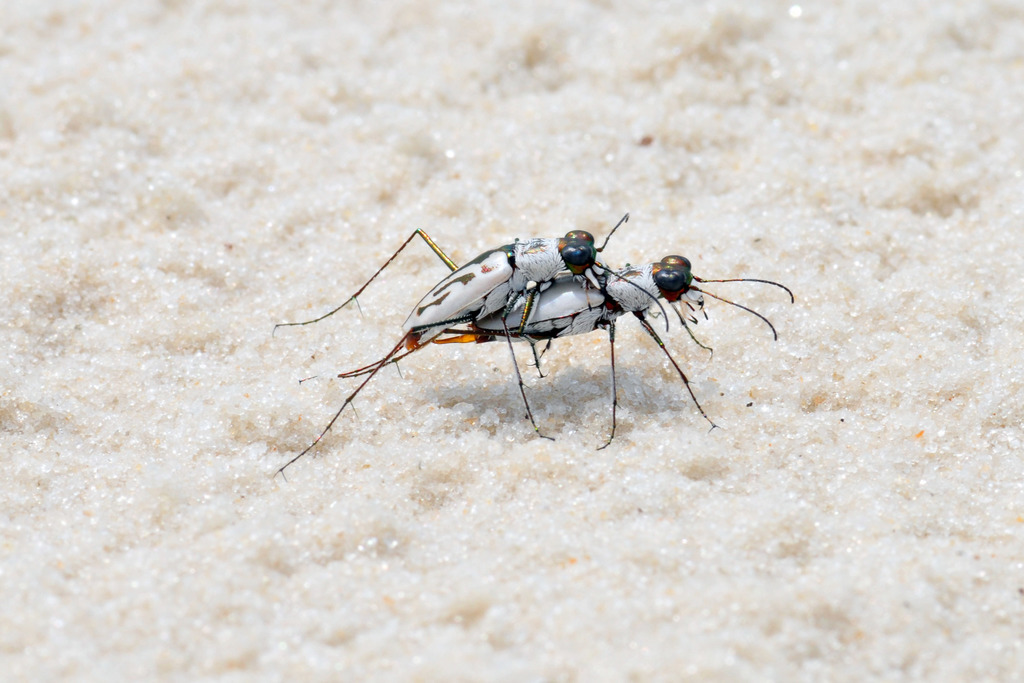
(c) Tom Kennedy, some rights reserved (CC BY) · licence
Family: Carabidae · Class: Insecta · Order: Coleoptera
Conservation status: G2G4 S1
Habroscelimorpha gabbii (Western Tidal-flat Tiger Beetle) is a California animal in the Carabidae family.
The Western Tidal-flat Tiger Beetle is a medium-sized ground beetle in the family Carabidae (formerly Cicindelidae). This species has undergone recent taxonomic revision, with the current accepted scientific name being Eunota gabbii, though it was formerly known as Cicindela gabbii and Habroscelimorpha gabbii (NatureServe Explorer). Like other tiger beetles, this species displays the characteristic predatory adaptations of the group, including large prominent eyes, elongated legs adapted for rapid movement, and powerful mandibles for capturing prey. The Western Tidal-flat Tiger Beetle occurs along the Pacific Coast, with populations documented in California's coastal regions. The species' common name reflects its association with tidal flat habitats, distinguishing it from other tiger beetle species that occupy different ecological niches. Current distribution data indicates the species maintains a limited range along specific coastal areas. As indicated by its common name, this species is closely associated with tidal flat environments. These habitats are characterized by areas of exposed mud and sand that are periodically inundated by tidal waters. Tidal flats provide the specific substrate conditions and prey availability that support tiger beetle populations. The species likely requires areas with appropriate salinity levels, moisture content, and prey density typical of estuarine and near-shore marine environments. Like other tiger beetles, the Western Tidal-flat Tiger Beetle is presumed to be an active predator during both larval and adult stages. Adult tiger beetles are known for their exceptional speed and visual acuity when hunting small invertebrates on open substrates. The larvae typically develop in vertical burrows in suitable substrate, where they ambush passing prey from the burrow entrance. The species' life cycle is likely adapted to the dynamic conditions of tidal flat environments, including periodic inundation and exposure cycles. The Western Tidal-flat Tiger Beetle carries a global rank of G2G4, indicating the species ranges from imperiled to apparently secure globally, while its state rank of S1 in California designates it as critically imperiled within the state, with typically fewer than six occurrences or very few remaining individuals (NatureServe ranking system). This ranking suggests significant conservation concern at the state level despite potentially broader stability elsewhere in its range. The species faces threats typical of coastal habitats, including habitat modification, development pressure, and sea level change. Tidal flat ecosystems are particularly vulnerable to human activities and climate-related impacts, as these environments exist at the interface between terrestrial and marine systems. The taxonomic uncertainty surrounding this species, as evidenced by multiple scientific name changes, highlights the ongoing need for systematic research within the tiger beetle group. Conservation efforts for this species would benefit from detailed population surveys, habitat mapping, and ecological studies to better understand its specific requirements and vulnerability to environmental change.
Classification
Class: Insecta · Order: Coleoptera · Family: Carabidae
Conservation status
G2G4 S1
Frequently asked questions
How is Habroscelimorpha gabbii classified?
Habroscelimorpha gabbii belongs to class Insecta, order Coleoptera, family Carabidae.
What family does Habroscelimorpha gabbii belong to?
Habroscelimorpha gabbii is in the Carabidae family.
Is Habroscelimorpha gabbii protected or of conservation concern?
Habroscelimorpha gabbii carries the following status: G2G4 S1.
What is Habroscelimorpha gabbii?
The Western Tidal-flat Tiger Beetle is a medium-sized ground beetle in the family Carabidae (formerly Cicindelidae).
Is Habroscelimorpha gabbii found in California?
Yes. Habroscelimorpha gabbii is recorded in California in The California Species Project's catalogue.
Related species
Other California species in the same genus, family, or bioregion.
Data from The California Species Project — 14,000+ California species with verified data from CNPS, CDFW, USFWS, and more.