Haematopus bachmani
Black Oystercatcher
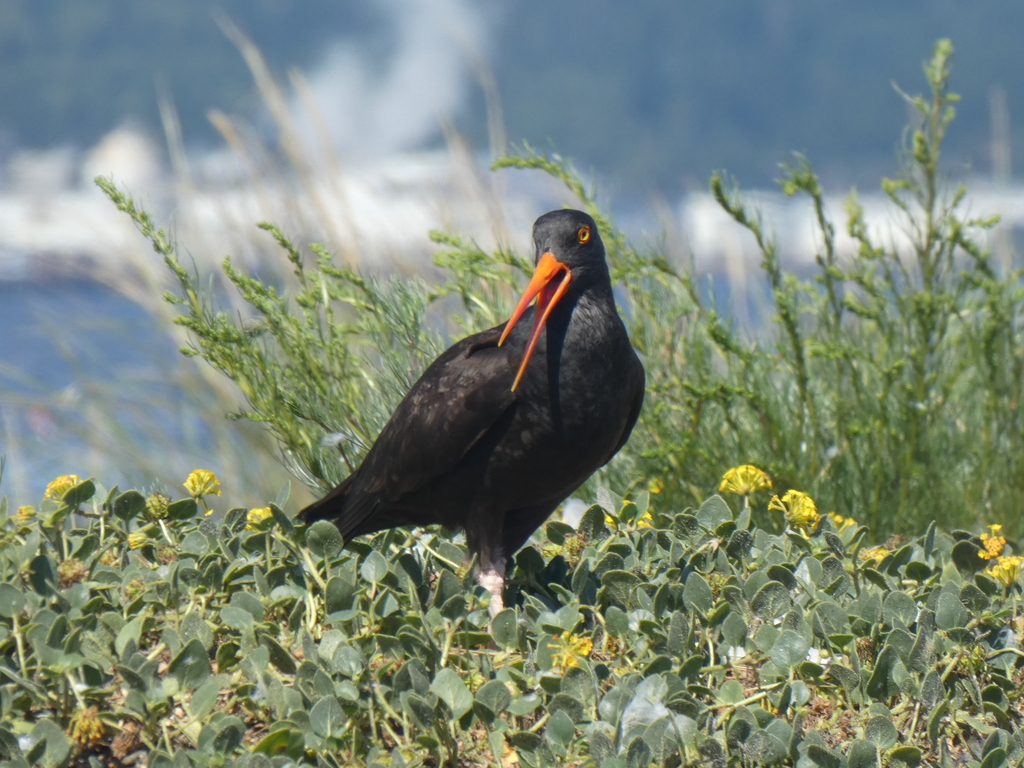
(c) Mara Christensen, some rights reserved (CC BY) · licence
Family: Haematopodidae · Class: Aves · Order: Charadriiformes
Haematopus bachmani (Black Oystercatcher) is a California animal in the Haematopodidae family.
The Black Oystercatcher is a large, robust shorebird measuring 42 to 47 centimeters (16.5 to 18.5 inches) in length with a wingspan of 81 to 87 centimeters (32 to 34 inches). Adults weigh between 650 to 700 grams (1.4 to 1.5 pounds). The species displays entirely sooty black plumage across all body regions, with no seasonal variation in coloration. The most distinctive feature is the bright orange-red bill, measuring 8 to 9 centimeters in length, which is laterally compressed and chisel-shaped for prying open shellfish. The legs and feet are thick and pink to orange-red in color. Eyes are bright yellow with orange orbital rings. Juveniles appear similar to adults but show brownish edges to wing coverts and a duller, more orange bill tip. Black Oystercatchers inhabit the Pacific Coast of North America from the Aleutian Islands in Alaska south to central Baja California, Mexico. In California, the species occurs along the entire coastline, with the highest breeding densities documented on offshore islands and isolated rocky headlands. Major breeding populations are found on the Channel Islands, Farallon Islands, and along the Mendocino and Humboldt County coastlines. The species maintains year-round residency throughout most of its California range, though some northern populations may move south during winter months. This species requires rocky intertidal zones and adjacent coastal habitats for foraging and nesting. Black Oystercatchers are found exclusively on exposed rocky shores, jetties, and breakwaters where they can access their primary prey. Nesting occurs on rocky ledges, cliff tops, and isolated beaches above the high tide line. Territories are typically established on rocky platforms with adjacent foraging areas containing dense populations of mussels, barnacles, and other shellfish. Black Oystercatchers are specialized mollusk predators, using their powerful bills to pry open mussels, particularly California mussels (Mytilus californianus), and to dislodge barnacles, limpets, and chitons from rock surfaces. The species employs two primary foraging techniques: hammering to break shells and stabbing to sever adductor muscles. Breeding pairs are monogamous and highly territorial, defending territories averaging 200 to 300 meters of coastline. Nesting occurs from April through August, with peak activity in May and June. Females lay 1 to 3 olive-colored eggs with dark brown markings in simple scrapes lined with shell fragments and pebbles. Incubation lasts 24 to 29 days, and chicks fledge after 35 to 40 days. The Black Oystercatcher is not federally listed but is considered a species of conservation concern due to its specialized habitat requirements and limited distribution. According to the North American Breeding Bird Survey, populations have shown slight declines since the 1960s, though trends vary regionally. Primary threats include coastal development, human disturbance at nesting sites, oil spills, and sea level rise associated with climate change. The species is particularly vulnerable to disturbance during the breeding season, as adults may abandon nests when approached by humans or domestic animals.
Classification
Class: Aves · Order: Charadriiformes · Family: Haematopodidae
Frequently asked questions
How is Haematopus bachmani classified?
Haematopus bachmani belongs to class Aves, order Charadriiformes, family Haematopodidae.
What family does Haematopus bachmani belong to?
Haematopus bachmani is in the Haematopodidae family.
What is Haematopus bachmani?
The Black Oystercatcher is a large, robust shorebird measuring 42 to 47 centimeters (16.5 to 18.5 inches) in length with a wingspan of 81 to 87 centimeters (32 to 34 inches).
Is Haematopus bachmani found in California?
Yes. Haematopus bachmani is recorded in California in The California Species Project's catalogue.
Related species
Other California species in the same genus, family, or bioregion.
Data from The California Species Project — 14,000+ California species with verified data from CNPS, CDFW, USFWS, and more.