Haemorhous mexicanus
House Finch
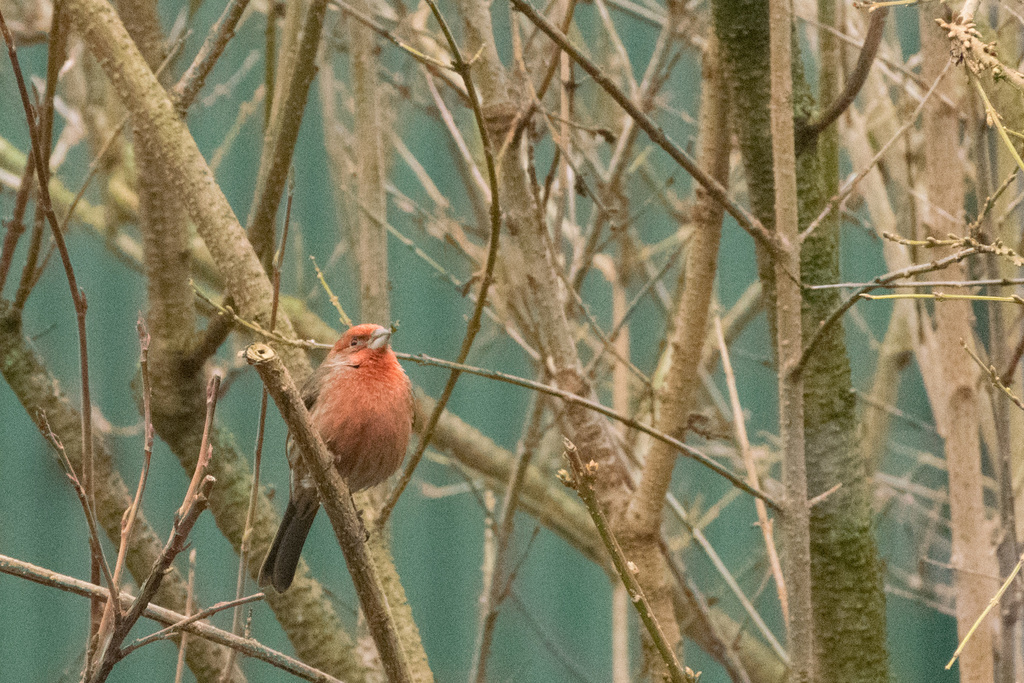
(c) dennisvo, some rights reserved (CC BY) · licence
Family: Fringillidae · Class: Aves · Order: Passeriformes
Haemorhous mexicanus (House Finch) is a California animal in the Fringillidae family.
The House Finch is a small songbird measuring 12.5 to 15 centimeters (5 to 6 inches) in length with a wingspan of 20 to 25 centimeters (8 to 10 inches). Adult males display bright red to orange-red coloration on the head, breast, and rump, with brown streaking on the back and flanks. Females and juveniles are brown and heavily streaked throughout, lacking the red pigmentation. Both sexes have relatively large, conical bills adapted for seed consumption and notched tails. Males can vary in coloration intensity from pale yellow to deep red depending on diet and genetics. Originally native to western North America from British Columbia south through Mexico, the House Finch has dramatically expanded its range following introductions. The species naturally occurs throughout California, from sea level to elevations exceeding 2,000 meters (6,600 feet). Eastern populations originated from birds released in New York in the 1940s and have since colonized much of North America east of the Rocky Mountains. The species now ranges from southern Canada to central Mexico. House Finches inhabit diverse environments including urban areas, suburban neighborhoods, agricultural lands, desert scrub, oak woodlands, and riparian zones. They show strong adaptation to human-modified landscapes and are commonly found around residential areas, parks, and commercial districts. The species frequents areas with scattered trees and shrubs for nesting, particularly favoring ornamental plantings, building eaves, and other artificial structures for nest sites. House Finches are granivorous, feeding primarily on seeds of grasses, forbs, and trees. Common food sources include dandelion, thistle, mulberry, and various cultivated plants. They readily visit bird feeders and consume sunflower seeds, millet, and nyjer. The species breeds from February through August, with peak activity occurring March through July. Females construct cup-shaped nests of grass, feathers, and debris in trees, shrubs, or human structures. Clutches typically contain 3 to 5 pale blue eggs with fine spotting. Incubation lasts 12 to 14 days, and nestlings fledge after 12 to 19 days. Pairs may produce up to six broods annually under favorable conditions. The House Finch is not federally or state listed and maintains stable populations across most of its range. According to the North American Breeding Bird Survey, continental populations have remained relatively stable since 1970, though some regional variations exist. The species experienced periodic population declines in eastern regions during the 1990s due to mycoplasmal conjunctivitis outbreaks, but populations have largely recovered. Urban expansion and the proliferation of bird feeding have generally benefited House Finch populations. Climate change may affect distribution patterns, but the species' adaptability to diverse habitats suggests continued population stability. Primary threats include window collisions, predation by domestic cats, and periodic disease outbreaks.
Classification
Class: Aves · Order: Passeriformes · Family: Fringillidae
Frequently asked questions
How is Haemorhous mexicanus classified?
Haemorhous mexicanus belongs to class Aves, order Passeriformes, family Fringillidae.
What family does Haemorhous mexicanus belong to?
Haemorhous mexicanus is in the Fringillidae family.
What is Haemorhous mexicanus?
The House Finch is a small songbird measuring 12.5 to 15 centimeters (5 to 6 inches) in length with a wingspan of 20 to 25 centimeters (8 to 10 inches).
Is Haemorhous mexicanus found in California?
Yes. Haemorhous mexicanus is recorded in California in The California Species Project's catalogue.
Related species
Other California species in the same genus, family, or bioregion.
Data from The California Species Project — 14,000+ California species with verified data from CNPS, CDFW, USFWS, and more.