Halichondria panicea
Bread-crumb Sponge
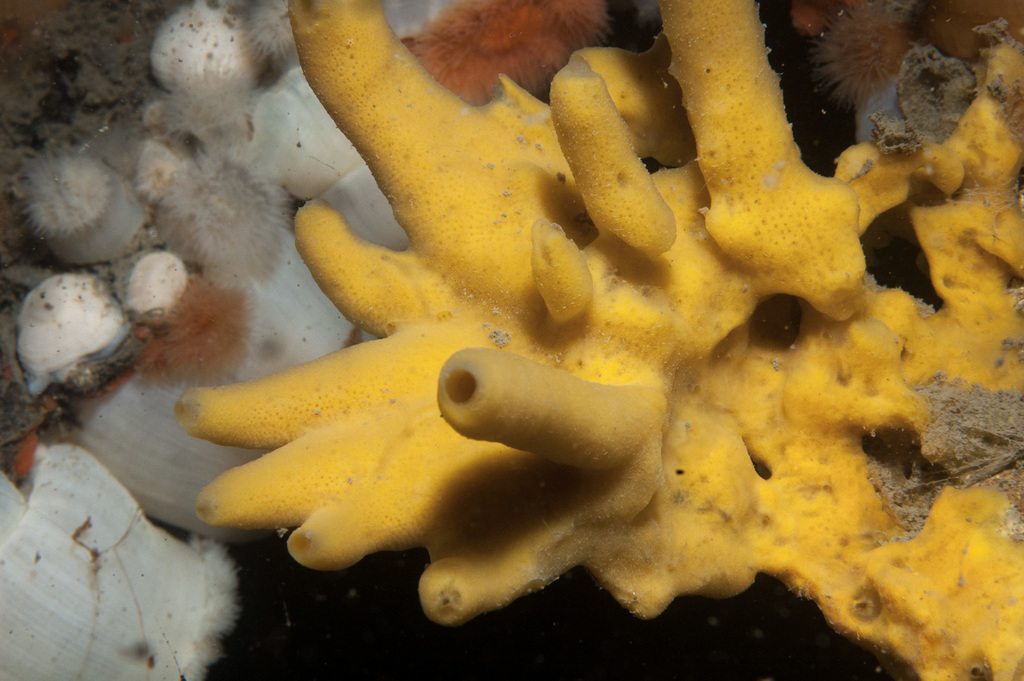
(c) Bernard Picton, some rights reserved (CC BY) · licence
Family: Halichondriidae · Class: Demospongiae · Order: Suberitida
Halichondria panicea (Bread-crumb Sponge) is a California animal in the Halichondriidae family.
Halichondria panicea, commonly known as the bread-crumb sponge, is a marine demosponge belonging to the family Halichondriidae. This encrusting sponge forms irregular masses that can reach several centimeters in thickness and up to 30 centimeters in diameter. The surface texture resembles coarse breadcrumbs, giving the species its common name. Coloration varies from pale yellow to orange, brown, or greenish, depending on environmental conditions and associated microorganisms. The sponge's surface is characterized by numerous small, raised oscula (excurrent openings) and a network of channels visible through the semi-transparent body wall. Halichondria panicea has a widespread distribution in temperate marine waters of the North Atlantic and North Pacific oceans. Along the California coast, this species occurs in intertidal and shallow subtidal zones from central California northward to Alaska. The species is also found along the Atlantic coast from the Arctic to North Carolina, as well as in European waters from Norway to the Mediterranean Sea. In California waters, populations are documented in San Francisco Bay and along rocky coastlines of northern California. This sponge inhabits rocky intertidal areas, tidepools, and shallow subtidal environments typically at depths ranging from the low intertidal zone to approximately 200 meters. Halichondria panicea attaches to hard substrates including rocks, shells, dock pilings, and other solid surfaces. The species tolerates a wide range of salinity conditions and can survive periodic exposure to air during low tides. It thrives in areas with moderate to strong water flow that facilitates feeding and waste removal. As a filter feeder, Halichondria panicea obtains nutrients by pumping water through its body cavity and capturing suspended organic particles, bacteria, and small plankton. Water enters through numerous microscopic pores called ostia and exits through the larger oscula. The species can process several times its body volume in water each day. Reproduction occurs both sexually and asexually. Sexual reproduction involves the release of sperm into the water column, with fertilization occurring internally. Larvae develop within the sponge before being released to settle on suitable substrates. Asexual reproduction occurs through budding and fragmentation. The species hosts diverse microbial communities, including bacteria that contribute to nitrogen fixation and other metabolic processes. These symbiotic relationships are crucial for the sponge's nutrition and may influence its coloration. Halichondria panicea serves as habitat for various small invertebrates and plays an important ecological role in marine food webs. Currently, Halichondria panicea has no federal or state conservation listing in California. However, research by the California Department of Fish and Wildlife's Marine Invasive Species Program has investigated the genetic diversity and geographic origins of Halichondria species in California waters, including populations in San Francisco Bay. The species faces potential threats from habitat degradation, pollution, and climate change effects on ocean temperature and chemistry. As a widespread and adaptable species, Halichondria panicea appears relatively stable, though local populations may be affected by coastal development and water quality issues.
Classification
Class: Demospongiae · Order: Suberitida · Family: Halichondriidae
Frequently asked questions
How is Halichondria panicea classified?
Halichondria panicea belongs to class Demospongiae, order Suberitida, family Halichondriidae.
What family does Halichondria panicea belong to?
Halichondria panicea is in the Halichondriidae family.
What is Halichondria panicea?
Halichondria panicea, commonly known as the bread-crumb sponge, is a marine demosponge belonging to the family Halichondriidae.
Is Halichondria panicea found in California?
Yes. Halichondria panicea is recorded in California in The California Species Project's catalogue.
More California species
This species has no close relatives in our California data — here are other species to explore.
Data from The California Species Project — 14,000+ California species with verified data from CNPS, CDFW, USFWS, and more.