Halictus farinosus
Wide-striped Sweat Bee
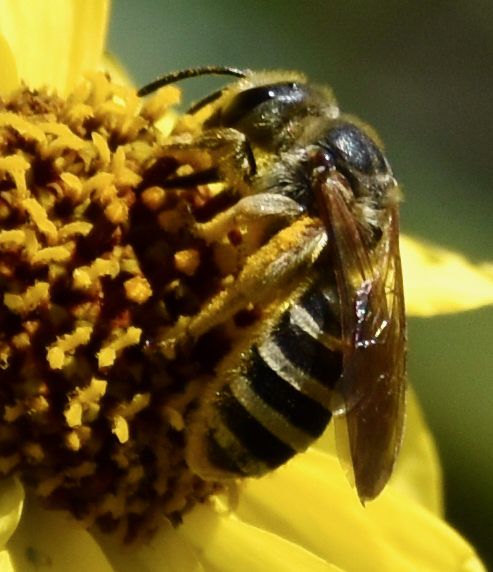
(c) Jim Julius, some rights reserved (CC BY) · licence
Family: Halictidae · Class: Insecta · Order: Hymenoptera
Halictus farinosus (Wide-striped Sweat Bee) is a California animal in the Halictidae family.
Halictus farinosus, commonly known as the Wide-striped Sweat Bee or Brown-winged Furrow Bee, is a native solitary bee in the family Halictidae. Adults are small to medium-sized bees, typically measuring 8-12 mm (0.3-0.5 inches) in length. The species exhibits sexual dimorphism, with females generally larger and more robust than males. The body is primarily dark brown to black with distinctive pale stripes across the abdomen formed by bands of light-colored hair. Wings appear brownish, giving rise to one of its common names. Females possess specialized pollen-carrying structures (scopae) on their hind legs, which appear as dense brushes of branched hairs that can become heavily loaded with pollen during foraging. This species has a broad distribution across western North America, ranging from South Dakota to Oregon and south to Mexico (BugGuide). In California, H. farinosus occurs throughout much of the state, from coastal areas to inland valleys and foothills. The species demonstrates considerable ecological adaptability, occupying diverse elevation ranges from near sea level to montane environments. Halictus farinosus inhabits a wide variety of open and semi-open habitats including grasslands, agricultural areas, urban gardens, coastal scrub, and chaparral communities. The species shows particular tolerance for disturbed and weedy environments, making it well-suited to human-modified landscapes. Adults are commonly observed in areas with exposed soil suitable for nesting, as they are ground-nesting bees that excavate burrows in compacted earth, often in bare patches between vegetation. As a generalist pollinator, H. farinosus visits a diverse array of flowering plants throughout its active season, which typically extends from spring through fall in most regions (Xerces Society). Females are solitary nesters, constructing individual burrows where they provision cells with pollen and nectar for their developing larvae. The species exhibits rapid, sometimes erratic flight patterns when foraging, and individuals may be observed crawling around the base of flowers or moving quickly between bloom clusters. Like other sweat bees, H. farinosus may be attracted to human perspiration, particularly on warm days, though they are generally non-aggressive. The species plays an important ecological role as a native pollinator, contributing to the reproduction of both wild plants and agricultural crops. According to the Xerces Society, sweat bees like H. farinosus are particularly valuable as generalist pollinators capable of exploiting diverse floral resources and surviving in degraded plant communities. This adaptability makes them important contributors to ecosystem resilience in fragmented landscapes. Currently, H. farinosus does not hold any federal or state conservation listing status, and populations appear stable across most of its range. However, like many native bee species, it may face localized pressures from habitat loss, pesticide use, and climate change effects on flowering plant communities.
Classification
Class: Insecta · Order: Hymenoptera · Family: Halictidae
Frequently asked questions
How is Halictus farinosus classified?
Halictus farinosus belongs to class Insecta, order Hymenoptera, family Halictidae.
What family does Halictus farinosus belong to?
Halictus farinosus is in the Halictidae family.
What is Halictus farinosus?
Halictus farinosus, commonly known as the Wide-striped Sweat Bee or Brown-winged Furrow Bee, is a native solitary bee in the family Halictidae.
Is Halictus farinosus found in California?
Yes. Halictus farinosus is recorded in California in The California Species Project's catalogue.
Related species
Other California species in the same genus, family, or bioregion.
Data from The California Species Project — 14,000+ California species with verified data from CNPS, CDFW, USFWS, and more.