Halictus tripartitus
Tripartite Sweat Bee
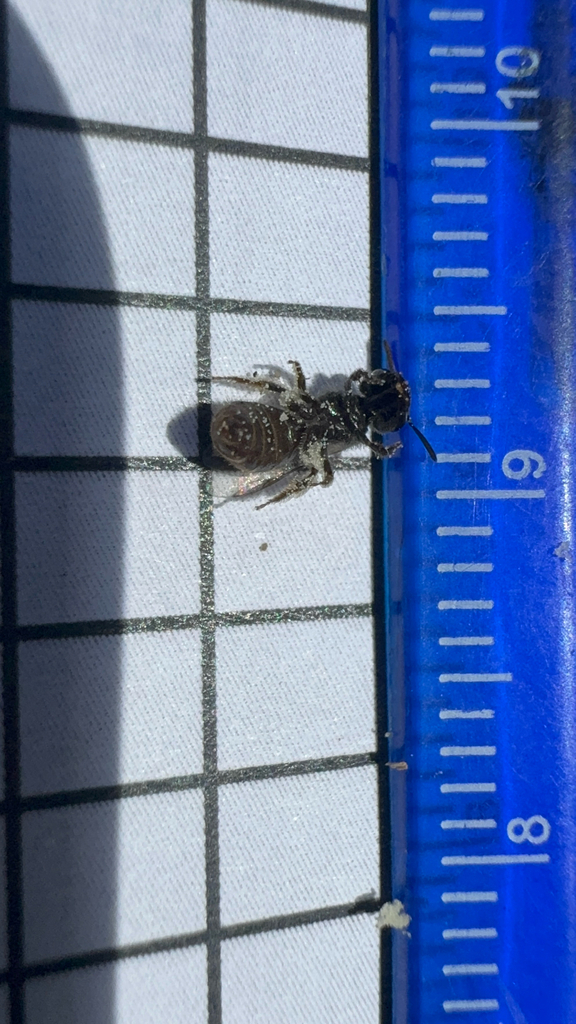
(c) Parker James Lloyd, some rights reserved (CC BY) · licence
Family: Halictidae · Class: Insecta · Order: Hymenoptera
Halictus tripartitus (Tripartite Sweat Bee) is a California animal in the Halictidae family.
The Tripartite Sweat Bee (Halictus tripartitus) is a small native bee in the family Halictidae, measuring approximately 7 to 15 mm in length. This species exhibits the typical sweat bee morphology with a dark metallic body and distinctive striped markings on the abdomen that may appear faint and vary in color from creamy to dark gray. Like other members of the genus Halictus, females possess a scopa, a specialized brush of hair on the upper portion of the hind legs used for collecting and transporting pollen. Halictus tripartitus occurs primarily in the southwestern United States. The species has been documented in California and other western states, with records extending into areas of specialized plant communities. The bee's distribution appears to be closely associated with specific flowering plant communities and suitable nesting habitats. This species inhabits diverse habitats including grasslands, herbaceous areas, old fields, cropland edges with hedgerows, suburban orchards, and urban environments (NatureServe). The adaptability to both natural and anthropogenic landscapes suggests a degree of ecological flexibility typical of many halictid bees. Nesting behavior follows the ground-nesting pattern common to most sweat bees, with females excavating burrows in suitable soil substrates. Halictus tripartitus functions as a generalist pollinator, visiting flowers of various plant species for nectar and pollen collection. The species has been documented as one of the native pollinators of White River beardtongue (Penstemon scariosus var. albifluvis), contributing to the pollination services for this rare plant species (USFWS 2014). Like other sweat bees, this species may exhibit crawling behavior around the base of flowers or inside flower structures, with characteristically fast movements that sometimes appear jagged or erratic. The seasonal activity pattern and specific reproductive biology of H. tripartitus have not been extensively documented, though it likely follows the general halictid pattern of spring emergence and summer activity. Currently, Halictus tripartitus does not hold any federal or state conservation listing status. The species appears to maintain populations across its range, benefiting from its generalist foraging habits and ability to utilize both natural and modified habitats. However, like many native bee species, H. tripartitus may face challenges from habitat loss, pesticide use, and landscape fragmentation. The species' role as a pollinator of rare plants like White River beardtongue highlights its ecological importance in maintaining plant-pollinator networks. Conservation of diverse flowering plant communities and protection of suitable nesting sites remain important for maintaining healthy populations of this and other native bee species. The adaptability to urban and agricultural environments may provide some resilience against habitat modifications, though monitoring of population trends would be valuable for long-term conservation planning.
Classification
Class: Insecta · Order: Hymenoptera · Family: Halictidae
Frequently asked questions
How is Halictus tripartitus classified?
Halictus tripartitus belongs to class Insecta, order Hymenoptera, family Halictidae.
What family does Halictus tripartitus belong to?
Halictus tripartitus is in the Halictidae family.
What is Halictus tripartitus?
The Tripartite Sweat Bee (Halictus tripartitus) is a small native bee in the family Halictidae, measuring approximately 7 to 15 mm in length.
Is Halictus tripartitus found in California?
Yes. Halictus tripartitus is recorded in California in The California Species Project's catalogue.
Related species
Other California species in the same genus, family, or bioregion.
Data from The California Species Project — 14,000+ California species with verified data from CNPS, CDFW, USFWS, and more.