Haliotis sorenseni
White abalone
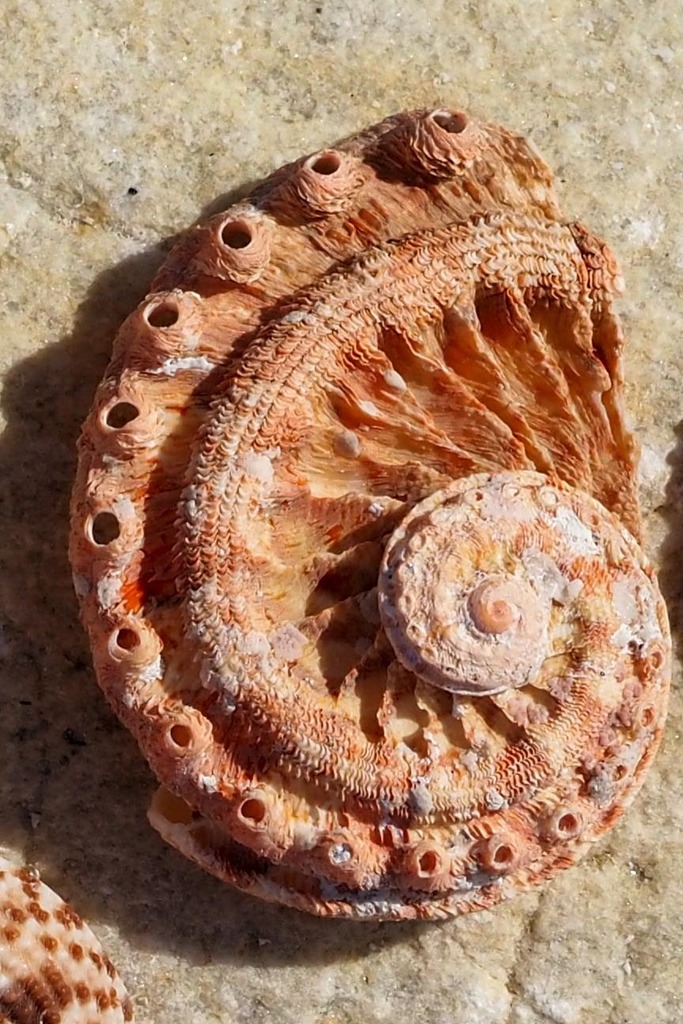
(c) Jesse de Vries, some rights reserved (CC BY) · licence
Family: Haliotidae · Class: Gastropoda · Order: Lepetellida
Conservation status: Endangered · G1 S2
Haliotis sorenseni (White abalone) is a California animal in the Haliotidae family.
The white abalone is a large marine gastropod mollusk in the family Haliotidae, distinguished by its oval shell that can reach 20 to 25 centimeters (8 to 10 inches) in length. The shell exhibits a characteristic white to cream coloration on the exterior, with a nacreous (mother-of-pearl) interior surface. Like other abalone species, the shell features a series of respiratory pores along its outer edge and a broad, muscular foot used for attachment to rocky substrates. Historically, white abalone ranged from Point Conception, California, south to Punta Abreojos, Baja California, Mexico, along the Pacific Coast. The species once occurred throughout the Southern California Bight, including waters around the Channel Islands. Current populations, where they exist, are restricted to deeper waters off southern California, with most recent sightings concentrated around the Channel Islands. White abalone inhabit rocky reef environments in subtidal zones, typically at depths ranging from 26 to 65 meters (85 to 213 feet). They prefer areas with complex rocky terrain that provides shelter and surfaces for attachment. The species requires well-oxygenated waters with strong currents that deliver food particles and remove metabolic waste. These deeper habitats distinguish white abalone from black abalone, which occupy intertidal zones. As herbivorous grazers, white abalone feed primarily on drift kelp and other algae that settle on the seafloor. They use their radula, a rasping feeding organ, to scrape algal material from rock surfaces. White abalone are broadcast spawners, releasing eggs and sperm into the water column for external fertilization. Reproduction requires close proximity between individuals, as sperm viability decreases rapidly in seawater. The species exhibits slow growth rates and late sexual maturity, not reaching reproductive age until 3 to 6 years old. The white abalone became the first marine invertebrate listed under the U.S. Endangered Species Act when it was designated as endangered in June 2001 by the National Marine Fisheries Service. Commercial and recreational harvesting from the 1940s through 1990s severely depleted populations, with fishermen systematically exploiting one area after another. California closed all abalone fisheries in 1997, but population densities had already fallen below levels necessary for successful reproduction. Current populations are estimated at fewer than 2,000 individuals scattered across their former range, with densities too low to facilitate natural reproduction. Recovery efforts include captive breeding programs and habitat restoration, but the species remains on the brink of extinction. The primary ongoing threats include continued low population density, climate change effects on ocean chemistry and temperature, and potential impacts from pollution and coastal development.
Classification
Class: Gastropoda · Order: Lepetellida · Family: Haliotidae
Conservation status
Endangered · G1 S2
Frequently asked questions
How is Haliotis sorenseni classified?
Haliotis sorenseni belongs to class Gastropoda, order Lepetellida, family Haliotidae.
What family does Haliotis sorenseni belong to?
Haliotis sorenseni is in the Haliotidae family.
Is Haliotis sorenseni protected or of conservation concern?
Haliotis sorenseni carries the following status: Endangered · G1 S2.
What is Haliotis sorenseni?
The white abalone is a large marine gastropod mollusk in the family Haliotidae, distinguished by its oval shell that can reach 20 to 25 centimeters (8 to 10 inches) in length.
Is Haliotis sorenseni found in California?
Yes. Haliotis sorenseni is recorded in California in The California Species Project's catalogue.
Related species
Other California species in the same genus, family, or bioregion.
Data from The California Species Project — 14,000+ California species with verified data from CNPS, CDFW, USFWS, and more.