Halmus chalybeus
Steelblue Lady Beetle
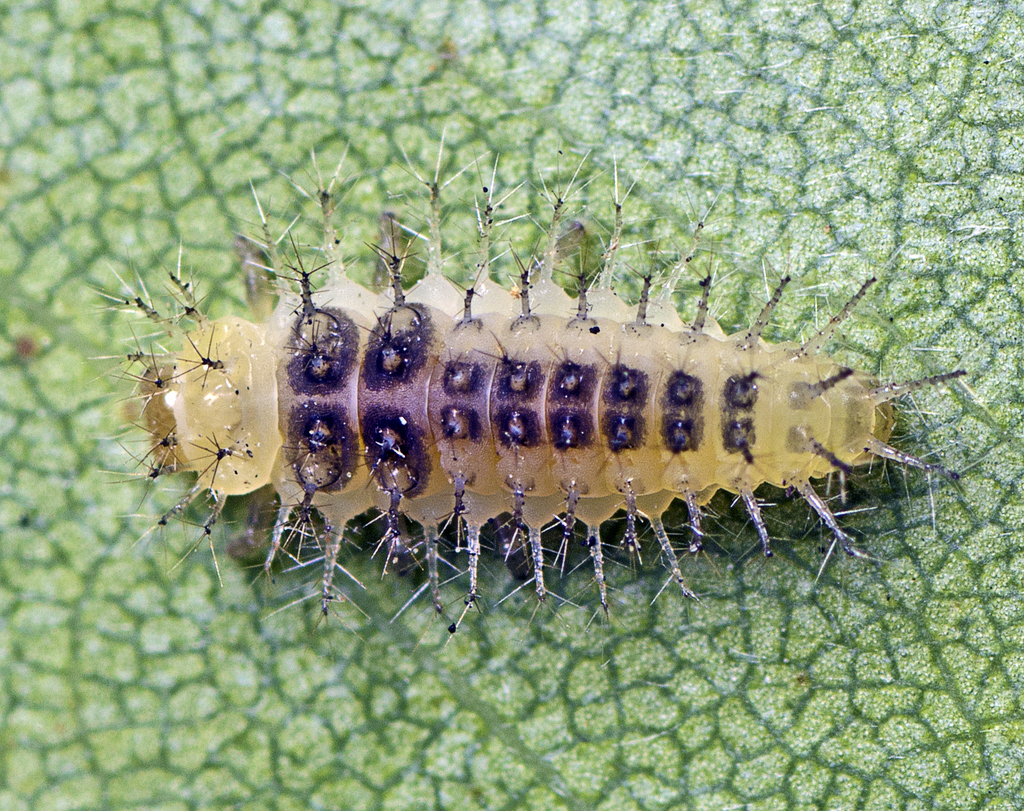
(c) Tony Eales, some rights reserved (CC BY-SA) · licence
Family: Coccinellidae · Class: Insecta · Order: Coleoptera
Halmus chalybeus (Steelblue Lady Beetle) is a California animal in the Coccinellidae family.
The Steelblue Lady Beetle is a small, oval-shaped coccinellid beetle measuring approximately 3-4 mm in length. Adults display distinctive metallic steel-blue to dark blue coloration with a glossy surface that distinguishes them from most native North American lady beetles. The elytra lack the typical spotted patterns found on many coccinellid species, instead presenting a uniform metallic blue appearance. The antennae are short and clubbed, typical of the family Coccinellidae. This species is not native to North America, having been introduced from Australia in the 2000s as a biological control agent (BugGuide). The beetle has established populations in California and other western states, though its current distribution within California remains incompletely documented. The species appears to be expanding its range following its relatively recent introduction. Halmus chalybeus inhabits citrus orchards, ornamental landscapes, and urban areas where its preferred prey species occur. The species shows particular association with plants infested by scale insects and mealybugs. Adults and larvae are commonly found on citrus trees, ornamental shrubs, and various landscape plants in Mediterranean climates similar to its native Australian habitat. The Steelblue Lady Beetle functions as a predatory species, feeding primarily on soft scale insects, mealybugs, and related hemipteran pests. Both adults and larvae are active predators, with larvae being particularly voracious consumers of scale insects. Adults overwinter in protected locations such as bark crevices and leaf litter, becoming active again in spring when prey populations increase. Reproduction occurs during warmer months, with females laying yellow eggs in clusters near prey colonies. Development from egg to adult typically requires several weeks depending on temperature and prey availability. As an introduced species, Halmus chalybeus lacks formal conservation status listings at federal or state levels. The species was deliberately introduced as part of biological control programs targeting agricultural and ornamental pests, particularly scale insects that damage citrus crops and landscape plants. Studies have evaluated its toxicity responses to various pesticides commonly used in integrated pest management programs, indicating concern for maintaining viable populations in agricultural systems (Lo 2004). The species' establishment success appears linked to the abundance of suitable prey species and compatible climate conditions. The long-term ecological impacts of this introduced predator on native arthropod communities remain under study. While beneficial for pest control, introduced coccinellids can sometimes compete with native beneficial insects or exhibit unexpected host preferences. Current research focuses on understanding the species' prey specificity and potential non-target effects. The beetle's role in California's agricultural systems continues to develop as populations establish and expand their geographic range. Monitoring programs track both the species' distribution and its effectiveness as a biological control agent in various cropping systems and urban landscapes.
Classification
Class: Insecta · Order: Coleoptera · Family: Coccinellidae
Frequently asked questions
How is Halmus chalybeus classified?
Halmus chalybeus belongs to class Insecta, order Coleoptera, family Coccinellidae.
What family does Halmus chalybeus belong to?
Halmus chalybeus is in the Coccinellidae family.
What is Halmus chalybeus?
The Steelblue Lady Beetle is a small, oval-shaped coccinellid beetle measuring approximately 3-4 mm in length.
Is Halmus chalybeus found in California?
Yes. Halmus chalybeus is recorded in California in The California Species Project's catalogue.
Related species
Other California species in the same genus, family, or bioregion.
Data from The California Species Project — 14,000+ California species with verified data from CNPS, CDFW, USFWS, and more.